| The Victorian way of...death! | |
|  | | Take a trip back in time! |
| | In the second of a series in which Bradford people look back at the district's hidden history Pete Crosier - who works at Bradford College - shows that in that city the dead were not always allowed to lie in peace... |
| | | The next time you have time to spare, take a walk around Undercliffe Cemetery in Bradford and look at the monuments and try to interpret their meaning.
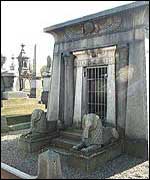
Clasped hands show that a husband and wife are united in death; columns soar upwards (when complete indicating the deceased led a full life and when broken indicating the end of the male line in a family); ivy shows friendship or portrays immortality; the phoenix stands for the Resurrection; a serpent biting its own tail represents the ring of eternity. The list is almost endless. This all seems very polite and civilised but the reality for the average Victorian, the Victorian who worked in the mills and the weaving sheds, the Victorian who was not rich, was so far removed from all this, that it might have almost been in another time period. | | "Ineqality existed in death as it did in life:"The Illingworth monument at Undercliffe Cemetery |
It is a story of overcrowded graveyards where the dead were not allowed to rest in peace. Despite the fact that the word cemetery comes from the Greek and means to sleep in peace, acts which would today be seen as totally unacceptable were routinely carried out.
The rich had extravagant monuments to the dead erected on private plots, which cost from one to ten guineas per plot. The finer of the graves for important citizens of the town covered a number of plots - a not insubstantial amount of money, but inequality existed in death as it did in life.
A handoom weaver earned as little as 35 pence per week in 1854 putting the cost of a plot in Undercliffe Cemetery well beyond his means. It was for this reason that the directors of Undercliffe Cemetery provided paupers graves (euphemistically called Company Graves) for the poor of the town at a nominal cost.
| | | |
|
|








 Music listings