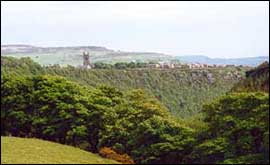
| Imagine Haworth without the Brontes, the railway and the crowds. Think of one of those Devon villages where attractive cottages crowd around a steep, cobbled street but without the tourists. Heptonstall is a wonderfully preserved village with a main street that has changed very little in the last 200 years. The village has changed surprisingly little in the last 200 years. This may be because the village is quite difficult to get to. Even those arriving by car from Hebden Bridge have to drive past the road up Heptonstall to use a turning circle. The walk up 'the Buttress' from the centre of Hebden Bridge is not for the faint-hearted yet in the days before canals, railways and steam power this small village was an important place. 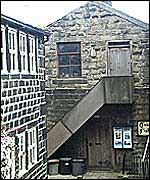 | | The village has changed surprisingly little in the last 200 years |
The village was, of course, a centre for hand-loom weaving. The cottage windows, designed to let maximum light in, are a reminder of the days when weavers worked at home. Heptonstall had a cloth hall at which the finished work was traded before Halifax had its Piece Hall, and it's still there today! The old Grammar School, by the churchyard, also testifies to the village's illustrious past. If you are lucky enough to find a space in the car park in the very centre of the village, take the path leading out in the opposite direction from the road past the pound (now a picnic area) and follow it around until you reach an unusual octagonal building. This is the oldest Methodist Church in continual use anywhere in the world and attracts visitors from far afield. John Wesley laid the foundation stone for the chapel in 1764. Take a look inside if it is open. 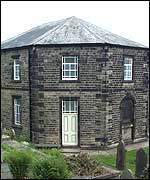 | | The octagonal Methodist Church is the oldest in the world to be in continual use. |
Follow the snickets round to the main village street, Towngate. In Northgate look for a large archway carved with the initials IB. This dates from 1578. The house you can see through the arch was once a farm. Another house is marked not only by the initials of the owners - in this case HEF but also with their figures and the date 1736. It is in Towngate that the two village pubs can be found. The Cross Inn does not look that old but is believed to date from the early seventeenth century. Heptonstall was the scene of a battle and siege during the Civil War - you may even see a Roundhead on a horse riding around near the pub! The White Lion can be found further up the street. Both pubs sells food and good ale and it is not unusual to spot the odd actor relaxing in one of the bars. 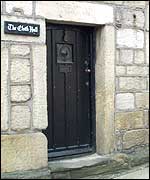 | | Heptonstall had its Cloth Hall before Halifax had its Piece Hall |
If there's one memory you'll take away from Heptonstall it's the churchyard which must be one of the most fascinating in the country. Not only is it supposed to hold the remains of possibly more than 100,000 people - the visible gravestones represent just some of those buried there, but it also contains two churches. You will probably need to step across the pavement of gravestones to get between the two churches. The ruined church is St Thomas a Becket, named after the Archbishop of Canterbury who was murdered on the order of the King not long before building started on the Church. After it was damaged by a gale in 1847 it was decided to build a new church across the yard. Although the old church is now only a shell it still provides an opportunity to examine a church that escaped Victorian restoration - an information leaflet from the West Yorkshire Archaeology Service can be found in the new church. 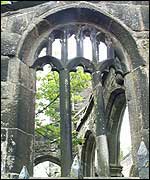 | | The tower of Heptonstall's new church seen through the ruined window of the old. |
The church of St Thomas a Becket had been built low to avoid the worst of the Pennine weather but even St Thomas the Apostle, the new church, could not escape this and in 1875 it was struck by lightning. The falling masonry caused extensive damage to the roof and adjacent tombstones.
Despite Heptonstall's three churches (and it should be remembered there were once many more pubs and beer houses in the village) the churchyard shows that the history of the village has not only been one of piety. Go to the porch of the old church and look closely at the surrounding gravestones to find that of David Hartley. Known as the 'King of the Cragg Vale Coiners,' he was hanged in York in 1770 "for unlawfully stamping and clipping a public coin." Around this time counterfeiting the coinage was something of a cottage industry in nearby Cragg Vale and has been much written about in both fact and fiction.
|