|  | The Yorkshire dialect is sometimes referred to as Broad Yorkshire, however - to those of us living and speaking Tyke - the Yorkshire dialect isn't quite as universal as we may think.
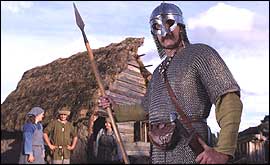
The Vikings arrived in the 9th Century and carved the county up into 'thrithings' or thirds. These 'Thirds' would later be called the North, East and West Ridings. These administrative boundaries remained intact for well over one thousand years.
In 1974 they were abolished but although the old county lines may have been broken up and consigned to the history books in terms of mapping and local authority control, they still continue to exist on a much more subtle level - by virtue of our local dialect, in other words: what we say and how we say it!
Each Riding appears to have its own specific form of dialect. The West Riding dialect is considered to have a hard, almost brash sound to it. This is seen by some as a reflection of the hardships endured by those employed within the mills.
The North and East Ridings by comparison are seen as having a much softer spoken dialect, quite possibly because it was used by farmers and others from tiny rural communities.
There is little doubt that there are certain differences and this can be seen in the following examples:
STANDARD
ENGLISH | WEST
RIDING | EAST
RIDING | House | 'Ahse | 'Oose | Round | Rahnd | Roond | Boot | Booit | Beeat | School | Schooil | Scheeal |
A good example of the hard and soft sound that differentiates the West and North/East Ridings is the word 'Father.' In the West Riding it's pronounced 'Fatther,' which is quite hard. Whereas people from the North/East Ridings pronounce it much softer as in, 'Feyther,' or 'Faather'
There are other differences too. A West Riding person intending to go somewhere would say, 'Bahn ter.' If they were from the North Riding, they'd most likely say 'Off ti.'
However, there's one peculiarity of our regional dialect that is common in all three regions. Regarded by some an absolute treasure, it's known as the 'glottal stop.' Countless outsiders fail miserably when they try to execute the glottal stop, quite simply 'flummoxed' by this most Yorkshire of things!
 | | The Worldwide Web is just the place to find out more about why we speak how we speak in West Yorkshire! |
To better understand it, let's take the term "There was a right bang in the night." If we then 'Yorkshire' this up, we end up with 'Ther worra reyt bang in t' neyt.' Pronounced correctly (ie Tyke!), the "t'" of "t' neyt" remains silent and the throat tightens slightly, acting as an unspoken marker for the word 'the.'
The three Ridings also share a similar use of what's known as subject pronoun. In the phrase "We talk.", 'we' is the subject pronoun.
"Ah know't":I know it
"Tha shunt": You shouldn't (Usually thoo in N or E Riding)
"'E worra reyt 'un!": He was a right one!
"Wi laiked abaht": We played about
"Yer's lot are forrit": You lot are in trouble
"The wo bawlin'all t'neyt": They were crying all night
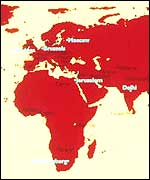 | | As Broad Yorkshire fades into a memory, Pete says it's "the price we pay for progress and our place in the Global Village." |
For anyone interested in finding out more about the Yorkshire dialect, quite a few books have been written on the subject. You can also find a lot on the internet and there are even societies devoted to all things dialectic. The University of Leeds continues to support links with the Yorkshire Dialect Society and there are regular meetings throughout West Yorkshire and beyond.
However, despite all of the above it's a shame to say that there's little doubt that the local dialect is on the wane. It's really sad that the people of Yorkshire can't use formal speech for work and business and revert to a more natural, more entertaining brogue for home and entertainment. But that, I suppose, is the price we pay for progress and our place in the Global Village.
Here are some phrases you've sent in...
"Put 't wood in 't 'oil!": Close the door!
"Ees proper shuck 'e is!": He's crazy, that one!
"Gerrod o' thissen, afore fatther braces thee": Sort yourself out before your father belts you.
"'E's double fisted an' threpple thrioted": Someone aggressive and a heavy drinker
"A brussen tup": somebody full of themselves
"Ah, wi mud as weal": We might as well
"She's nobbut just got the 'ippins off 'er backside and she's courtin'": he's barely out of nappies and she's courting
"Like wot I does": As I do
| HAVE YOUR SAY ABOUT DIALECT! |
Pete would like to hear from anyone who knows of dialect words they'd like to send in! Maybe you've heard slang words and have no idea what they mean - but someone out there might help to unravel the mystery! If you'd like to talk about dialect - or even words you used to use but just don't hear anymore - just fill in the form below!
YOUR COMMENTS:
kyron , ponte
this confuses most "it int tint tin" kyron , ponte
arm on'e twenna n am rayt fond o west yorkshire accent.me mam allus use T'se ger'up ginnel n get tha sen off to scho'will n dunt fo'get tha snap. and ard neva gera stone in my boot allus a stoo'un in me boo'it p.s n e 1's dad eva wear britchers
Fill in the form below with YOUR comments, then press 'SUBMIT': |
PLEASE NOTE:
* Your comments may be edited for legal reasons.
* We cannot guarantee that all comments will be published.
* The Editor's decision is final.
|
|