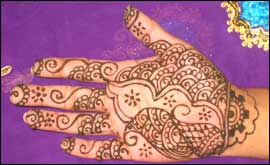
At the heart of the exhibition is 'mehndi', an artform which has been used predominantly by women for millennia and which is now being popularised as a fashion accessory by Hollywood personalities and western pop stars. But the 'Body And Adornment and Ceremony' exhibition claims that treating it as a temporary tattoo trivialises its place in Asian history and culture and so tries to explore those areas while at the same time showing how younger generations have modernised an old tradition. 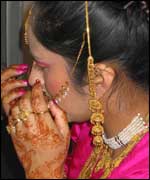 | | Mehndi is traditionally South Asian, African and Middle Eastern |
Mehndi has traditionally been used in South Asia, Africa and the Middle East and is now recognised as an art form in the Western world. The Dewsbury Museum exhibition focuses on South Asian mehndi in Kirklees, in particular the wedding preparations which involve painting the bride's hands and feet with intricate henna patterns. The exhibition includes photographs, many loaned by local South Asian brides, illustrating the art of mehndi and the various designs used as well as interviews with local women and mehndi artists and specially commissioned poetry about this beautiful body art. Dewsbury's Community Education Officer Carmen Taylor says: "Mehndi has become an exciting art form. It used to be an art passed down through the generations in family groups, there was no formal training. Now there are courses and certificates in mehndi and it has become a profession which more women are taking up. There is great competition as regards the intricacies of the pattern, the quality and colour of the design and the speed in which it is completed." Carmen says the exhibition is also important as a record of some of the patterns of mehndi: "It is temporary skin decoration and each is a unique piece of art. If you don't get a record of it, that work of art fades away and is gone forever."
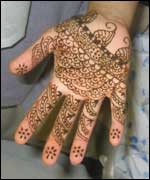 | | "Each is a unique piece of art" |
The exhibition comprises of 12 panels of text and photographs, each looking at a different theme including an explanation of mehndi and henna, how it is applied, the patterns and their meaning and its role in South Asian weddings. There are also local stories and comments from mehndi artists, including London-based Joshiv Taglani who is not only recorded in the Guinness Book of Records as the fastest mehndi artist in the world but is world renowned for her total bridal service and professional training courses. It also includes specially-commissioned poetry by Jeanne Ellin. If that wasn't enough, Dewsbury Museum's wedding theme continues with the display of two stunning Asian wedding outfits. The bride's outfit, in deep red silk and smothered with gold embroidery, was designed by a local company and made in Pakistan. The groom's outfit, a traditional long coat with turban, is from Bradford. 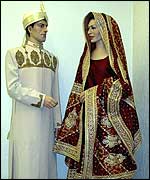 | | 'And The Bride or Red' |
The 'And The Bride Wore Red' display is the result of a research project to find out about the latest Asian wedding fashions. It's emerged that more and more couples in West Yorkshire's Asian communities are choosing traditional styles for their weddings today, rather than adopting Western style white dresses and three-piece suits.
The outfits were selected by women from Batley and bought by Kirklees Community History Service. Collections Assistant Katina Bill says: "To the trained Asian eye, they are fashionable and modern
I am very excited to add these outfits to our collections, they are so beautiful." Both exhibitions are now on at Dewsbury Museum, Crow Nest Park, Dewsbury, until 6th February 2005.
|