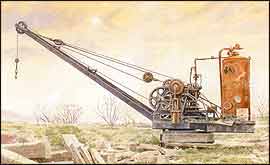
Back in the 1960s Terry Sutton was a student at Batley School of Art and Design. It was at a time when slum clearance programmes were changing the face of the then West Riding. Not only houses, but many of the other buildings that people had taken for granted - mills, cinemas, chapels and even railway stations - were disappearing. Some of Terry's images from this time were originally published as a book, Yesterday's Yorkshire, in 2001. Now visitors to Dewsbury Museum can see his original drawings and photos. We caught up with Terry to find out more about his own very personal "celebration of the Industrial West Riding." 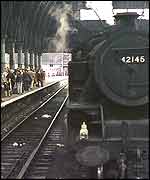 | | Exchange Station: Could this have been Bradford's GMEX? |
Terry explains: "It's really based on some sketches and photographs, and it starts with my days at art college in Batley in the 1960s. That was really the time when things were being demolished. The exhibition could have been called Slum Clearance - The Shopping Malls. It's this period of time when things were just left. Local cinemas disappeared, local breweries and other things, but they didn't disappear straight away. In fact they were left for 10 or 15 years. Now if something is not used it's demolished and there's another building in its place, but at that time things like railway stations were left as though we really didn't know what to do with them. I didn't set out with the intentions of doing a book but this just fascinated me. A lot of the mills were pulled down but, of course, some of them are now bijou residences. It completely changes the face of the landscape." In fact, when Terry left art school he put all his pictures into the loft. Later he returned to Batley Art School as a lecturer and it was only when his time there came to an end that he decided he might be able to use his sketches and photos in a book. 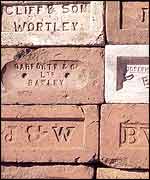 | | Terry is fascinated by everything that goes into the making of a building. |
He says: "The book is written in a very personal way - it's just me. There are things like outside toilets in there, urinals, and people ask me about that. It's about lockup shops, it's about markets and railway stations, and, when it gets to the toilets, the expression on people's faces change and they ask, 'What is this man about?' I can remember outside toilets, it's like frost on the windows when you woke up in the morning, freezing cold, no central heating. It's of that era and I think the book revives people's interests. "A lot of it is still there but life itself has changed and our approach to it. Shopping then was a necessity but now it's a luxury. It's cappuccinos and café lattés, then it was a cup of tea and a toasted teacake. If you go out now with a camera a lot of this has disappeared and the reason for doing it has gone with it. Everything has been tidied up a little bit - at that time we seem to have lost our way as to where we were going and now it's all big industrial estates." 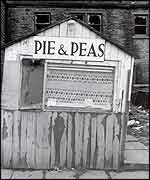 | | Lockup shops like this have disappeared. |
Terry does not believe everywhere has changed to the same extent: "Halifax is one of my favourite spots and it's still fairly untouched, Bradford has changed quite a lot...Kirkgate Market and Exchange Station, they've gone, and you can't help feeling that if they'd survived another couple of years some things might have changed. I think Exchange Station may have made a superb venue for exhibitions, much the same as GMEX in Manchester. It had this fantastic overall roof and this wonderful space." This, according to Terry, was the world of the lockup shop, the café he remembers visiting with his grandmother or an anti-spitting sign you wouldn't find in any of West Yorkshire's modern shopping malls. It was also a time he thinks when we were more honest about our surroundings: "You wouldn't call anything the clencher (a toilet) now as a brand name, there was a kind of honesty about names then. It's in some of the street names - like in Yard No 3, people weren't ashamed to live in Yard No 3 but, now we are at a safe distance, it's more likely to be Weavers' Croft. You wouldn't be able to photo that street now because it would be full of cars. I think it cars and television that have made the difference." There is a public toilet that has the appearance of an art deco cinema, a passage under the railway line in Batley that looks positively medieval and faded messages on walls, only meant to be up there for a short time but still to be seen decades later. From textures to chimneys Terry's illustrations also show the incredible craftsmanship that went into some of these buildings. He says: "And it's the textures that fascinate me. I think when these buildings were left something happened to them - they were falling down but there was a sort of a dignity about them." Yesterday's Yorkshire - A Celebration of the Industrial West Riding is at Dewsbury Museum until January 2006. |