Anyone in Bradford who was looking for a good film to go and watch on May 8th 1945 (VE Day) may well have been tempted by a special Victory programme at the Odeon. The cinema was offering not one, but three films - all of them made in the USA. Even more surprisingly one of the films on offer, Since You Went Away, was about the effect of war on an American home. But just as the war in West Yorkshire, and beyond, called on everyone to play their part so those efforts came to be reflected on the silver screen.  | | This Bradford family celebrate the Allied Victory in Europe. |
While the best-remembered wartime movies, such as In Which We Serve, focus on fighting men, one of the most popular films for home audiences was Millions Like Us. The film which kicks off with the words "Millions like us, millions like you" is based on the experience of young women in an armaments factory and stars Eric Portman from Halifax. During the war the cinema had an important propaganda role to play. Amongst the many documentary films made at the time, Humphrey Jennings' film Listen To Britain featured the Huddersfield Choral Society as well as the very popular double-act Flanagan and Allen (responsible for the theme tune for Dad's Army). 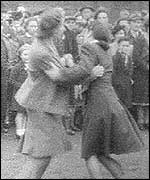 | | Dancing in the centre of Bradford on VE Day |
But West Yorkshire people could also be found behind the camera during the war years and some of the resulting footage, now in the Yorkshire Film Archive, will be shown at the National Museum of Photography, Film and Television in Bradford on the 60th anniversary of VE Day (May 8th 2005). Alex Southern, Education Development Officer for the Archive, will be presenting the show on the day. She says the show will consist of "wartime footage made by local people in the region, showing life on the Home Front and the valuable contribution to the war effort made in Yorkshire. The show will include film of the Home Guard, Civil Defence units, the Air Training Corps and the Women's Land Army as well as the processions and celebrations in Bradford on VE Day 1945.  | | People crowd into the centre of Bradford for VE Day |
"Many of the films in the show have been conserved with the support of the BBC People's War project. This has enabled the Archive to safeguard the original films and provide greater access to the collections so that these fascinating films will always be accessible to the public in the future." 'Yorkshire in Wartime' is just the first in a series of film shows called 'Framing the Past,' presented by the Yorkshire Film Archive which will be coming to the Museum. The final show will consist of films made in and about Bradford over the past century. Even before the war came to an end in 1945 British films were asking what the country might be like after the war. The Way To The Stars, made in 1945 and starring the late John Mills, is ostensibly about life on a British bomber base but suggests that the ensuing peace should be worth the sacrifice of so many lives. This message is reinforced in the film by the use of a poem, For Johnny by John Pudney, about a dead airman which includes the lines:
Better by far
For Johnny-the-bright-star,
To keep your head,
And see his children fed.  | | Some of the people who spent VE Day in Bradford were in uniform. |
The National Museum of Photography, Film and Television will be taking this story forward a few years when, as part of its VE Day event, it will be screening the 1949 film Passport To Pimlico. This light-hearted look at post-war redevelopmentis about what happens when the inhabitants of Pimlico find they are part of Burgundy and declare an end to rationing! However, the film also looks back nostalgically to the war years when people seem to be united behind a common purpose. Bill Lawrence, Head of Film at the Museum, talks about the effect of the war on the British cinema: "With the declaration of war cinemas closed overnight - they thought there were going to be major bombardments - but after a week they decided this was unnecessary because it was a major morale booster that people could still go to the cinema and life could have a semblance of normality. After an initial dip, there were about 990,000 admissions just before the war, it started to rise again and by 1946 it had crept up to 1.6 billion admissions in the UK which compares to 176 million admissions now so it was a fantastic period of people going to the cinema. The Ministry of Information realised film was a major way you could get ideas across to the public and get them to understand things.  | | People like you and me found themselves on the big screen and behind the camera. |
"The cinema was a way that people could plug into the bigger picture - films like The Foreman Went to France as well as semi-propaganda films like Went The Day Well. There were concerns in the early part of the war about invasion and plots about Nazis invading Britain or hidden as landed gentry were written into story-lines." However, not all propaganda films were so entertaining - Bill has unearthed a short information film about compost heaps. Although Passport To Pimlico is a farce Bill says it look back the way people had to pull together during the war: "There is a real sense that things were quite good during the war in terms of communities bonding but there's this major reconstruction taking place at the same time."  | | Can you imagine George Formby as a double-agent? |
Bill has been looking back at the films that were popular during the war. He says: "There were films that were successful like Gone With The Wind but then there are films that have been forgotten like The Wicked Lady which came out towards the end of the war just seemed to strike a chord...One of the things during the war is everybody is really open for a good laugh and people like George Formby really came into their own during the war. He made his last film in 1946 but in the five years of the war he made nine different feature films, some of which we're very relevant to the war. In one he plays a double-agent in Germany. Can you imagine George Formby as a double agents. Arthur Lucan (Old Mother Riley) also made nine films during the war. In some ways I can't imagine them being successful in any other period." And if you are still wondering what other films you may have missed because you could not get along to The Odeon in Bradford on May 8th 1945 then we can reveal they were Thirty Seconds Over Tokyo, featuring Spencer Tracey and Robert Mitchum, and the now completely forgotten Man In Half Moon Street. Perhaps going to a street party might have been a better bet.
Thanks to the Yorkshire Film Archive fo
Thanks to the Yorkshire Film Archive for permission to use the film and all images of Bradford on VE Day, 1945. No images may be reproduced without permission from the Archive.
|