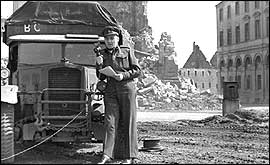
It's sixty years since the end of World War Two. What would you say about the state the world's in now?
Well, if you look back, since the end of the Second World War people seem to think we've lived in an era of peace but since then there have been 25million people killed in war and probably about 75million people seriously injured, and that's leaving out all the people who've died of poverty and other diseases. We've had over 100 wars and some of them individually have killed over one million people so the idea we've moved from war to peace is a misnomer.
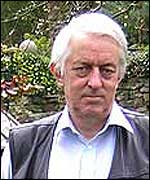 |
| Professor Paul Rogers |
The Second World War was easily the worst in terms of numbers killed but there have been ongoing conflicts ever since, and even if the Cold War never went hot, so to speak, there were numerous proxy wars - East-West proxy wars - and 10million people died in those. So, in one sense, it's worth looking back at the end of the Second World War and reflecting that it at least came to an end, but to get the impression we are out of the woods is very far from the truth.
You are a professor of Peace Studies but every time the BBC talks to you it tends to be about war or terrorism but your starting point is still peace?
Yes, within the department we have people working on many different areas and we have a whole team who work on conflict prevention and conflict resolution. I tend to work on issues of actual security so, if you like, I'm more at the hard end of things in the department but, even so, what you try to do in my kind of work is to point to the dangers of war and its effects and look always at creative alternatives. So, yes, I am a professor of Peace Studies. I'm looking at it in a fairly hard-headed way.
You say you look at peace and conflict at all sorts of levels so would your department also be looking at tensions in, say, cities like Bradford?
Very much so. The department is now very big - we have 400 students from 40 countries or so, and we do a wide range of work. One of our more recently established centres is the International Centre For Participation Studies, and that's very much about communities working together, and the staff are closely connected with developments in Bradford. It's part of a community and university-wide initiative called A Programme For A Peaceful City led by one of my colleagues, Jenny Pearce, so the department goes from the community to the international level and different people work in the different areas.
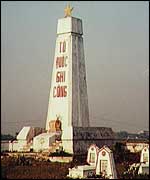 |
| A memorial to North Vietnamese soldiers - "Even if the Cold War never went hot there were numerous proxy wars." |
At the end of World War Two I assume the United Nations was seen as a way to make sure a war on this scale would not happen again but the League of Nations after the First World War was a failure. What sort of job do you think the United Nations has done?
If you look at it overall some of the specialist agencies of the United Nations have been very good. The World Health Organisation, the International Labour Office and, indeed, the UN Conference on Trade and Development have been trying for 30 years to get everything from trade reform to aid development so in all those areas I think you can see a lot that is positive.
The UN was weakened in a sense by the attitude of its member states but in many ways a lot of what it says or does is imaginative and far-sighted but implementation is another matter. Throughout the last 60 years the UN has tried on numerous occasions to bring wars to an end, to put observer missions in...I wouldn't pretend the record is as good as it should be but I do feel that's partly the fault of the leading member states that tend to use it for their own devices.
You talk about the leading member states. I suppose what we've had is a few dominant powers. Does that make war inevitable?
It doesn't make war inevitable but when you get major powers that are clearly vying for position then it can very easily lead to conflicts, particularly when they believe they can almost bypass international law. We've been in a period over the last 50 years or so, trying to get more and more international agreements, really to counter the tendency of states to act purely in their own interests. We're in a difficult position at present because, if anything, things are going a little bit backwards but in many other areas there are international agreements that do actually work - aspects of the international law of the sea, many of the agreements on health issues and communications. In all those sorts of areas the UN does oversee inter-govenmental relations and that is all very positive but I'm not pretending we haven't got a huge way to go, even so.
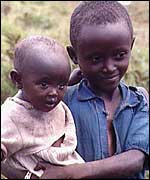 |
| Rwandan refugees - millions of people have been displaced by war since 1945 |
You mentioned going backwards. What do you think is the most serious challenge facing the world today?
I think one of the problems is you do have an extremely powerful state, the United States, which was almost dealt a body blow by the 9/11 attacks and has acted very vigorously and in some ways very antagonistically to traditional principles of international law. At the moment it's going through a phase of going its own way much more, to the real worry of many people in other parts of the world, not least in European capitals. There are a number of treaties that have been abrogated or ignored by the US so I think that's one problem, but one also has to say that some other states hide behind that US attitude so it's not just the Americans who are causing problems at present.