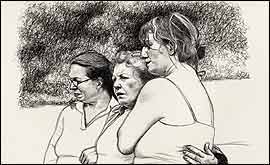
Using his skills as an illustrator Simon documented the excavation process, producing a series of images that have now gone on show at the Artsmill in Hebden Bridge. We caught up with Simon to find out more about the exhibition and the tragedy it depicts. Simon explains what took him to Spain: "I read an article in The Guardian which described an exhumation of three women in a village in Leon who had been victims of one of the many murders during the Civil War and right at the end of the article it asked for volunteers to take part in further exhumations." 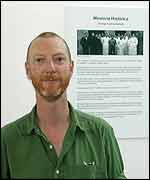 | | Simon Manfield standing in front of a photo of those who died at Valdediós in 1937. |
He was already a frequent visitor to the country: "I've always loved Spain, and I've been a traveller to Spain for many years. As far as the Spanish Civil War is concerned I'd read books by Orwell and Laurie Lee and was quite fascinated by the whole movement of intellectuals and the workers during the 1930s relating to Spain - I suppose it was a bit of a romantic vision, like a lot of people have about the Civil War but it wasn't until I got to Spain to take part in this exhumation that I realised it's not romance." Because he felt his Spanish was not up to scratch Simon offered his services as a documentary illustrator. His proposal interested The Association for the Recovery of Historic Memory who have organised the excavation of many communal graves throughout Spain. Not knowing what to expect he arrived in the village of Valdediós in the northern province of Asturias. Even now, Simon believes people are very affected by the events of the Civil War: "There's a great deal of fear, even during this exhumation. On the second day we turned up on site and on the gate into the meadow, where the grave was, there was a big hand-written sign basically saying when you've finished looking for their murderers basically look for THEIR victims and there was a small drawing of a syringe at the right-hand corner." It is believed that 29 employees of La Cadellada psychiatric hospital in Orviedo, who had fled from the town of Orviedo to an abandoned monastery in Valdediós, were murdered by troops fighting for Franco on October 25th, 1937. The events surrounding the murder are confused but testimonies suggest that the soldiers raped some of the women and then decided to eliminate both victims and witnesses. However, the message in the meadow suggests there are those who still believe that the medical staff were killing the patients because they were not psychiatric patients, but landowners and members of the clergy, and this was an act of retribution. Simon comments: "There's still a lot of fear but there's still a lot of passion, aggressive passion I suppose. There were also people coming up to the site and saying, 'You're digging in the wrong place,' and they were looking around as though they were still being watched and then running off...General Franco's regime was incredibly oppressive and, even though he died in 1975, that fear still exists. It's something you can't get rid of really until something like this begins to happen. It's the fear of acceptance as well. It's almost 70 years since the end of the Civil War and there are people like Antonio Piedrafita - we found his father in the grave - who had been looking for his father for 66 years, and it's very difficult having it on your back for so many decades. It still conjures up that sort of fear and there's still division between families - one family on the National side and one on the Republican side." But are visitors to the exhibition in Hebden Bridge likely to understand the circumstances in which the Valdediós tragedy took place? Simon explains: "It's very confusing. Basically in the early 1930s there was a Republican government and in 1936 Franco and others on the right decided they did not want a Republican government and decided to change it. On July 19th 1936, the first day of the conflict, different parts of Spain were taken over by the Nationalists (Franco's side) and other parts were kept by the Republican side and there was a Civil War. The Nationalists were being helped by Hitler's Germany and Mussolini's Italy and at the beginning the Republicans weren't being helped by anybody apart from the Russians. Britain and France decided there would be a non-intervention pact - if they didn't intervene then it would just fizzle out. In fact their non-intervention made it go on for a lot longer. In 1936 like-minded people, left-wing and right-wing, formed international brigades to fight with the different sides and in 1939 Franco won." Despite knowing something about the history of Spain, Simon had no idea what to expect at the exhumation - either as a person or as an artist: "We commenced work, and I started drawing, and as days passed I found it very difficult to draw from life because things were happening all over the site so I decided I would have to take photographs, and I took just over 500. I found it quite extraordinary because once we did start recovering bones I wasn't shocked or anything. I just continued drawing and taking photographs and it wasn't until personal effects like watches, wallets, rings and shoes, lots of shoes, started showing up that there was, in some way, the connection to that person. "That watch was still beside the body of the person it came from and that really got me, and also at the point we found Antonio Piedrafita's father recognisable by a row of gold teeth, that really hit home as well. I had to just go up the hill and have a cry. It's something I will never ever forget. I hope to take part in more exhumations but I will always remain very close to the people of Valdediós and the victims' relatives. And as far as my art work is concerned it's strengthened it without any doubt whatsoever." 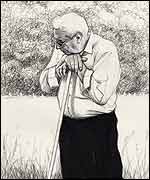 | "It's that American expression 'closure.'" |
Simon has been invited to witness the exhumation of the great Spanish writer Frederico Garcia Lorca which may take place next year, the 70th anniversary of his death, and there is also a possibility he may attend the opening of a grave in Guatemala. He firmly believes such action is important: "It's that American expression, 'closure.' It's the whole historic memory movement to regain what is part of you, and to give that person a decent burial after 66 years - not knowing exactly where your parent or cousin or brother was, to find them and give them the burial they so rightly deserve." For the last two years Simon has been working on 60 illustrations documenting the Valdediós dig and 36 of these are on show at the Artsmill in Hebden Bridge. He says: "It hasn't left me...It's now part of my life. It's part of me. It changed my life when I was there. There's not one day that I don't at some point think about it." I walk around the exhibition with Simon. It begins with a group photo of the murdered medical staff. One of Simon's illustrations shows the lane along which the victims were taken down before they were shot. Many of the images show the volunteers who came from all over the world. The actual exhumation was not without its difficulties - it was supposed to take two weeks but nothing had been found by the beginning of the second week. The digging was temporarily halted after the abrupt departure of the team leader but the remaining volunteers eventually decided to continue with the search. Help came in the form of forensic archaeologist Paco Extebarra: "This man arrived like a whirlwind. He also arrived with a mechanical digger. The day after he arrived we located the first bone. We were digging in an area where we had first dug - it was clay soil so it was very difficult to get through it by hand but, as soon as the mechanical digger came, we dug a pit and there they were. "It was an L-shaped grave because at the time of the murder it was a wood and this grave they were forced to dig themselves was an L-shape around chestnut trees." For the relatives "this was the beginning of the end of the journey." One image is of Antonio Piedrafita at the point at which his father's remains were found. Finally we arrive at an idyllic rural scene. Simon says: "This is it. This is Valdediós, the meadow. It's beautiful, it's absolutely beautiful. You were asking me earlier about how I felt about coming back to somewhere so beautiful [Hebden Bridge] but this can happen somewhere that is so beautiful. It doesn't matter where you are. It's the same result." Chris Verguson Memoria Histórica runs at Hebden Bridge Artsmill, Linden Road, until Sunday September 4th. Phone 01422 843413 for more details. |