

A new and sharper view on the cosmos
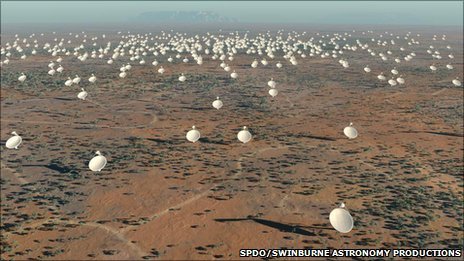
Scientists and engineers from more than 20 countries meet in Rome today to decide whether the UK (or Germany or the Netherlands), should host the project office for the biggest radio telescope the world has ever seen.
The Square Kilometre Array (SKA) has been dubbed astronomy's answer to the Large Hadron Collider - a multi billion Euro project that will dramatically improve our understanding of the universe and take us beyond Einsteinian physics.
The telescope is actually not one, but some 3,000 individual dishes all connected together in a series of spiralling arms (it looks a bit like a spiral galaxy), and giving an overall collecting area of a square kilometre - hence the name.
In order to see this content you need to have both Javascript enabled and Flash installed. Visit BBC Webwise for full instructions. If you're reading via RSS, you'll need to visit the blog to access this content.
Because of the vast area of land required, and the need to keep interference from mobile phones, electrical appliances, even people, to a minimum just two front runners have emerged to host the array: A Southern African bid based in the Karoo desert in the northern Cape; and an Australia-New Zealand consortium centred on Murchison in the Western Territory.
But in a sense it doesn't really matter where the dishes are located. What matters, according to the professor of Astrophysics at Oxford University Steve Rawlings, is the resolution they give on the cosmos.
"Even phase one of the Square Kilometre Array is getting on for being a hundred times more sensitive than instruments we have at the moment. That's a massive improvement in capability".
That first phase of the project will allow astronomers to study the so called "dark ages" of the universe, the period before the first stars began to shine, in unprecedented detail. It should confirm the existence of gravitational waves, the ripples in space-time predicted in Einstein's theory of general relativity.
But the real power of the SKA may be to take us beyond Einsteinian physics to explore the structure of dark matter and dark energy.
Before all that can happen, scientists, engineers and government officials meeting in Rome have a series of more mundane decisions to make on funding, the administrative structure of the project, and where all this astronomical data comes back down to earth.
An announcement on the UK bid to host the SKA project office at the Jodrell Bank Centre for Astrophysics is expected on Saturday.

 I'm Tom Feilden and I'm the science correspondent on the Today programme. This is where we can talk about the scientific issues we're covering on the programme.
