

Colouring in the dinosaurs
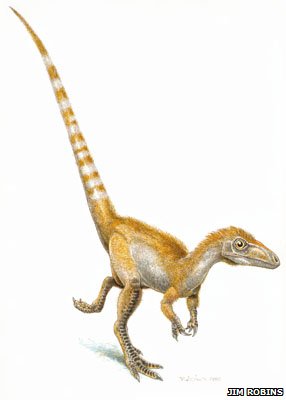 Take a look at this artist's impression of Sinosauropteryx - a small flesh-eating therapod dinosaur dating from the early cretaceous period 125 million years ago.
It may surprise you to learn that this image is the first illustration of a dinosaur in which the colour the artist chose has been directly determined by evidence from the fossil record.
Until now the palette employed by artists like James Robins to bring long dead animals back to life - in everything from academic journals to children's books and films like Jurassic Park - has been based on guesswork. Educated guesswork, informed by our understanding of the natural world, but guesswork none the less.
All that has changed with the discovery of melanosomes in the fossil remains of Sinosauropteryx. Melanosomes are colour coding structures found in the feathers and hair of modern birds and mammals, and depending on their shape (from round through oval to sausage shaped) they produce black, grey and reddish brown tones. The absence of melanosomes gives you white.
Using a powerful electron microscope, palaeontologists at Bristol University have identified melanosomes in the fossilised remains of the spiny bristles - the precursors of feathers - running down the back of Sinosauropteryx.
From their shape professor Mike Benton says it's clear this dinosaur was quite a bright orange with distinctive white rings on its tail.
"There's a very clear line of feathers running down from the top of its head and along its back like a Mohican."
Professor Benton says the discovery will help us to "colour-in" a wide range of feathered and bristly dinosaurs, and to resolve a long-standing dispute about the original purpose of feathers.
"We know that feathers came before wings, so they didn't originate as flight structures" he says, "We suggest that feathers first arose as agents for colourful display. Only later in their evolutionary history did they become useful for flight."
Sadly, melanosomes don't tell the whole story. Other structures are responsible for different colours, and they're not present at all in scales and skin. We may never know if feathered dinosaurs were as colourful as many modern birds, and the discovery tells us nothing about the palette employed by the giant sauropods like Diplodocus and Brachiosaurus.
On the other hand, the children's laureate Anthony Browne is free to carry on using his imagination as he sees fit.
 I'm Tom Feilden and I'm the science correspondent on the Today programme. This is where we can talk about the scientific issues we're covering on the programme.
