

A first for carbon capture
Scottish Power will throw the switch on what promises to be a new era of "clean" coal-fired power generation today. The company's Longannet power station on the Firth of Forth has been fitted with the UK's first carbon capture unit.
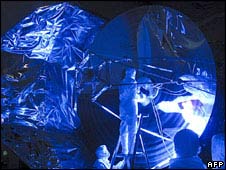
 The prototype has been developed by the Norwegian firm Aker Clean Carbon. It's a "retro-fit" solution, bolted on to the power station's exhaust pipe, and uses a recyclable amine solution to scrub carbon out of the plume.
Weighing about 30 tonnes, and designed to fit inside a single cargo container, the test unit will initially siphon 1000 cubic meters of exhaust gases from the Longannet stack every hour.
That's less than 1% of Longannet's overall emissions, but Scottish Power has ambitious plans to scale up this demonstration into a fully functioning carbon capture plant by 2014. Eventually the company hope the system will capture 90% of the power station's carbon emissions - the equivalent of taking a million cars off the road. According to Scottish Power's chief executive Nick Horler, "it's about taking the concept of CCS out of the lab and making it a full-scale commercial reality".
In order to see this content you need to have both Javascript enabled and Flash installed. Visit BBC Webwise for full instructions. If you're reading via RSS, you'll need to visit the blog to access this content.
With 50,000 coal-fired power stations belching out carbon dioxide around the world, the prize for the first company to develop a working carbon capture system is potentially enormous. But all this carbon has to go somewhere, and Scottish Power are hoping a carbon-free Longannet will help kick-start a new North Sea carbon storage industry.
After 40 years of oil and gas exploration the industry know-how is already there, and a recent study by Edinburgh University suggests the saline aquifers of the North Sea bed are vast, with the potential to hold all of Europe's carbon emissions well into the next century.

 I'm Tom Feilden and I'm the science correspondent on the Today programme. This is where we can talk about the scientific issues we're covering on the programme.
