The rain in Spain falls mainly on the....weekend.
Apologies to Frederick Loewe and Alan Jay Lerner who wrote the original song for My Fair Lady, but they may have been on to something. It seems that the rain really does fall not on the plain - but at 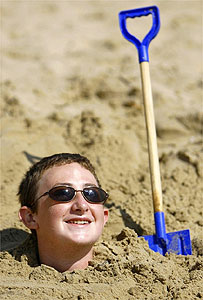 the weekend.
Scientists have known for some time that human activity can drive local weather patterns. That's because sooty particles and other pollutants can influence air circulation as they are heated by the sun, and can help to seed clouds. And of course we produce more pollution during the week.
Although the phenomenon is well documented in the US, China and Japan it was thought that European weather systems were too complicated to show the effect clearly. But now a team led Arturo Sanchez-Lorenzo at the University of Barcelona is claiming to have found similar patterns over Spain and much of western Europe.
The research, published in the Journal of Geophysical Research Letters and reported in next week's New Scientist, shows more rain falling during the week in the winter, while in summer months the pattern is reversed.
So now you know why it always seems to look so sunny out of the office window, and why that tantalising promise never holds until you're free to enjoy it at the weekend. Well, that's the theory anyway....and the forecast for the weekend? It's going to bucket down, naturally.
A fascinating discussion about the use of robots in medicine on the programme this morning. I'm not sure how you'd feel being quizzed about your health by a miniature Dalek at the foot of your bed, but Lord Winston clearly didn't like the idea.
The debate was sparked by a new TV series about the use of technology in medicine that the celebrated fertility expert is presenting - you can see part one of "SuperDoctors" on BBC1 at 9 o'clock tonight.
Lord Winston is pretty dismissive of consultant surgeon (and health minister) Ara Darzi's use of what amounts to a glorified video-conferencing machine to conduct his ward rounds. Lord Darzi's justification for using the robot is the enormous amount of time it saves him as he juggles meetings and consultations across a number of hospitals.
You can see how the idea might help to bring medical expertise to even the most remote location, but I have to say I have a lot of sympathy for Lord Winston's point; that medicine is about more than cold biological facts or efficiency. Certainly the patient who was the subject of this consultation - a fiesty old Irish woman - seemed less than impressed.
Even more interesting is the use of robotics to enhance human performance in the operating theatre. Lord Winston travelled to Canada to watch a robot perform brain surgery, and to Leeds where consultant paediatrician Azad Najmoldin was preparing to operate on a one year old boy. Azad Najmoldin is an experienced surgeon who has performed thousands of similar operations "by hand". So why Lord Winston wanted to know was he abandoning a proven and successful technique to experiment with a robot he had only used 8 times? Didn't that put the patient at greater risk?
The argument seems to go to the heart of what medical progress is all about. While the robots in use today may not be better than an experienced surgeon they have enormous potential. But if that potential is to be realised it has to be developed in the operating theatre. In this case, where Azad Najmoldin felt he was in control of the procedure and could take over manually at any point, he clearly felt any additional risk was manageable and worth it to take the technique forward.
Fascinating stuff, and well worth watching.
Back from holiday (two lovely rain-drenched weeks in Cornwall) to find the countdown has begun!
Just 20 days to go until "First Beam". The moment scientists at CERN in Geneva finally switch on the largest and most complex scientific experiment ever built, the Large Hadron Collider or LHC.
This giant atom smasher (sorry, particle collider) buried under the alps on the Swiss/French border will re-create the conditions that existed just a split second after the Big Bang. To do that the LHC fires two streams of protons in opposite directions around a ring bigger than London Underground's Circle Line. Travelling at velocities approaching the speed of light, and cooled to -271 degrees, the streams of protons are then crossed smashing into each other at fantastic energies.
The results, measured in four giant detectors around the ring, could help solve the most fundamental questions about the nature of the material world, reveal the secrets of dark matter, and even point the way to a theory of everything.
You'll hear a lot more about the project here on the Today programme and across Radio 4 over the coming weeks, and we'll be there live for the "big switch on" on September the 10th. 20 days and counting....


 I'm Tom Feilden and I'm the science correspondent on the Today programme. This is where we can talk about the scientific issues we're covering on the programme.
