
BBC BLOGS - Iredale's Eye on Politics

Archives for February 2011

A tale of two Kingstons and the North-South divide

Tim Iredale|13:03 UK time, Friday, 25 February 2011

Comments

In order to see this content you need to have both Javascript enabled and Flash installed. Visit BBC Webwise for full instructions. If you're reading via RSS, you'll need to visit the blog to access this content.


The Royal Borough of Kingston-upon-Thames appears to have little in common with its northern namesake - Kingston-upon-Hull.

Think rowing, rather than rugby league. White collar service sector over blue collar manufacturing.

Then there's the question of how this outer London borough is coping with the spending squeeze...

In 2011/12 - Kingston-upon-Thames is facing a reduction in its revenue spending power of 2.57% - compared with 8.9% in Kingston-upon-Hull.

Proof say Labour that deprived urban areas - such as Hull - are losing out.

But many South of England Conservatives dispute that claim and argue they too have their fair share of problems.

Conservative councillor David Cunningham recalls how the former Deputy Prime Minister Lord Prescott used to describe the town as the "leafy borough" of Kingston-upon-Thames - a description he does not recognise as the area has a number of deprived housing estates.

In Hull, much attention has been focussed on how vulnerable groups will be affected by council cuts and the situation is mirrored in Kingston-upon-Thames.

I met up with former Kingston council worker Jane Young, who is campaigning against a proposed increase in the charges paid by disabled and elderly residents for the care they receive in their own homes.

Jane dismissed talk of a North-South divide, claiming that her local authority is facing total cuts to its budget of 25% over two years - a substantial chunk for a small council, she argues.

The Liberal Democrat leader of Kingston Council declined our offer to be interviewed for the BBC Politics Show in Yorkshire and Lincolnshire.

While there's no doubt that some town halls will be hit more than others - it's clear that council cutbacks are having an impact on the people who live by the Thames, as well as those who live on the Humber.

Town Halls defy calls to axe council newspapers

Tim Iredale|14:36 UK time, Friday, 18 February 2011

Comments (3)

In order to see this content you need to have both Javascript enabled and Flash installed. Visit BBC Webwise for full instructions. If you're reading via RSS, you'll need to visit the blog to access this content.


They have been described by the Local Government Secretary Eric Pickles as the product of "Town Hall Pravda printing presses".

Many Tories believe council newspapers delivered to households are little more than taxpayer-funded propaganda and argue they should be scrapped, or at the very least, scaled back.

New guidance issued by Eric Pickles' department suggests that local authorities should reduce their publications to a quarterly service.

A number of local newspaper publishers have been calling for government curbs on Town Hall free sheets.

North East Lincolnshire Council is faced with making savings of around £30m over four years. The Grimsby-based authority has announced it's reducing editions of its paper from monthly to bi-monthly.

Linc-Up currently costs around £100,000 a year to produce and council chiefs believe they can cut that amount by less than half by reducing the print run and finding cheaper delivery options.

The Liberal Democrat leader of North East Lincolnshire Council, Andrew De Freitas, believes the paper serves an important role by informing residents about how their council tax is being spent.

However, Martin Vickers, the Conservative MP for Cleethorpes - who is a former North East Lincolnshire councillor - disagrees and claims the money would be better spent on an occasional supplement published in co-operation with the local media.

Others would also argue that in an era of Facebook and Twitter, council chiefs should concentrate on web-based communication.

For the time being, council papers look to be here to stay and it's a subject we discussed on this week's Politics Show in Yorkshire and Lincolnshire.

Your comments, as always, are welcome on this subject.

David Davis: No compromise on votes for prisoners

Tim Iredale|17:14 UK time, Wednesday, 9 February 2011

Comments (1)

In order to see this content you need to have both Javascript enabled and Flash installed. Visit BBC Webwise for full instructions. If you're reading via RSS, you'll need to visit the blog to access this content.


The prospect of ballot boxes behind bars pleases few in the corridors of power.

David Cameron has said it makes him feel "physically ill".

But it's another David who is leading Parliament's opposition to prisoners getting the vote.

David Davis has teamed up with Labour's former Home Secretary Jack Straw to oppose moves to allow prisoners serving sentences of less than four years to take part in elections.

The Tory MP for Haltemprice and Howden told me in an interview for BBC Look North: "Those who break the law cannot be allowed to make the law".

The Government recently accepted - albeit reluctantly - a ruling by the European Court of Human Rights that British prisoners should be allowed to vote.

The case was originally taken to Strasbourg by John Hirst, a former prisoner from Hull, who served more than 20 years in jail for manslaughter.

Many MPs are angry this decision has been made without the support of Parliament and on Thursday the House of Commons overwhelmingly rejected the idea by 234 votes to 22 - a majority of 212.

The Government has been warned that defying the ECHR ruling could open the flood gates for compensation claims worth more than £100m.

The debate over prison votes is likely to focus on which court should prevail. The European Court of Human Rights or the court of public opinion?

Ministers consider Humber Bridge 'sell-off'

Tim Iredale|23:03 UK time, Thursday, 3 February 2011

Comments (1)

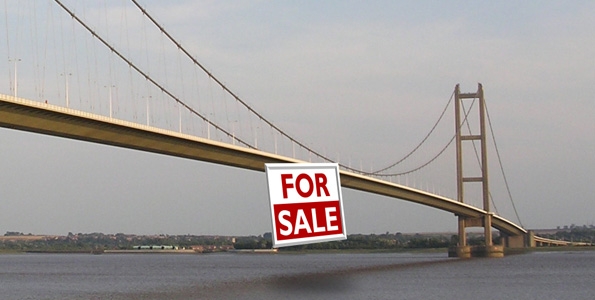
Humber Bridge

Ministers are being asked to consider a radical proposal to sell-off the Humber Bridge, with a long term aim of reducing tolls and boosting the regional economy.

It's a scenario that would have once seemed unthinkable, but Hull-based property boss Malcolm Scott believes the Government should pay serious attention to his proposal, which would pay off a big chunk of the outstanding debt on the 30 year old structure.

Malcolm Scott is offering to buy the Humber Bridge debt for £100m. That's less than a third of the outstanding debt, which now stands at £330m.

The price of the tolls would remain at their current level for eight years and would then be reduced to one pound per crossing. The bridge would be run and maintained by a community interest company.

A number of MPs and council leaders are supporting the Scott proposal. The only concern seems to be the time it would take for the tolls to be reduced from current level of £2.70 each way for cars.

The Labour leader of North Lincolnshire Council, Mark Kirk said he was still hopeful that ministers would look at a look at a financial package to reduce the tolls sooner rather than later.

This is the statement issued by the Transport Minister Norman Baker: "I am fully aware of the region's concern regarding the Humber Bridge tolls and am working closely with Economic Secretary to the Treasury, Justine Greening, to help the region and bridge owners find a long term sustainable way forward for this important transport link.

"The Department for Transport is working closely with the Treasury to consider the level of tolls and the implications for transport and the economy for the Humber region and nationally. The review will take into account any views put to us, including those from business leaders, local councils, the Bridge Board and local MPs.

"We will of course have to look at the information from the review in the round, taking account of the economic assessment as well as the difficult financial challenges we currently face as a country."

Malcolm Scott's proposal could be seen a classic example of Localism and the Big Society in action - a community coming up with its own solution to a problem and not relying on 'big' government.

It could be an offer the Coalition will find hard to resist.

BBC © 2014The BBC is not responsible for the content of external sites. Read more.

This page is best viewed in an up-to-date web browser with style sheets (CSS) enabled. While you will be able to view the content of this page in your current browser, you will not be able to get the full visual experience. Please consider upgrading your browser software or enabling style sheets (CSS) if you are able to do so.