

Tyranny of the young
- 7 Feb 07, 03:43 PM
Medialand is a scary place for any company that’s more than five years old. You can see that in today’s profit warning from Emap. Its shares slumped after it warned of poor advertising performance at its radio stations and consumer magazines (the likes of Grazia and Zoo). Its woes are the flip side of one of the phenomena of 2006/7, a significant shift in advertising revenues to the internet.
The effectiveness of internet advertising may still be in doubt. But almost every business to which I speak is devoting a significant proportion of its marketing budget to the internet. Why? Because all the other corporates are. And no marketing director ever got the sack for following the corporate fashion. Which should put the fear of oblivion into any newspaper, magazine, TV channel or radio station that hasn’t yet made a significant investment in creating a serious online presence.
And there’s another example of the tyranny of the young in MySpace’s deal with Vodafone. MySpace, controlled by Rupert Murdoch, may claim to be the world’s number one “lifestyle portal”. But it doesn’t have either the £13.5bn annual cash flows of Vodafone or Voda’s paying customers. Yet it seems to have bigger boots in commercial negotiations than Voda.
How else to explain Vodafone’s excitement that it has secured a head start on its rivals in offering a mobile version of MySpace to its customers? For a few months or so, only Voda customers will be able to gain access to MySpace Mobile, which Voda thinks will help it win lots of customers (especially younger ones) at the expense of O2, Orange and the rest.
What’s more, Voda wouldn’t have secured this exclusive relationship if it weren’t in some shape or form paying for the privilege – since without a subvention from Voda, it would have been more rational for MySpace to swell subscriber numbers by making its mobile version available to Voda and all its competitors at the same time.
The access to MySpace makes a Voda mobile less of a commodity and therefore helps Voda to compete on quality of experience, not just price. But the deal reinforces the point that mobile phone networks have become more of a basic utility than they were.
And if those fabled massive Voda cash flows aren’t to be eroded by price competition over time, it’ll have to secure lots of other MySpace-style exclusive content deals – although let’s hope it doesn’t ever make the mistake of thinking it can own and manage a creative or so-called “content” business like MySpace.
Future climate for business
- 7 Feb 07, 08:35 AM
“Political parties won’t be electable, and companies will not be profitable – or at least they will be less profitable - without credibility on environmental issues.”
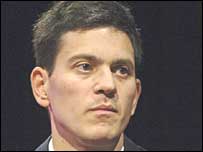 Such was the resonant claim made last night by David Miliband, Secretary of State for the Environment, Food and Rural Affairs, at an event hosted by FTSE4Good, the creator of a greenish stock-market index.
Picture him saying it. And when you do, is he holding a juicy delicious carrot or a huge great stick with which to beat the private sector?
Or to put it another way, if you believe climate change is a real and present danger (as it happens I do – but don’t hold that against me), is David Miliband saying that the market will automatically reward those companies – like M&S or Tesco – that are taking serious steps to reduce their carbon footprint, and the market will also create massively profitable opportunities for companies engaging in all sorts of green product/service development, from the manufacture of hydrogen fuel cells to the burying of CO2 under the North Sea?
In this kind of world, where customers en masse would favour businesses doing the right green thing, the only role for Government would be to give the odd pat on the back for environmental pioneers (gongs for greenery, instead of loans for peerages, perhaps).
By contrast, and it is an ideological distinction of some importance, does David Miliband believe that the market is bound to fail big time, and that it’s down to Government to severely punish companies that lack “credibility on environmental issues” (his words) by imposing swingeing taxes and punitive costs from emissions trading schemes on them?
As it happens, the choice won’t be quite as stark as that. But where we end up on the spectrum between dirty great Government-imposed penalties versus delicious market-generated profits represents a world of difference in respect of the future climate (sorry for the pun) for businesses operating in the UK. And what may be a slight concern is that mid-way through this Parliament, I don’t think we can really be sure quite yet where either Labour or the Tories are, in respect of wielding a stick versus dangling a carrot.
The BBC is not responsible for the content of external internet sites
I'm Robert Peston, the BBC's business editor. This blog is my regular take on the business stories and issues that matter.
Click here for all the business news
The New Capitalism: Download a PDF [37Kb] with my thoughts on how the global crisis occurred and what the re-made economy will look like


Archives
« February 2007 »
| Sun | Mon | Tue | Wed | Thu | Fri | Sat |
|---|---|---|---|---|---|---|
| 1 | 2 | 3 | ||||
| 4 | 5 | 6 | 7 | 8 | 9 | 10 |
| 11 | 12 | 13 | 14 | 15 | 16 | 17 |
| 18 | 19 | 20 | 21 | 22 | 23 | 24 |
| 25 | 26 | 27 | 28 |
Being Discussed Now
- Will Thiam survive at Pru?(50)
- BP's financial pain is America's pain(407)
- Government cuts private pensions(137)
- Peston Picks is moving(46)
- HSBC banks on UK(61)
- What price a Greek haircut?(91)
- The big PPI lesson for banks(85)
- RBS opposes internal firewalls(97)
- Lloyds to settle PPI claims(136)
- Lloyds: back in the red?(27)
Websites linking here
- "Robert Peston at the BBC [gets blogging's] deepest utility: an essential intellectual tool as well as a means for distributing stories"
Website: Slugger O'Toole - "Peston, Murdoch and Marr sounds like a firm of dodgy solicitors, but they are, of course, the names of important prognosticators of our media future"
Website: Nick Baines - "Politicians really should be stepping up to make these arguments, but in their absence BBC reporter Robert Peston does a pretty good job of summing up"
Website: SqueezeBox - "I outline how blogging went from being an activity by a handful of journalists to being adopted by some of the BBC's biggest names, such as Business Editor Robert Peston, despite at times vehement opposition from within the corporation"
Website: Reportr
Robert's TV/Radio reports
- Rock criticised over risk taking
Broadcast: 20 March 2009 - Row over Sir Fred pension advance
Broadcast: 17 March 2009 - Testing times for China's economy
Broadcast: 12 March 2009 - Chinalco president on Rio Tinto deal
Broadcast: 06 March 2009 - China's factories 'in trouble'
Broadcast: 06 March 2009

Latest from BBC News blogs
Nick Robinson: |  |
Douglas Fraser: |  |
Brian Taylor: |  |
 |
Richard Black: |  |
Jonathan Amos: |  |
- News Editors
- Sport Editors
- Journalism Labs
- BBC Internet Blog
- Radio 4 Blog
- Peston's Picks
- Nick Robinson's Newslog
- Stephanomics
- Mark Easton's UK
- Mark Mardell's America
- Nick Bryant's Australia
- Andrew Harding on Africa
- Gavin Hewitt's Europe
- Soutik Biswas' India
- dot.Rory
- Science: Jonathan Amos
- Richard Black on environment
- Today: Tom Feilden
- Fergus Walsh's medical files
- Newsnight: Paul Mason
- Newsnight: Mark Urban
- Torin Douglas
- Will Gompertz's arts
- Phil Coomes on photojournalism
- Magazine Monitor
- Mark D'Arcy in Westminster
- NI: Mark Devenport
- Scotland: Brian Taylor
- Scotland: Douglas Fraser
- Wales: Betsan Powys
- Martin Rosenbaum on FOI
- 5 Live Breakfast
- Newsnight
- PM programme (iPM)
- World Tonight: Robin Lustig
