

A green inauguration?
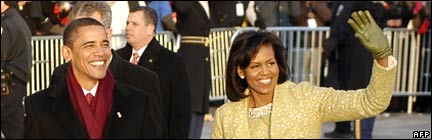 Before the inauguration speech, New Scientist asked whether he would use the "E-word".
In the event, he didn't - nor the C-word, although the W-word did crop up once in the speech, as a pledge to "roll back the spectre of a warming planet".
In a chill Washington DC, Barack Obama also vowed to "harness the sun and the winds and the soil to fuel our cars and run our factories".
Now that we are done with the ceremonials, what environmental moves can we expect as the new president's senior officials assemble their teams and grapple with the practicailties of turning campaign promises into political realities?
According to the often well-informed Yale Environment 360, we're going to see dramatic action on energy in little more than the time it takes to flick on a light, with Mr Obama launching his presidency "with a daring idea: to anchor the American economy with energy sources not derived from fossil fuels".
Fifty billion dollars will go into the "green economy", it suggests.
Campaign pledges also referred to creating five million jobs in that green economy - a vast hike from the 750,000 that exist today[pdf link], according to the US Conference of Mayors.
Another pledge mentioned setting up a greenhouse gas "cap-and-trade" scheme, a concept pioneered in the US to curb acid-rain-causing sulphur dioxide emissions.
He has spoken, too, of taking a leading role in the UN climate negotiations, which enter a critical phase later this year.
US-based observers are better placed than I to comment on what all this will mean for American citizens and how they're likely to react to the various components.
 But from an international perspective, it's clear that Mr Obama's actions over the next 11 months on energy and climate - both the domestic policies and the approach to international treaties - will be absolutely vital in deciding whether the UN climate negotiations in December in Copenhagen can achieve a deal delivering major carbon cuts.
If his administration flinches in the face of its economic woes, other governments will then have an easy reason for curbing their own ambitions.
There's another aspect to the financial issue, in that developing countries are likely to ask the industrialised world for sums in the ballpark of $50bn per year to fund protection against potential climate impacts.
That is the likely price-tag of a Copenhagen deal - and they'd be expecting the US to stump up a significant proportion of that cash.
It's a point that I'm not sure is properly appreciated in western capitals, but a taste of it is emerging right now from a climate conference in Ethiopia, with Prime Minister Meles Zenawi insisting that "those who contributed more to causing the problem, who are also better positioned to assist, will contribute more to the costs of adapting and implementing climate-friendly development paths".
When the warm inauguration glow fades, spending billions on railway lines and home insulation and solar panels, built by Americans for Americans, may still make political sense for hard-pressed Congressional representatives.
But spending billions to build sea walls in the Seychelles and put schools on stilts in Nicaragua? I wonder.
 Climate may be the most pressing environmental item for the new president, but there are others.
Chunks of the country are just about as low in water as they've been in living memory. Infrastructure investments, effiiciency measures and international deals to buy water are among the possible policy options.
Conservation groups have made the Endangered Species Act something of a political football in recent years, seeing protection for polar bears and corals as one of the few tools they had for putting pressure on the Bush administration on climate change.
But it remains a powerful piece of legislation that could be deployed as a way of tackling the decline in biodiversity that's affecting the US along with just about every other nation on Earth.
Internationally, Mr Obama might be considering whether to make the US a party to the UN's Convention on Biological Diversity (CBD), the global treaty charged with stopping the loss of species. Despite playing a leading role in drafting the convention back in the early 1990s, the US now shares "non-party" status with Andorra, Iraq and Somalia.
US ratification and renewed leadership on biodiversity would be applauded by conservationists and by many other governments - as would a decision to put the US inside the scope of other international treaties with an environmental dimension such as the UN Law of the Sea Convention.
The US has powerful domestic legislation enabling it to put trade sanctions on countries violating fisheries rules.
In the late days of Mr Bush's term there were hints that his officials were contemplating deploying these measures more vigorously, and it will be interesting to see whether Mr Obama's appointees follow through.
All that, one suspects, will be put below the climate change tasksheet in Mr Obama's in-tray.
I'd be interested to see what you make of it all, and what you would be urging his team to do, either on the C-issue or the much broader E-issue.
 I'm Richard Black, environment correspondent for the BBC News website. This is my take on what's happening to our shared environment as the human population grows and our use of nature's resources increases.


Comments
Sign in or register to comment.