

Sporting metaphors
Mid-morning, in a colosseum-like stadium that is sometimes known as the “Gabbatoir”, Cricket Australia ushered in a new era of the country’s national game.
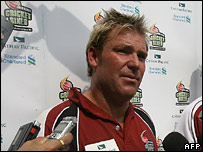
Absent from the team were three stalwarts, or “legends” as they are known in these parts: retirees Shane Warne, Glenn McGrath and Justin Langer. Trying to fill their giant-sized cricket boots were two novices, debutant fast bowler Mitchell Johnson and opening batsman Phil Jacques, and a spin bowler, Stuart McGill, who not only boasts the wicket-taking abilities of Shane Warne but the same corpulent girth.
Australia became the world’s sole cricketing super-power because of the bowling combination of McGrath and Warne, the game’s most successful ever partnership.
Now what?
Between them, Mssrs Warne, McGrath and Langer accumulated 374 test matches. Mssrs Johnson, Jacques and McGill can muster just 42.
No wonder it’s a sense of nervousness rather than excitement that greeted what turned out to be a rain-interrupted new dawn. Sure, Ricky Ponting is still there, so, too, Matthew Hayden and Adam Gilchrist. And marvellously, it was the reassuring voice of 77-year-old Richie Benaud who provided commentary on the first ball at the Gabba.
 Still, Australian cricket fans have been confronted with an unfamiliar concept: change.
Judging by their electoral behaviour, Australian voters are similarly fond of the status quo and are a notoriously change-averse bunch.
There have been 23 federal elections since the late-1940s. The government of the day was sacked in only four of them. In the past 23 years, there has only been one change in government, when Paul Keating was ousted by one John Winston Howard.
At the state and territory level, too, you have to go back five years – 2002 in South Australia - to find evidence of that genuine Australian rarity: a sacked government.
“Time for a change”: the world’s most tried and successfully tested political slogan does not have the same resonance in Australia.
Why so?
Clearly the powers of incumbency are immense. Prime ministers can set political agendas, look important at international summits and mount pre-election spending sprees. Helpfully, the Sydney Morning Herald publishes a daily “Porkometer”. Today it shows that the Liberal-led government is outbidding Labor on the spending promise front by $A54bn to $A51bn. Many of those pork barrel projects have clearly been targeted at marginal constituencies. A new road here, a new technical college there.
The tax-payer also provides sitting MPs with a hefty campaign war chest, paying for printing entitlements and mail-outs.
And what of compulsory voting (which, I know, should technically be called “compulsory attendance”)?
Forcing eligible voters to turn up at polling stations is commonly thought to help Labor, because it drives up turn-out among the working classes and immigrant groups. But is there an argument to be made that it helps incumbents by compelling people to vote who don’t really care either way, and therefore plump for the government of the day?
The nationwide polls suggest still that this will be a “change” election, and that the Howard government has reached the point of political perishability. And unquestionably, governments often struggle after 10 years in office. Just ask Margaret Thatcher, Tony Blair, Jacques Chirac or Jean Chretien.
As Australia’s most powerful “cricket tragic” knows all too well, Mssrs Warne, McGrath and Langer bowed out on the highest of highs, with a 5-0 Ashes win over England and a lavish musical farewell at the Sydney Cricket Ground. While the three champions shuffled embarrassedly on the balcony of the home team dressing room, an opera singer serenaded them from down below with the tear-inducing aria “Con te partiro” – “Time to Say Good-Bye”.
John Howard is plotting his own retirement, saying he’ll step down well into his sixth term as prime minister. But will he be given a chance to script and orchestrate his own wistful send-off?
 I'm
I'm 


Comments Post your comment
Australians are no more "change-averse" than anyone else. We change things when we feel dissatisfied. The country usually provides us all with a good life, and it's up to those who want change to put forward a convincing case for consideration. For most of the post-war era, the Oppositions - whether Liberal or Labor - have simply not done this.
Complain about this post