

Games or gridlock?
"The American people did not vote for gridlock," said President Barack Obama after meeting the new masters, the Republicans who will be in charge of the House after January.
He said that despite what he called a generally "hyper-partisan" atmosphere in Washington, the White House meeting with both parties from Congress had agreed to find sensible common ground, "and that will require choosing the best of our ideas over the worst of our politics".
Mr Obama said that in the next couple of days there would be an effort to square the circle over tax cuts.
Republicans want them all extended, including for those earning over $250,000. Democrats want them just for what they call the middle classes.
The president spoke, too, of the importance of the New Start treaty with Russia.
The president pronounced himself encouraged by the tone of the meeting and said there was an agreement not to rush to the microphones and paint the other side as "unyielding and uncooperative". That, he said, would be "trying to win the news cycle instead of solving problems... just another move in an old Washington game".
But you don't get this town to play a new game that easily. Democrats believe that their main priorities for the "lame duck" session poll well with the public. In addition to the tax cuts and Start, they have two other priorities: abolishing "don't ask, don't tell" so that gay people can serve openly in the military, and passing the Dream Act, which would allow illegal immigrants to become citizens if they served in the armed forces. Good news for gay illegal immigrants who want to serve their adopted country.
Democratic strategists believe that if the Republicans are vocal in opposing these measures, they will find themselves annoying the voters and defined as partisan before they take control of the House. In particular, the Dream Act is a trap. The Democratic strategists think opposition to it would kill Republican hopes with Hispanic voters. But above these details, they think that by not being bipartisan, being seen to oppose compromise and working together would damage the Republicans.
So, no-one is rushing to the microphones. Not yet. Leave it a few weeks. Hyper-partisanship is not dead, Washington games are not at an end.



 There's no on the record reaction to
  What do you do when you are asked to two parties at the same time? Ask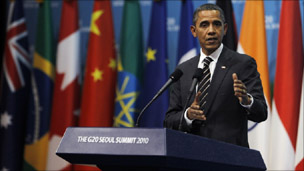
 "The problem is real, the solution is painful" is the stark heading to one part of a
  "I
"I 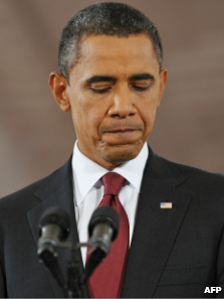 We've just witnessed what must be one of the most extraordinary presidential appearances ever. At times, it felt more like therapy than a news conference.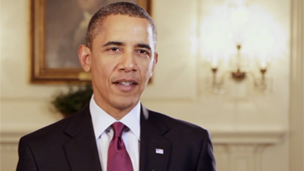
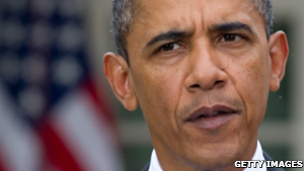 Just two years since widespread jubilation was seen at the election of President Barack Obama, the political direction of the US is once again in the balance. For a while, the winner-takes-all presidential election and the acceptance of the Democratic outcome disguised the deep divisions in the country. But America's version of the permanent revolution - the permanent election - makes sure those divisions may soon be to the fore again. Two very different visions of society are slugging it out.
 I’m Mark Mardell, the BBC's North America editor. These are my reflections on American politics, some thoughts on being a Brit living in the USA, and who knows what else? My


