

Keeping pace with Italian voters
- 9 Apr 08, 09:18 AM
GianBeppe Moreschi holds up a highly polished brown hide, disconcertingly still very alligator-shaped. 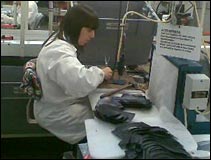
We are in his prestigious shoe factory just outside Milan and he’s telling me how it takes two such skins to make one special pair of shoes to order.
We walk down rows of women at machines, stamping out the bits that go to make up shoes, and others sewing them together.
There are over 300 separate operations by hand to make a pair of shoes at this factory.
They charge £3,000 for a customised pair of alligator pumps, and don’t make a lot of profit out of it. But I am not here to talk about slippery reptiles with sharp, little teeth, but Italian politicians and the elections this weekend.
A cheap shot, I know. Most Italians have even less respect for their politicians than voters in other countries. But is it possible that could be about to change?
Flat economy
Mr Moreschi tells me that the Italian economy is flat and difficult for business people like himself who stick to the rules.
He says Italian business needs fewer regulations but ones that people will obey.
While custom-made alligator shoes are the exception, the firm is at the top end of the market, producing hand-stitched quality shoes that sell all over the world: from prestigious British customers to new shops opening up all over their growing market, Russia.
With 450 employees and a turnover of 30m euros a year, his business is obviously thriving but his is one of the few companies left in an area that used to be thronging with shoe factories.
Many have fallen victim to cheap imports from China. What’s his secret?
“There’s no secret,” he tells me, “just following the quality established in my father’s day”.
His dad started the company at the end of the war and GianBeppe’s three sons are all in the business today.
He has a twinkily engaging smile and a passionate enthusiasm for the craftsmanship.
I soon find myself more interested in questioning him about the arcanery of footware production than Italian politics.
Blue Peter
I learn to recognise leather made from ostrich (it’s got goose-, or I suppose, ostrich-pimples) and discover that Peccary leather is the softest money can buy.
How do you make suede, I ask. “That’s a Blue Peter question,” a colleague observes. Well, I like to learn something new, and the answer is that leather is the outside of the animal, suede the inside.
But I drag myself back to my real purpose here. Mr Moreschi hopes these elections will make a break with the past.
At first sight this is surprising. It’s easy to see these elections as “the same old, the same old”.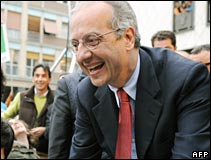
When I covered the last elections, and Silvio Berlusconi’s defeat, I thought it was the end of the pugnacious billionaire-turned politician. But he’s back and in the lead in the polls.
Walter Veltroni, the candidate of the centre left, is a new leader and a good communicator but on the face of it doesn’t offer radically new policies to the last government. So why the hope for change?
After Romani Prodi’s administration fell when the hard left pulled the rug, the centre left’s Walter Veltroni has said he won’t do a deal with them.
Mr Moreschi observes that, in business, 51% control is real control. Not in Italian politics.
“I’m an optimist and the most important thing is that our politicians follow the right path,” he says.
“The trouble is we have too many little, tiny parties and what we need is something like what you’ve got in England: one on the left, one on the right and, when the need arises, they need to be able to take decisions and work together.”
'Chairman of the Board'
Intriguingly, there is talk of the possibility of a German-style “Grand coalition”.
A former ambassador-turned political commentator for Milan’s Corriere della Sera, Sergio Romano, says this is a real possibility, at least to achieve some change to the political system.
“They all realise that Italy has a very bad political system and the time for reform is now,” he told me.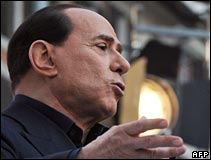
Now Berlusconi and Veltroni probably agree without saying so on the need for constitutional reform, to give the prime minister the powers of his colleagues in Europe.
“The Italian Prime Minister does not have the power of the British PM, the German chancellor or the Spanish PM, he is really just a chairman of the board and nothing more.
“If you have lots and lots of parties, then governing is a very difficult task because you have to negotiate every single measure and generally you reach the lower possible level of decisions”.
Is this wishful thinking or could Italian politics be about to change?
The BBC is not responsible for the content of external internet sites
Description
Archive
« April 2008 »
| Sun | Mon | Tue | Wed | Thu | Fri | Sat |
|---|---|---|---|---|---|---|
| 1 | 2 | 3 | 4 | 5 | ||
| 6 | 7 | 8 | 9 | 10 | 11 | 12 |
| 13 | 14 | 15 | 16 | 17 | 18 | 19 |
| 20 | 21 | 22 | 23 | 24 | 25 | 26 |
| 27 | 28 | 29 | 30 |
Being Discussed Now

Latest from BBC News blogs
Nick Robinson: |  |
Douglas Fraser: |  |
Brian Taylor: |  |
 |
Richard Black: |  |
Jonathan Amos: |  |
- News Editors
- Sport Editors
- Journalism Labs
- BBC Internet Blog
- Radio 4 Blog
- Peston's Picks
- Nick Robinson's Newslog
- Stephanomics
- Mark Easton's UK
- Mark Mardell's America
- Nick Bryant's Australia
- Andrew Harding on Africa
- Gavin Hewitt's Europe
- Soutik Biswas' India
- dot.Rory
- Science: Jonathan Amos
- Richard Black on environment
- Today: Tom Feilden
- Fergus Walsh's medical files
- Newsnight: Paul Mason
- Newsnight: Mark Urban
- Torin Douglas
- Will Gompertz's arts
- Phil Coomes on photojournalism
- Magazine Monitor
- Mark D'Arcy in Westminster
- NI: Mark Devenport
- Scotland: Brian Taylor
- Scotland: Douglas Fraser
- Wales: Betsan Powys
- Martin Rosenbaum on FOI
- 5 Live Breakfast
- Newsnight
- PM programme (iPM)
- World Tonight: Robin Lustig
