

Can President Sarkozy change?
The left took around 30 big towns and cities off Mr Sarkozy’s party and the vote is widely being seen as a rebuke to the president of ten months. 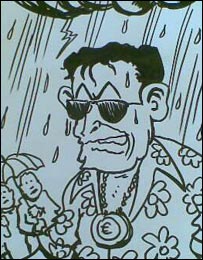
He’s letting it be known that the message has been heard and he’ll calm down a bit.
Today, at a solemn ceremony to mark the death of the last French soldier who fought in World War I, was an ideal opportunity to try out the new demeanour.
He can do it. During the election ten months ago, many were surprised that he kept a tight rein on himself, and there were no outbursts and no surprises. But after the election it was a different matter.
I talked to Sophie de Menthon, president of a small business organisation who recently wrote an open letter to the president in Le Monde newspaper, saying that she voted for him because of his dynamism, conviction and good sense but was now disappointed.
Although I was trying to getting her to talk about the perception that he hadn’t pressed ahead with economic reforms, she - like many French people - came back to the same worry.
“He promised a lot and I thought he seemed to understand the economy and he was going to get people back to work and deal with the 35 hour week. I thought, as soon as he was president, everything would change. 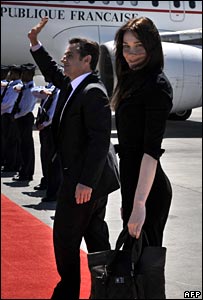
“But what was very important and disturbing was that, the first months, all we saw was his divorce, him meeting a top model and getting married. People want something else.”
The sense that there has been too little change, too much in the gossip columns, is very widespread.
Not that you can really accuse Mr Sarkozy of standing still. Indeed another of Sophie de Menthon’s complaints was that he seemed to dash from one problem to the next, suggesting he could solve everything.
Politicians complain about this too.
Ideas powerhouse
At home and abroad he is a powerhouse of new ideas. But many of them are not thought through, or even discussed in advance.
What frustrates both foreign diplomats and French civil servants and ministers is his ability to come up with an amazing new idea which they then have to interpret, explain or defend, whether it is the Mediterranean Union or Holocaust education for children.
This is about style and mood. I re-visit Riss, a cartoonist for Charlie Hebdo and co-author of a brilliant picture book on Sarkozy’s rise to power.
He dashes off cartoons so quickly it’s unbelievable, quickly sketching a cartoon of Sarkozy jumping with energy, his wrists covered with flash watches. 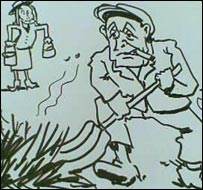
This time of a Sarkozy as a glum farmer shoving manure: hard working, diligent, and not having too much fun.
I ask him what the French want in a President, looking for a short answer for a TV piece. But instead of replying in words he just says "well, something like this..." and starts to sketch another picture.
What does he think of Sarkozy’s promise to change his style? He draws the President of Bling, in wrap-around shades despite the rain and lightning all around him.
“He will never change. Whether it rains or it storms he can’t change. It’s beyond him.”
I'm taking a break over Easter so this will be my last post for a while.

 I’m Mark Mardell, the BBC's North America editor. These are my reflections on American politics, some thoughts on being a Brit living in the USA, and who knows what else? My


