

A short break under the knife
- 18 Dec 07, 10:31 PM
The team of surgeons in a hospital in Bruges stare intently at a monitor, watching a tiny knife tear into flesh.
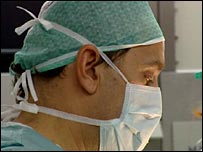
Bruno Dillemans is one of the world's experts in keyhole surgery and it's fascinating to watch him manipulate long-handled instruments that allow him to carry out this delicate operation.
Although the tools he holds look a bit like pruning scissors, the procedure seems more like playing a video game as fingers on left and right hands flick in a confident blur.
The intestine on the screen that we are all looking at belongs to Sara Jane Snocken, a 35 year-old primary teacher.
Search engine
She is having a gastric bypass to lose weight. She says she has tried all sorts of diets and exercise but nothing has worked.
She's paying around £5,000 for the operation and has come to Belgium for a number of reasons. "The waiting lists, incidents of MRSA here are a lot lower; this guy has a very low morbidity rate so I have a good chance of not popping my clogs while I'm under. Plus his name is the one that comes up the most on Google."
And here she is waiting to go down to surgery, just four weeks after entering the words "gastric bypass" into the search engine. She compares that to the plight of her friend.
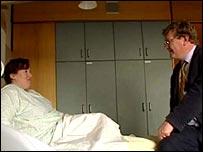
"She's been waiting five years and she's seriously obese. Even bigger than I am. Five years to get exactly the same operation because it's only done in very few places in the UK, and more people need it."
In the end, it was both waiting lists and her lack of satisfaction with the NHS that tipped the balance: "I decided to take it into my own hands and get it sorted out myself.
"For three years I went to the obesity clinic. Every time they said there's a two-year waiting list; it's not worth it; you could do it yourself in diet and exercise in the time. And, hello, it's still not worked, so here I am."
We both thought there was a couple hours before the operation, but a nurse comes in and tell Sara Jane to get ready. She's going down to theatre now, having handed over £5,000 in cash for the operation.
Cashback
But a planned new European law, which I mentioned last week, might give a future Sara Jane the right to claim the money back off the NHS.
I've seen the document and it goes rather further than I expected. It not only enshrines people's right to go abroad if there is "undue delay" but says people should have the right to seek any health care that would have been provided at home. 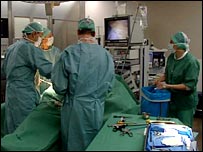
They would get back whatever it cost in their home country. If the operation or treatment is more expensive than that, people could top it up with their own money.
This would be pretty radical, and mean that Britain would have to adapt to a much more continental insurance-based system. But there is a potential opt-out.
If a Government can provide evidence that the impact of the law would undermine planning in their health service then they can partially opt out of the scheme.
They would be allowed to insist that patients get the green light from the health service before they travel.
British opt-out
It's widely thought that this clause has been stuck in to satisfy the British Government.
But it will mean patients have much less freedom in countries that invoke this clause. Sara Jane doesn't intend to try to get any money back off the NHS, but if the new law was in place she could try.
Under the main proposal, she would pay for the operation, prove that it is provided on the NHS, and then claim back whatever it would cost in Britain.
But if the Government invokes the get-out clause, she would have to get prior approval from her local NHS trust, which would first have to say that she needed the operation, and then agree a cost.
The BBC is not responsible for the content of external internet sites
Description
Archive
« December 2007 »
| Sun | Mon | Tue | Wed | Thu | Fri | Sat |
|---|---|---|---|---|---|---|
| 1 | ||||||
| 2 | 3 | 4 | 5 | 6 | 7 | 8 |
| 9 | 10 | 11 | 12 | 13 | 14 | 15 |
| 16 | 17 | 18 | 19 | 20 | 21 | 22 |
| 23 | 24 | 25 | 26 | 27 | 28 | 29 |
| 30 | 31 |
Being Discussed Now

Latest from BBC News blogs
Nick Robinson: |  |
Douglas Fraser: |  |
Brian Taylor: |  |
 |
Richard Black: |  |
Jonathan Amos: |  |
- News Editors
- Sport Editors
- Journalism Labs
- BBC Internet Blog
- Radio 4 Blog
- Peston's Picks
- Nick Robinson's Newslog
- Stephanomics
- Mark Easton's UK
- Mark Mardell's America
- Nick Bryant's Australia
- Andrew Harding on Africa
- Gavin Hewitt's Europe
- Soutik Biswas' India
- dot.Rory
- Science: Jonathan Amos
- Richard Black on environment
- Today: Tom Feilden
- Fergus Walsh's medical files
- Newsnight: Paul Mason
- Newsnight: Mark Urban
- Torin Douglas
- Will Gompertz's arts
- Phil Coomes on photojournalism
- Magazine Monitor
- Mark D'Arcy in Westminster
- NI: Mark Devenport
- Scotland: Brian Taylor
- Scotland: Douglas Fraser
- Wales: Betsan Powys
- Martin Rosenbaum on FOI
- 5 Live Breakfast
- Newsnight
- PM programme (iPM)
- World Tonight: Robin Lustig
