

Passionately pro-Europe?
Pity the poor Piris group, their partners and children.
These are the legal experts from each of the 27 EU countries who are being asked to do a most un-Brussels-ish thing and work through August. They will be fleshing out the new Reform Treaty so that it is ready for perusal by the European Union’s foreign ministers in early September.
Although I was still in Turkey at the time, as far as I can gather the unveiling of the intergovernmental conference earlier in the week was something of a damp squib.
Perhaps this was intentional. Although the Brits are the greatest worry, no-one in the European Union establishment has any interest in anyone trying to re-open arguments or question the smooth ratification of the treaty. Almost uniquely for a major document, it was made available only in French. The cunning blighters had failed to spot one thing: some of the Eurosceptics have been dashed clever and have actually gone and learnt the bally language.
Dishonesty claims
In Britain, those opposed to a new treaty are doing their level best to keep it in the news, bobbing way beneath the surface of all that flood water. They want to garner support for their argument that the government’s case for the treaty is unravelling, and that it is pretty much the same as the old constitution.
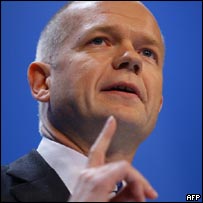 The shadow foreign secretary William Hague has repeated his call for a referendum saying the government are out on a limb when they claim this is not the same as the constitution. Labour MEP Richard Corbett attacks this as “intellectually dishonest”.
Open Europe say their research shows that 96 % of the treaty is the same as the constitution with only 10 items out of 250 dropped.
The former Europe Minister Denis MacShane accuses them of mis-translating the French to suggest there will be an EU foreign minister, rather than a high representative.
The Conservatives’ Europe spokesman Mark Francois keeps hammering away, arguing that it is “the constitution under another name”. A government white paper on the process sets out the nature of an “amending treaty”.
Global Vision says this is deeply dishonest as Britain’s relationship with the EU will be “profoundly altered”.
Much of this depends whether you accept the government’s argument, which it can’t state as baldly as it would like. It would go something like this: “We never thought it was a real constitution in the first place but once they called the wretched thing a ‘constitution’ it was hard to resist calls for a referendum. Now we’ve got rid of the word and all the mentions of flags and anthems and other constitutional stuff it doesn’t look like a constitution. So even if it is pretty much the same as the old document there’s no need for a referendum. Now, can we get on with something more interesting?”
Sexier subjects
Funnily enough, it’s the sentence I have just invented that I’m most interested in at the moment.
For I think all the signs are that Britain has its most passionately pro-European foreign secretary since Robin Cook, who intends to win, not duck the argument about Europe. Jack Straw and Margaret Beckett were in terms of New Labour’s boundaries, sceptics.
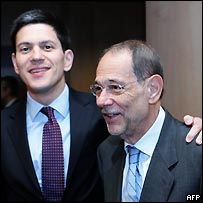 David Miliband’s first visit was not to Washington or Iraq, but Paris and Berlin. The white paper states quite clearly that the European Union is “crucial” to Britain and “at the heart” of its efforts in the world. Mr Miliband has made it one of his top priorities.
That’s a pretty bland, politico-speak sentence - but think about it.
In his first big foreign policy speech, Mr Miliband mocked the idea that the Foreign Office had 10 “strategic priorities.” So he has whittled them down to just three:
- • Tackling extremism and its causes
- • Climate change
- • Forging a “more effective European Union to help build prosperity and security within European borders and beyond"
Out goes fighting international crime, supporting the UK economy and managing migration - all on the surface sexier subjects than the EU. Which makes me think he really means it.
Neck out
In the same speech he states: “Britain acting alone does not possess the power or legitimacy to directly effect changes on the scale required” in the world. He repeats his call for the EU to become the “Environmental Union” and goes out of the way to argue for the EU to play a bigger role in foreign affairs, “giving better expression to the common commitments of nation states”.
Now, I have heard Jack Straw and Margaret Beckett say similar things in interviews or when put on the spot in the Commons. But Mr Miliband is sticking his neck out, emphasising that this analysis is central to his approach.
Indeed, in his statement on the Alexander Litvinenko case he suggests Russia should amend its constitution to accept the European arrest warrant if it wants freer access to EU markets.
I don’t want to overstate the significance of this, but many senior British politicians who support the EU don’t go out of the way to give it good reviews, and give positive examples of where they think it increases Britain’s clout in the world. They think it just puts another barrier between their argument and their audience.
I think, come the autumn, we are in for a more interesting battle than we thought. But however strongly Mr Miliband believes in his case, I doubt he wants to test it in a referendum.
 Thank you all for your comments. Yes,
 I know some colleagues do use "Islamist" and they regard it as accurate. For myself, I feel "Islamic" simply describes a religion, while "Islamist" means political Islam with a radical agenda, and is usually pejorative in the West. I would describe the AKP as having "Islamist roots", but otherwise wouldn't use the word in connection with them. It's clear others do think they are Islamist, but I think that is part of the argument, open to debate. I have sympathy with the "Muslim Democrat" point made by
  Secondly the army... I think I do have a better understanding of the view that the army is a balancing force. But it is valid to question whether it is compatable with democracy.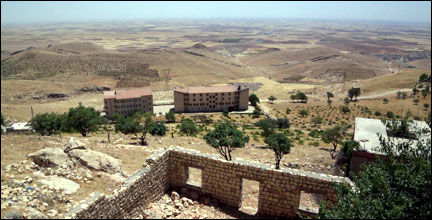
 In the cities, the colourful election bunting has already come down. In Ankara, they're sweeping up after the AKP's ecstatic street celebrations, following a victory that surprised even the ruling party's most loyal supporters.
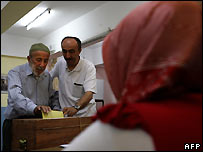 They have a huge moral mandate. This is not a hollow victory. Not a pyrrhic victory. But if the earth moved for them, there was no landslide as a result. As Napoleon or Stalin might have said: "How many legions does a moral mandate have?" This odd twist comes about because Turkish electoral law keeps out of parliament any party that does not get at least 10% of the national vote. Last time round, that meant there were just two parties in the parliament. Now there are four main groups and that means fewer MPs for the ruling party.
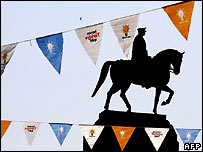 I always think the day after elections is like the day after a battle. The smoke drifts away, the forces are in new positions. But there is no time to relax. The new deployment raises new questions that weren't clear before. There are fresh dilemmas and questions raised for the tacticians and strategists from both winning and losing sides. Here are some of the key questions:
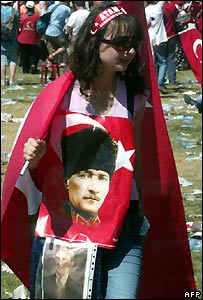 He says business is going well and that is why he is voting for the government party, the AKP, and not because they have Islamic roots. He says they’ve delivered low interest rates, kept fuel prices stable and helped with access to health care.
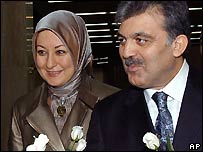
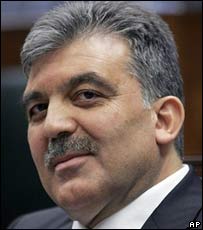 My BBC colleagues were filming the other day in Kayseri, in Turkey’s heartland. Every morning the great and good of this newly booming town get together for a healthy brisk walk up the hill before prayers. It’s a hard-working, clean-living place, evidently. There’s been an explosion of industry with a big new factory estate and a newly prosperous middle class to go with it. It’s the home town of Abdullah Gul, Turkey’s foreign minister, and in one sense the cause of these elections. Although he was the candidate of the ruling party to become president, the parliament didn’t endorse him, and the army put down its red lines because they see him as too Islamic (the symbol of that being that his wife wears a headscarf).
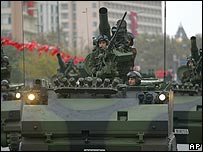 The big difference is that the Pentagon wouldn’t even dream of putting tanks on the White House lawn if George W held a prayer meeting. What my colleagues in Kayseri saw wasn’t such an intervention, more comic opera than civil strife, but perhaps telling. The vast factory complex has a works league, a series of fiercely contested football matches. In the match my colleagues were observing, in the last minute a penalty was awarded by the ref: it was a dubious call, to say the least. But the team that probably committed the foul in the first place went one up just before, as I believe they say, the final whistle. Players surrounded the ref and started arguing. About eight soldiers with rifles slung over their shoulders took to the pitch.
 An early morning drive across the Bosphorous to talk to a couple of retired senior military men, three-star generals. Many here believe it is the army that really calls the shots, without needing to fire any. Incidentally, when you say “retired military” in Turkey you are not talking about old buffers living out the last campaign from an armchair in the Turkish equivalent of a bungalow in Bournemouth, but vigorous men at the height of their powers, extremely intellectual and thoughtful, in the most senior positions in private enterprise after a distinguished career.
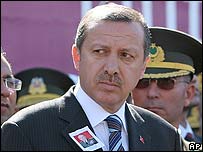 I put it to them that the
 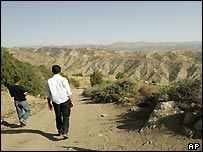 The men in the open-air tea room seem to be grouped strictly, by age and dress. At one table men in their forties, wearing white shirts and dark suit-trousers. They all have small neat moustaches. At another, older men, wizened and mostly bearded, wear looser-fitting clothes. We are invited to sit down and take a glass of tea with a group of men in their sixties. They wear crisp, careful, ironed white shirts, dark waistcoats and large elongated flat caps. They have big, bushy moustaches. I never get round to asking what they do, but they have an air of mild prosperity, small businessmen or shopkeepers.
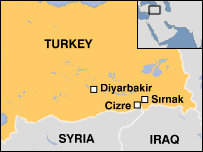 First I do ask about the troop build-up. One man says there has been a lot of activity, another says not more than normal. They seem to agree that there will be no invasion unless there is a big terrorist attack. If that happens, then probably something will be done. I sip the tea. The men tell me they call it "smugglers tea"… it's from Syria. All the sweeter, I say.
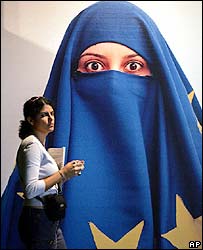
 Indeed secularism, the doctrine that religion has no place in politics, has become in itself almost untouchable, holy writ. That is why it filled some with such horror that their country might elect a president whose wife wears a headscarf.
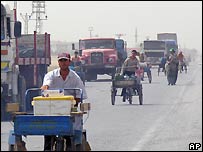
 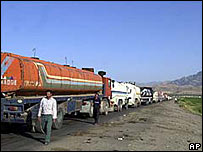 A long line of oil and petrol tankers snakes along the Silk Road, through parched fields, towards the mountains and the border crossing at Habur. The drivers are incredibly patient, sitting on little stools outside their vast vehicles in the burning heat and waiting for the boys to come along on rickety tricycles to sell them cold drinks or a glass from the trays of tea. "We are already starving," grumbles one man. "If they invade we will die."
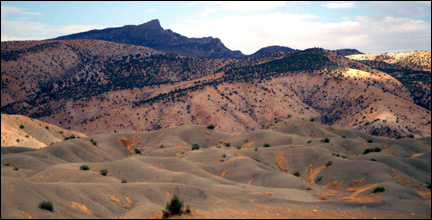
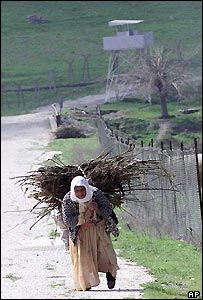
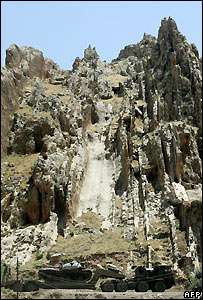 The scenery here is entrancing, dramatic and just plain weird. A vast panorama of fawn mountains gives way to a wide river delta. Black shale forms large hillocks like scrunched up velvet. The evening sun light fills the landscape with a golden glow. Geological formations like so many giant axe heads stick out sheer from the rock face. Every few miles there might be a sign of life. A low concrete building with a roof of dried branches, complete with leaves. A little girl pushing a wheel barrow across the road. A checkpoint. The young gendarmes are polite but look hard and don't smile. Reminders that this is a zone of conflict are everywhere.
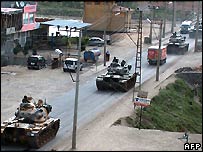 One local who knows the area well thinks perhaps there are now 60,000 men massed here. But guessing at numbers is fairly pointless. What is certainly the case is that this has been ramped up as an election issue. A stick to beat the ruling AK party with, as too scared to stand up for Turkish interests, too craven to defy the Americans, unwilling to pursue and destroy the terrorists.
 The other constant, that goes with applause, is that people are desperate to get up and be off, jostling each other to get their bags and stand up even though there will be a 20-minute wait before the doors open. True to form, women in colourful traditional dress jumped up and hauled their luggage out of the overhead lockers.
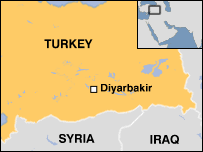
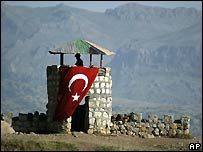
 The Silk Road running past the Turkish-Syrian border is not named for its smoothness. For mile after mile we drive through the tawny brown hills, on one side of the road runs a tall barbed wire fence and watch towers. Beyond that, charred blackened land, peppered with mines I'm told.
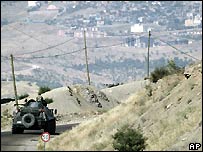 The landscape is not unlike some parts of Spain, arid and undulating, but it is still weird to think that this one day maybe the boundary of the European Union, literally bordering Iraq and Syria.
 There's still something thrilling about exotic names like Gaziantep, Erzurum, Trebizond (Son Gagri seems very popular... oh, no, that means "final call") coming up on the destination board. Well, more thrilling than hearing that emergency engineering meant all
  But Turkish nationalists and the military believe that secularism is under attack. The reason for the army's anger and anguish is that
 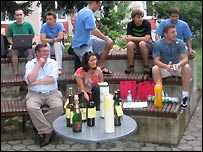 Your intrepid reporter can exclusively reveal that Romanian wine, followed by Moldovan brandy, Slovenian blueberry schnapps, French Calvados and Scottish single malt certainly makes an evening slip by in a painless fashion. But is the attempt to mix 27 countries together enough to give even federalists a thumping headache?
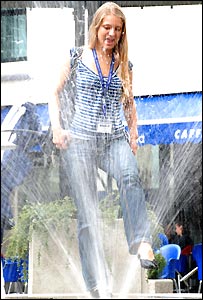 The boys seemed especially keen on capturing pictures of the blonde Latvian delegate, Anete Skrastina, for posterity. She tells me what sights have captured Europe for her: "Daddy carrying his kid on his shoulders. The thoughtful face of an old lady." It's a bit wishy-washy for me. Surely people smile in America and Asia too? Eugen Soineanu from Romania answers: "It's about what links people. You can see love in a Romanian's eyes and a Belgian's eyes… Yes, you can see it in an American's eyes, but Europeans are more docile and calm and romantic. Think about High Romanticism: we were the ones who invited romanticism and now we are picking the fruits of it 200 years later."
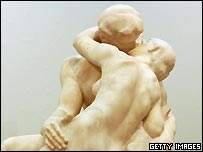 Before the uncorking of the local liquid delicacies, each student gives a brief presentation about their country. Nearly all of them claim to be at the heart of Europe and to have the most beautiful women. The French are introduced by their Slovenian host as liking stinky cheese. The two women play the game, branding themselves as arrogant eaters of frogs' legs. A beret perched jauntily atop her pigtails, Violaine Faubert proclaims they invented the French kiss. But they also invented the more controversial embrace of European federalism. What does Violaine make of the dreams of French statesmen like Monnet and Schuman?
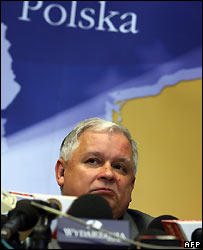 As
As 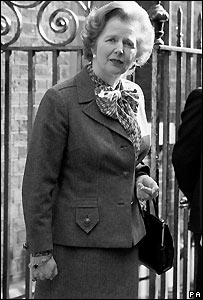 I am tempted to write that they have done a Thatcher, waving their handbags. But perhaps that would be unwise as the twins' ultra-conservative government
 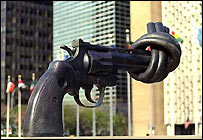 Often the European Union's role in burying the divisions of the past is talked about in rather wishy-washy terms. But it was built on a number of practical measures. The
 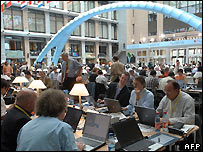 I don't really understand the suggestion by the MST that only the British government's view is reflected. For a start "The British Government" isn't a single voice. Or it wasn't at the summit. My colleague James Landale got quite a different account of Gordon Brown's interest in the proceedings than we were getting from Downing Street. Then there is the opposition and pressure groups and business organisations, all of which have their own contacts, who may know what is going on. There are 26 other countries, all of which have
  That is not the end of it.
 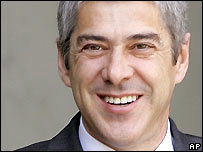 One tiny example of why some support this. It takes me about three hours to get my accreditation online. And I spend time doing this every six months. It's not the fault of the Portuguese, and probably has a lot to do with the BBC's own computer security. No-one's heart will bleed for me and other journalists having annoying few hours. But it does raise the question why we have to go through this bother every six months. Presumably all the thousands of diplomats, civil servants and politicians who come to the EU meetings have to do something similar. And that's just about badges. Each country that takes over may see it as an opportunity, but it also ties up civil servants in everything from designing websites and
  I’m Mark Mardell, the BBC's North America editor. These are my reflections on American politics, some thoughts on being a Brit living in the USA, and who knows what else? My


