

A major concession?
- 14 Jun 07, 04:36 PM
Just seen a copy of a report by the Germans to national governments about the new treaty. Got to rush because I’m trying to do something for both Radios Four and Five. On first sight it's not great news for the British Government.
It says that Britain, France and the Dutch can have a smaller, amending treaty, not called a constitution - but other countries have made it clear this is “a major concession” and “they insist on the need to preserve the substance of the innovations agreed” in the run up to the constitution.
They want next week's summit to give a “precise and comprehensive” mandate to a conference in the autumn. And they say among the sticking points are still...
- • The question of the primacy of EU law... a big one this.
- • Terminology... not sure what this means (I mean, I do, but not in this context).
- • The charter of fundamental rights... they note that some (like Britain) want this out of the treaty and others oppose this. So they suggest as long as it is made clear that it is legally binding that will be ok.
- • Details of foreign policy... including whether there is a foreign minister...
- • "Delineation of competencies" between EU and member states.
- • The role of national parliaments.
This, of course, is not the end of the negotiations. Sorry for the breathless tone... must rush.
UPDATE: Here are some key excerpts from the German document:
- "All Member States recognise that further uncertainty about the treaty reform process would jeopardise the Union's ability to deliver. Settling this issue quickly is therefore a priority... there is a very strong demand for the Union to increase its efficiency, to enhance its democratic functioning and to improve the coherence of its external action."
- "A certain number of Member States underlined the importance of avoiding the impression which might be given by the symbolism and the title 'Constitution' that the nature of the Union is undergoing radical change. For them this also implies a return to the traditional method of treaty change through an amending treaty, as well a number of changes of terminology, not least the dropping of the title 'Constitution'.
- "Such an approach is not incompatible with the demand from those Member States which have already ratified, that as much of the substance of the Constitutional Treaty as possible should be preserved. They are ready to consider the alternative method of treaty change... They have made it very clear however that this would represent a major concession. They insist on the need to preserve the substance of the innovations agreed upon in the 2004 IGC."
- "Some delegations have requested that the text of the Charter of Fundamental Rights be removed from the Treaty. Others strongly oppose this move. Most of the latter could however accept it, provided that the legally binding character of the Charter is preserved by means of a cross-reference in the body of the Treaty."
Europe in khaki
- 14 Jun 07, 12:00 AM
Regular readers of my Europe Diary will still find a considered diary-style piece here every Thursday. This blog allows me to continue as before, while adding other posts from time to time.
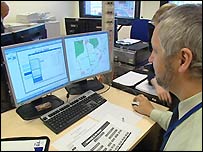
The European Union’s foreign minister is in earnest discussion with senior, uniformed military men in the rather rudimentary military ops centre in Brussels. He’s already given the order that European troops should go into action. On pale pine desks, soldiers and civilians operate computers, the screens filling with maps of a foreign country, detailing borders, the weather and even the current condition of roads. Men with lots of pips on their shoulders ponder the best airstrip on which to land the European Union’s army. Fantasy? Yes, but only just.
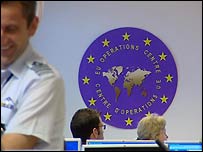 First off, I am watching an exercise, not a real operation. Secondly, Javier Solana is currently the EU’s High Representative: it was the constitution that would have given him the title Foreign Minister and that proposal probably won’t survive a new treaty. Thirdly, the EU doesn’t have an army, any more than Nato has an army. Like Nato, it does have military personnel from member countries who work together on a regular basis, and if this operation was real it would probably be the Nordic Battle Group getting their boots dirty.
I am at the launch of the European Union Military Staff’s ops centre in Brussels. Men and women in subtly different shades of khaki are clustered around computer screens, pointing and having quiet debates. I spot officers from Britain, Cyprus, France, Sweden and Ireland but there will be many others represented in the 40-strong team.
They’re planning a peacekeeping operation. In the fictional African country of Alisia, attacks by the rebel National Freedom Movement are growing worse and causing huge refugee problems. The distribution of aid has become difficult. The officers here are co-ordinating, via encrypted satellite, with national headquarters in Sweden. There are no infantry taking part in this initial operation, but the centre is designed to put 2,000 of them in the field. This practice and any real operation would be carried out under Mr Solana’s authority, acting under instructions from the 27 nation states that make up the EU.
'Jackboots marching'
But why does the European Union need this Brussels-based operation? Other EU military missions have been directed from the three existing HQs in Britain, France and Germany. New HQs in Italy and Greece are expected to be up and running soon, so why the need for a sixth? Lt Gen David Leakey, a former chief of staff in Northern Ireland, is the director-general of the European Union Military Staff and he’s remarkably frank. He tells me, “There are political considerations. France, the UK or Germany may not want to act. A certain political liability goes along with providing the headquarters, an implicit liability. We can’t be sure the operational HQ of a member state will be available, so this gives us extra flexibility.”
A man who lists chainsawing among his hobbies, he has cut to the point. A military operation would never be given the go-ahead if France, Britain and Germany were against it, but it’s quite likely none of them would want to take the lead role. This is a way of getting round that, and sharing political responsibility.
In the lift on the way up to the ops room an American journalist fulminates, “They won’t say what it’s really about, draining sovereignty away from countries like Britain!” A Spanish journalist retorts, “Just like Nato?” His answer to her seems to be that the EU has money to carry out its own operations. It is a running sore with some people: why does the EU need its own military, when the bulk of its members are also part of Nato. The suspicion of many is that it plans a “Euro army”, independent of the USA.
 Veteran Eurosceptic Lord Pearson, in a recent debate in the House of Lords, said the EU’s desire to have its own force headquarters was “inspired by France’s deep psychotic need to bite the hand that freed her in two world wars,” and could damage Britain’s relationship with Washington. In the same speech about the European Union, albeit talking about the scope of European law, he said: “You have to be pretty deaf not to hear the jackboots marching, and pretty naive not to realise they are coming this way.”
Gen Leakey’s answer to the question “Why not Nato?” is a pragmatic and interesting one. “In the sort of area we are dealing with, military force is never the answer. The solutions are civil and political, economic. The peacekeeping approach is increasingly ‘Civ/Mil’- for instance co-operating with civil police. The European Union has all of this in-house. We also work very closely in conjunction with the Commission, which has huge sums of money to spend on development aid and stabilisation, and so we can co-operate with that side more easily. The advantage is, it’s comprehensive.”
'Division of labour'
In the ops room I see an example of the rather cold-sounding “Civ/Mil” in action. Jan Moerkerke is a civilian expert in property law, who normally works for the Belgian treasury. He’s studying border maps on his screen, planning what happens when the immediate crisis in Alisia is over. The refugees who’ve fled into neighbouring Arcadia will want to return one day. They weep no real tears for their lost homes, carry no real pathetic suitcases, clutch no real children. They exist only in the minds of EU planners. But the loss of house and home is one very real consequence of war, one that stores up hatred and bitterness, ready to trigger more bloodshed in a few years’ time.
Deciding who should own what land is one of the hardest things to sort out. Jan is in charge of this judgement of Solomon. “You have to face it after a ceasefire. Documents are stolen and burnt, that’s what happens in a war. People want to come back, but how do we arrange that?” He enjoys this secondment, dealing with big-world problems. “I guess Belgium became a bit small,” he says.
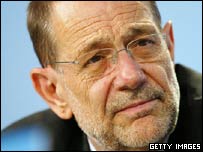 Back at the news conference, people feel the question “Does it undermine Nato?” hasn’t been answered. Mr Solana jumps in: “I will take that question. There is no question of competition but a division of labour, which is necessary with the number of crises we have. The needs are many and the resources are limited.”
I was filming this event for use in a piece about the new European treaty, the idea being that an EU constitution, like an EU military force, is a step (whatever sort of step, in whatever sort of boot) too far for many British people. So far I have heard nothing about what might be included in the new treaty about defence. The EU’s own briefing on the constitution says “defence provisions... have been substantially strengthened”. In particular, there is a mutual defence clause.
Whatever is in the treaty, I am pretty certain that this sort of defence co-operation will continue. What do you think? I’m particularly interested in hearing from past or present military people: Is serving under an EU mandate any different to serving under a Nato or UN one? And any Irish: how does it sit with your traditional neutrality?
The BBC is not responsible for the content of external internet sites
Description
Archive
June 2007 »
| Sun | Mon | Tue | Wed | Thu | Fri | Sat |
|---|---|---|---|---|---|---|
| 1 | 2 | |||||
| 3 | 4 | 5 | 6 | 7 | 8 | 9 |
| 10 | 11 | 12 | 13 | 14 | 15 | 16 |
| 17 | 18 | 19 | 20 | 21 | 22 | 23 |
| 24 | 25 | 26 | 27 | 28 | 29 | 30 |
Being Discussed Now

Latest from BBC News blogs
Nick Robinson: |  |
Douglas Fraser: |  |
Brian Taylor: |  |
 |
Richard Black: |  |
Jonathan Amos: |  |
- News Editors
- Sport Editors
- Journalism Labs
- BBC Internet Blog
- Radio 4 Blog
- Peston's Picks
- Nick Robinson's Newslog
- Stephanomics
- Mark Easton's UK
- Mark Mardell's America
- Nick Bryant's Australia
- Andrew Harding on Africa
- Gavin Hewitt's Europe
- Soutik Biswas' India
- dot.Rory
- Science: Jonathan Amos
- Richard Black on environment
- Today: Tom Feilden
- Fergus Walsh's medical files
- Newsnight: Paul Mason
- Newsnight: Mark Urban
- Torin Douglas
- Will Gompertz's arts
- Phil Coomes on photojournalism
- Magazine Monitor
- Mark D'Arcy in Westminster
- NI: Mark Devenport
- Scotland: Brian Taylor
- Scotland: Douglas Fraser
- Wales: Betsan Powys
- Martin Rosenbaum on FOI
- 5 Live Breakfast
- Newsnight
- PM programme (iPM)
- World Tonight: Robin Lustig
