

The clock counts down
- 4 Nov 08, 07:58 PM GMT
Chicago, Illinois:The Obama team let their emotions show at the last campaign stop in Virginia last night. When Barack Obama came on stage he seemed taken aback by the size of the crowd.
"Goodness gracious," he said. "wow." As he moved towards the Virginia governor and
the would-be senator who had introduced him, he wanted to dance up the final two steps but the energy deserted him.
The candidate himself could not quite believe that 100,000 people were standing in the Virginia night past eleven o'clock.
Before his speech finished I spoke to Robert Gibbs, his Director of Communications and one of the three aides closest to Obama..The mood was high. They think they have done enough.
"It was up to the people now," he told me. "There were days," he said, "when the mountains seemed too steep." But he was confident although "full of anxieties".
The anxieties were that people would not turn out in the numbers necessary; that some of John McCain's attacks had left their mark. And then there is the nagging concern about race, that on voting day some people might resist voting for a black president.
These are all unknowns and they make the front-runner's team nervous. David Axelrod, the campaign's chief strategist, would only say he was "cautious".
We sensed the lightness of mood when Barack Obama voted today. Afterwards at the airport on his way to Indiana he said he noticed that his wife Michelle had spent some time in the voting booth as if making up her mind who to chose.
Having spent some time visiting his campaign workers in Indiana Barack Obama is going to throw some hoops, play some basketball. It's an election night tradition with him. After that he will have dinner with his family then he's going to travel to the Hyatt hotel in Chicago to watch the results come in with his closest aides.
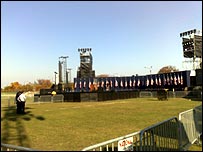
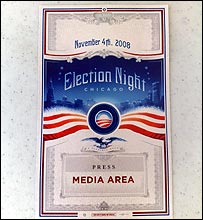
Only after the polls close will he travel to Grant Park to make a statement.
Chicago is bathed in sunshine. The temperature is in the seventies. The city is one the edge of excitement. Some businesses are closing early. 70,000 tickets have been issued for the main event but thousands, perhaps hundreds of thousands, will drift to the lakeside park to be there at what they hope will be a moment of history.
Barack Obama will speak between two large bullet-proof screens. It will either be a concession that would be unbearable to his supporters or it will be an acceptance that his message of change has persuaded the voters.
In that event America will be a changed country, offering a very different face to the world.
What victory would mean
- 4 Nov 08, 04:17 AM GMT
Jacksonville, Florida, and Manassas, Virginia: In Jacksonville, Florida, today the crowd had not come to listen to a speech. They had come to cheer, to celebrate. This was more like a homecoming, a ticker-tape moment.
So when Barack Obama started to speak, he was interrupted frequently. They chanted his name.
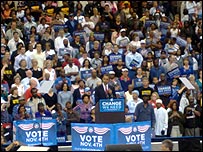
At the edge of the crowd, I started talking to African-Americans. They all believe that Obama will be the next president. There are few doubters in the crowds. There was a 72-year-old who remembered when dogs were turned on black voters. "This is such a big step," he said. "As big as when Jackie Robinson, the black baseball player, made it through."
Another man said it "would change the face of America". For him, it would be the moment when the American dream had meaning. He said it would mean that any person, whatever their colour or belief, could make it to the top.
I asked several people how they would react at the moment they knew that the next president of the United States was a black man. One woman said to me with a smile: "Cry. I will cry. Cry for joy and cry for all that has passed."
The 72-year-old said he would cry too. Tomorrow night, if victory goes to Obama, there will be a lot of tears and a lot of memories, some painful.
I came away from these conversations struck again as to how momentous this night could be. I met people who remember benches with the words "whites only" on them. Others talked about sit-ins at lunch counters. Others talked about the "Freedom Rides". All of this is within living memory.
There will be millions of African-Americans tomorrow who will recall the long struggle that has brought them to this point.
I was in Chicago about 10 years ago. I made a programme called "American Apartheid". It coincided with the Million Man March, when hundreds of thousands of African-Americans marched in Washington.
I remember the hopelessness of the Robert Taylor Homes on Chicago's South Side. I recall hearing the preacher Louis Farrakhan talk of "white devils", and the crowd was with him.
How times have changed and how Barack Obama has changed the times. The gangs had no role models and saw no means of escaping their neighbourhood. Obama, from the outset, did not want to define himself as a black candidate. Part of his appeal was that he said there was no black or white or Hispanic, only Americans.
The past two times that I have heard Michelle Obama, she has told a story. She talks of meeting an 80-year-old on the rope line who says to her: "I never thought I would live to see the day." On neither occasion does she finish the thought. She does not have to. Everyone listening knows that the man was saying that he never thought he'd live to see a black man living at 1600 Pennsylvania Avenue.
So, a victory for Obama on Tuesday evening would lead to huge celebrations - but to reflection, too, on the struggle that brought Americans to the point that they would vote for an African-American.
The BBC is not responsible for the content of external internet sites
I'm Razia Iqbal, the BBC's arts correspondent. This blog is my take on the UK's arts and culture scene.
Archive
« November 2008
| Sun | Mon | Tue | Wed | Thu | Fri | Sat |
|---|---|---|---|---|---|---|
| 1 | ||||||
| 2 | 3 | 4 | 5 | 6 | 7 | 8 |
| 9 | 10 | 11 | 12 | 13 | 14 | 15 |
| 16 | 17 | 18 | 19 | 20 | 21 | 22 |
| 23 | 24 | 25 | 26 | 27 | 28 | 29 |
| 30 |
October 2008 »
| Sun | Mon | Tue | Wed | Thu | Fri | Sat |
|---|---|---|---|---|---|---|
| 1 | 2 | 3 | 4 | |||
| 5 | 6 | 7 | 8 | 9 | 10 | 11 |
| 12 | 13 | 14 | 15 | 16 | 17 | 18 |
| 19 | 20 | 21 | 22 | 23 | 24 | 25 |
| 26 | 27 | 28 | 29 | 30 | 31 |
Being Discussed Now

Latest from BBC News blogs
Nick Robinson: |  |
Douglas Fraser: |  |
Brian Taylor: |  |
 |
Richard Black: |  |
Jonathan Amos: |  |
- News Editors
- Sport Editors
- Journalism Labs
- BBC Internet Blog
- Radio 4 Blog
- Peston's Picks
- Nick Robinson's Newslog
- Stephanomics
- Mark Easton's UK
- Mark Mardell's America
- Nick Bryant's Australia
- Andrew Harding on Africa
- Gavin Hewitt's Europe
- Soutik Biswas' India
- dot.Rory
- Science: Jonathan Amos
- Richard Black on environment
- Today: Tom Feilden
- Fergus Walsh's medical files
- Newsnight: Paul Mason
- Newsnight: Mark Urban
- Torin Douglas
- Will Gompertz's arts
- Phil Coomes on photojournalism
- Magazine Monitor
- Mark D'Arcy in Westminster
- NI: Mark Devenport
- Scotland: Brian Taylor
- Scotland: Douglas Fraser
- Wales: Betsan Powys
- Martin Rosenbaum on FOI
- 5 Live Breakfast
- Newsnight
- PM programme (iPM)
- World Tonight: Robin Lustig
