


Lack of defence
- 20 Sep 07, 04:26 PM
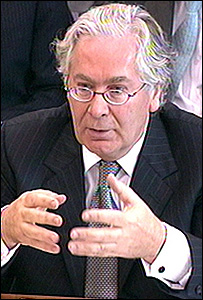 I don't think one can overestimate the importance of what Mervyn King told MPs this morning.
In effect, he told them that Britain currently has no proper defence mechanisms against bank failure. We built up the Maginot Line to protect us, only to find that when the Germans wanted to invade, they could wander in through Belgium.
At its first big test, the current system has quite spectacularly failed to prevent a bank run - indeed, worse than that, our defence mechanism caused one.
Why did our system fail?
We used to have old informal arrangements that did work. The Bank of England could orchestrate an immediate, secret takeover of a failing bank to be announced as a fait accompli before the depositors could let panic get out of hand. Or, the Bank could use its famous lender of last resort facility to help a struggling bank, without depositors knowing there was a problem.
That old system worked rather well.
But now we have laws against that kind of thing. The shareholders need to be told what's going on. The banks need to disclose material facts. So with everything in the open, when the lender of last resort facility is used, it (rationally) engenders panic among the depositors.
We could do everything in the open - and avoid panic - by ensuring that enough depositors have a secure enough guarantee of immediate access to all their money if the bank fails, that they don't need to queue to get their money out.
But our compensation scheme is slow and inadequate as well. Inferior to those elsewhere, the Governor told us this morning.
This is all pretty shocking.
And it's hard to see how this could have been avoided by early action, because at any stage you act openly, without full protection of depositors, you run the risk of creating panic.
Is Mervyn King just making excuses for his early inaction and failures to swamp the money markets with cash? Possibly. But injecting the whole market with the volumes of cash that would have been needed to protect Northern Rock, would have made life rather too easy for some other banks.
So where do we go from here?
Ironically, the one aspect of the system that MPs thought might be to blame - the splitting of authority between the triumvirate of the Treasury, the Bank and the FSA - is not the bit that didn't work, according to Mervyn King.
Others may not agree with him. But that is probably the least immediate area for reform.
The two (related) issues that need addressing are the deposit guarantee arrangements; and the insolvency arrangements for banks. We need to find a better system for guaranteeing retail deposits in respectable institutions; and the insolvency arrangements have to favour the depositors.
At the moment, the boom in securitisation (by which banks like Northern Rock sell their mortgages or borrow money secured against them) implies that the depositors are at the bottom of the queue for assets in the event of insolvency. The capital market investors have a prior claim to the mortgages which are the security for the loans they have made.
That is all fine, but not if it involves the depositors being unprotected, or protected at the expense of the taxpayer.
It's no wonder that Mervyn King believes we urgently need some thinking and some action - preferably in that order.
Rock climbing
- 20 Sep 07, 09:49 AM
A group of experienced climbers decide to enjoy a party on the top of a mountain. It seems quite sunny, so they pack a few drinks and as they reach the top, they crack open some bottles and blithely dismiss the warnings of impending storms that come from the mountain rescue people patrolling the area.
The climbers are very drunk when the storms eventually hit, but pretty soon they sober up as they realise they can't get down the mountain. So they call for the rescue helicopter to come and and get them and their picnic boxes.
Instead of sending a helicopter straight away, the mountain rescue team tells them to dump their picnic stuff and to try to make their way down the mountain alone. The rescue chief thinks they can still get down safely, and anyway he thinks it's only right to let them learn their lesson.
But he's wrong. They get into a bit of trouble, one is injured (although no-one dies). Once he sees there is trouble, the chief does relent and sends the helicopter for them.
This is not a very unfair characterisation of the situation between the Bank and the banks.
And who at the end of this tale should get punished? The experienced climbers? Or the boss of mountain rescue team?
At the moment, there is a keen desire for someone to blame, and the spotlight is falling on Mervyn King.
The case against him is pretty clear. He could have taken actions that would have avoided the Northern Rock debacle. He could have pumped cash into the banking system that would have obviated the need for Northern Rock to humiliate itself and come and get some on its own, creating a bank run. But he didn't.
Mr King would have had to pump quite a bit into the system, because to give enough to Northern Rock would have required giving a lot to many banks who didn't need it so badly. And if he had just injected a little cash, it wouldn't have found its way to Northern Rock.
But in the tripartite division of responsibilities, Mervyn King was the only one with the rescue helicopter, and he chose to use it later than many others wanted.
And as if to prove he was wrong, he made the U-turn yesterday, and did what everyone else had wanted all along.
The case in the defence of Mervyn King is pretty strong too, however.
It's quite simple. Rescuing the banks by validating their reckless behaviour has a cost. It encourages them to be reckless in future and it strengthens the relative competitive position of mis-managed banks over well-managed ones.
In addition, the Bank maintains that any solvent bank can get cash, just as long as they are willing to pay for it at a penalty interest rate. If they don't want cash, it's because they are too concerned with preserving their profits to borrow it.
In addition, Mr King has always recognised that there is a trade-off between letting the banks suffer from their actions, and helping the economy. He has always been clear, you can change your mind about where we are on that trade-off without performing a U-turn. He changed his mind this week.
For many, the subtleties of the argument are irrelevant. There has been a problem, someone should resign. It would be undoubtedly convenient in the city and in Westminster if it was Mervyn King.
But whatever the case on both sides, and whether or not Mr King keeps his job (I suspect he will, incidentally, but may not get his term in office renewed) the real questions after this affair are not so much about the handling of it in the past three weeks, but about the handling of it in the past three years.
The BBC is not responsible for the content of external internet sites
I'm Evan Davis, the former BBC economics editor.
I've now moved on to a new job, presenting Radio 4's Today programme. Evanomics will continue to exist in some form, as yet undecided.
Evan's categories
- (Latest entries, and comments)
- Notes on Real Life
| Are we stupid? (63) Central banks get together (32) Flat market (55) |
Small Change
 | Taboo of nationalisation (11) Chancing it (10) Shrinking economy (3) |
Vital Statistics
 | Setting prices (17) Unsustainable deficit (68) The first quarter... (20) |
Stars and strife
 | Dollar thrill (13) Prompts v causes (9) Dow vs ABX (11) |
Evan's Reading List
 | Irrationality (72) |
Archive
« January 2008
| Sun | Mon | Tue | Wed | Thu | Fri | Sat |
|---|---|---|---|---|---|---|
| 1 | 2 | 3 | 4 | 5 | ||
| 6 | 7 | 8 | 9 | 10 | 11 | 12 |
| 13 | 14 | 15 | 16 | 17 | 18 | 19 |
| 20 | 21 | 22 | 23 | 24 | 25 | 26 |
| 27 | 28 | 29 | 30 | 31 |
Evan's TV/Radio reports
- Banks' share trading probed
Broadcast: 19 Mar 2008 - Evan Davis on the economy
Broadcast: 18 Mar 2008 - Banks unite on credit crisis
Broadcast: 11 Mar 2008 - Housing slump hits flat prices
Broadcast: 29 Feb 2008 - Bank predicts soaring inflation
Broadcast: 13 Feb 2008
- The above links are to some of Evan's recent TV & Radio reports.
You will need Windows Media or Real Player to watch/listen (help).
Feeds

- News Editors
- Sport Editors
- Journalism Labs
- BBC Internet Blog
- Radio 4 Blog
- Peston's Picks
- Nick Robinson's Newslog
- Stephanomics
- Mark Easton's UK
- Mark Mardell's America
- Nick Bryant's Australia
- Andrew Harding on Africa
- Gavin Hewitt's Europe
- Soutik Biswas' India
- dot.Rory
- Science: Jonathan Amos
- Richard Black on environment
- Today: Tom Feilden
- Fergus Walsh's medical files
- Newsnight: Paul Mason
- Newsnight: Mark Urban
- Torin Douglas
- Will Gompertz's arts
- Phil Coomes on photojournalism
- Magazine Monitor
- Mark D'Arcy in Westminster
- NI: Mark Devenport
- Scotland: Brian Taylor
- Scotland: Douglas Fraser
- Wales: Betsan Powys
- Martin Rosenbaum on FOI
- 5 Live Breakfast
- Newsnight
- PM programme (iPM)
- World Tonight: Robin Lustig
