


Cost of the floods
- 25 Jul 07, 09:47 AM
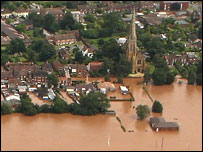 Flood repair is expected to cost billions of pounds. One estimate today suggests that insurers stand to pay out £3bn from this summer's weather. And there are likely to be repercussions for food prices. The Grocer magazine estimates that forty per cent of the British pea harvest has been lost for example.
But it's easy to exaggerate the costs of these events in the heat of the coverage.
So here are three points I would make about the economic damage of these floods.
First, they will cost us billions of pounds, and we should not trust precise estimates of these things. News from Hull that the number of homes affected by the floods there last month was 6,500, rather than the 16,000 reported at the time shows how easy it is for us all to overstate these things.
Taking into account the insured and uninsured damage, plus some cost deriving from loss of output, and some extra taxpayer support for flood relief and reconstruction, drives me to conclude the cost of the floods is several billion - with the total cost likely to be closer to five than say, one billion or ten billion. I wouldn't go more precise than that!
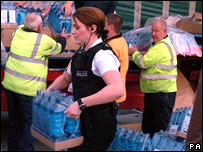 Secondly, if it was five billion, it would still represent under half a per cent of our national income, which is quite small.
We often find that big news events do not turn out to be big economic events. It's easy, gazing at TV news pictures, to put too much weight on what you are seeing. Most of the country is not flooded and economic life has carried on as normal, if a little damp.
Of course, a lot of life has been affected. I wouldn't want to understate the importance of the National Ballooning Championships in Ludlow, which have been cancelled. But we should not allow these things to crowd out of our minds all the things that are still going ahead.
And to see this, it's worth doing some back-of-an-envelope mental arithmetic. If 50,000 homes have been badly affected by flooding, that's probably 125,000 residents. Probably half of them are working. The average annual output per worker in our economy is (very roughly) £1,000 a week. If all the affected workers took a month off to deal with their flooded homes, we would lose a quarter if a billion of pounds of national income. That is less than a quarter of a tenth of a per cent of annual national income.
Or to put it another way, our economy is huge, and it takes something big to destabilise it.
But there is a third point. These floods might be carrying some economic news with them, as well as rain.
They might be giving us some information that has bigger economic implications than the havoc they are causing in parts of the country, because they might be telling us that floods now occur more often than we have generally thought. Then, we have a bigger economic story to cope with.
Five billion pounds looks very significant for a one in five year weather event, even if it seems quite bearable for a one in sixty year event.
The last two years of first drought and then flood possibly suggest a potential need for vastly greater investment in weather-proofed infrastructure. That could amount to many billions.
So perhaps the real economic significance of the flooding, is that it raises concern that all the expense derived from our apparently freakish weather is not that freakish after all.
The BBC is not responsible for the content of external internet sites
I'm Evan Davis, the former BBC economics editor.
I've now moved on to a new job, presenting Radio 4's Today programme. Evanomics will continue to exist in some form, as yet undecided.
Evan's categories
- (Latest entries, and comments)
- Notes on Real Life
| Are we stupid? (63) Central banks get together (32) Flat market (55) |
Small Change
 | Taboo of nationalisation (11) Chancing it (10) Shrinking economy (3) |
Vital Statistics
 | Setting prices (17) Unsustainable deficit (68) The first quarter... (20) |
Stars and strife
 | Dollar thrill (13) Prompts v causes (9) Dow vs ABX (11) |
Evan's Reading List
 | Irrationality (72) |
Archive
« January 2008
| Sun | Mon | Tue | Wed | Thu | Fri | Sat |
|---|---|---|---|---|---|---|
| 1 | 2 | 3 | 4 | 5 | ||
| 6 | 7 | 8 | 9 | 10 | 11 | 12 |
| 13 | 14 | 15 | 16 | 17 | 18 | 19 |
| 20 | 21 | 22 | 23 | 24 | 25 | 26 |
| 27 | 28 | 29 | 30 | 31 |
Evan's TV/Radio reports
- Banks' share trading probed
Broadcast: 19 Mar 2008 - Evan Davis on the economy
Broadcast: 18 Mar 2008 - Banks unite on credit crisis
Broadcast: 11 Mar 2008 - Housing slump hits flat prices
Broadcast: 29 Feb 2008 - Bank predicts soaring inflation
Broadcast: 13 Feb 2008
- The above links are to some of Evan's recent TV & Radio reports.
You will need Windows Media or Real Player to watch/listen (help).
Feeds

- News Editors
- Sport Editors
- Journalism Labs
- BBC Internet Blog
- Radio 4 Blog
- Peston's Picks
- Nick Robinson's Newslog
- Stephanomics
- Mark Easton's UK
- Mark Mardell's America
- Nick Bryant's Australia
- Andrew Harding on Africa
- Gavin Hewitt's Europe
- Soutik Biswas' India
- dot.Rory
- Science: Jonathan Amos
- Richard Black on environment
- Today: Tom Feilden
- Fergus Walsh's medical files
- Newsnight: Paul Mason
- Newsnight: Mark Urban
- Torin Douglas
- Will Gompertz's arts
- Phil Coomes on photojournalism
- Magazine Monitor
- Mark D'Arcy in Westminster
- NI: Mark Devenport
- Scotland: Brian Taylor
- Scotland: Douglas Fraser
- Wales: Betsan Powys
- Martin Rosenbaum on FOI
- 5 Live Breakfast
- Newsnight
- PM programme (iPM)
- World Tonight: Robin Lustig
