Arab Spring helps BBC Arabic audience to grow
The past 12 months have not been easy for BBC World Service. Following a significant cut in funding from the Foreign Office in October last year, it has involved painful decisions to close five language services, make stringent savings across the board and lose highly valued colleagues.
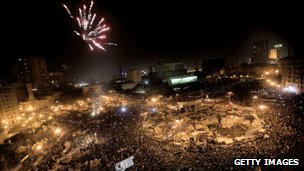
Protesters celebrated in Tahrir Square after President Mubarak stood down
Yet despite the tight financial environment, we have continued to raise the bar on quality and creativity in our services. Today, impressive new figures are published which demonstrate that the BBC's international journalism is as valued, vibrant and relevant as it has ever been.
New independent research shows that people across the Middle East have increasingly turned to the BBC during the Arab uprising with an unprecedented rise in audiences. Overall audiences to the BBC's Arabic services have climbed by more than 50% to a record high of 33.4 million adults weekly - up from 21.6 million before the Arab Spring.
BBC Arabic TV's audience has risen to 24.5 million from 13.5 million - up by more than 80%. Weekly reach across Egypt, Iraq, Saudi, Jordan, Lebanon and Morocco has nearly doubled to a weekly reach of 18.4% from 9.8%.*
The biggest increases were seen in Egypt, where the BBC Arabic TV audience quadrupled to a weekly reach of 16.2%, reaching 9.3 million people.
BBC Arabic TV also saw its weekly audience increase by almost a quarter in Iraq to a weekly reach of 26.6% (from 21.5%) reaching 4.9 million people. In addition, its weekly audience more than doubled in Jordan (weekly reach of 22.4% from 8.8%) and in Saudi Arabia (weekly reach of 24.6% from 12.2%).
These figures show that, in turbulent times, the BBC's aim to provide trusted news and impartial information is as valued as ever. International audiences in the Middle East are turning to us for independent, dependable and unvarnished news that they can trust.
Behind the numbers, and in an increasingly competitive media market, this is proof that there will always be space for high-quality journalism that seeks to inform all, even-handedly.
I am proud of our journalists and staff for never losing sight of the BBC's core purpose and hope our journalism makes a practical difference to people living through fragile times and sometimes frightening change.
* Weekly audience estimates are based on independent studies that were carried out by the Broadcasting Board of Governors' International Audience Research Program (IARP) in Egypt, Iraq, Saudi, Jordan, Lebanon and Morocco. The Broadcasting Board of Governors is an independent federal agency responsible for all US government-supported, civilian international broadcasting.
Liliane Landor is languages controller of BBC Global News.
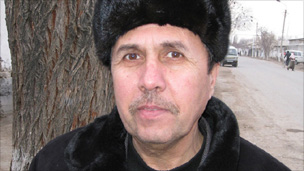
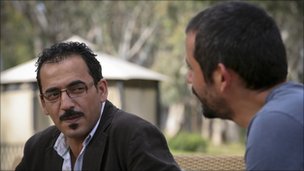

 Of course I am proud and honoured that our programmes facilitate the "global conversation", and that they've been such a lifeline to Alan, and before him to Brian Keenan, Terry Waite and John McCarthy, and before them to Mikhail Gorbachev. And of course I am pleased to read in the British press that we are "the best known and most respected voice in British broadcasting". I like to think that our 1.3 million listeners in the UK are not just insomniacs who listen when Radio 4 is off air, but people who make a clear choice to listen to us because they like the way we do news.
 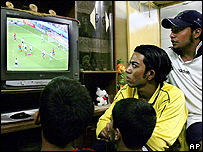 Yesterday he filed an extraordinary package from a sports café in Baghdad - Café Arabia - where he sat chatting to a group of young people about the usual stuff - who they support, who they want to see win the cup etc etc. And in between shouts of "Brazil!" or "England!", you learn that not so long ago boys and girls used to play football on the streets but that it's far far too dangerous to venture out now.
  The programme was simulcast with