


What is web science?
- 11 Mar 08, 17:40 GMT
In the august surroundings of the Royal Society of Arts and Sciences, in a lecture theatre decorated with 18th Century paintings, a crowd gathered on Tuesday morning to celebrate the birth of a new science.
It’s called Web Science, and is an attempt to start understanding and exploring the ever growing phenomenon of the world wide web. Who better, then, to be the main speaker at today’s event than Sir Tim Berners-Lee, the inventor of the web?
Sir Tim began with a vivid picture of the way his baby has grown: “There are more pages out there on the web than there are neurons in your brain.” He went on to explain that he hadn’t been sure about using the word “science” in this new discipline because web science needed to reach out and include sociologists, philosophers and artists as well as the technical community.
“When we build the web,” he explained, “we choose a lot of the answers to philosophical questions. We are constructing a whole new world and we are writing down the rules. And a huge amount of the design involves the psychology of the user.” As an example he described how e-mail had taken off because users trusted each other to send only valuable material – but was now under threat because of spam: “The social assumptions have changed – people no longer assume that messages they are getting are messages they need.”
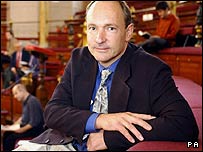 Sir Tim is working with the Southampton University computing science department, which along with Boston’s MIT, is leading the Web Science Research Initiative.
Professor Wendy Hall from Southampton (you can see an interview with her above) explained. “The web is the elephant in the room – it has transformed our lives, but we never see it. We feel the time has come to study it – to see its benefits and understand its possible dis-benefits.”
Her colleague Professor Nigel Shadbolt sketched out some early projects to illustrate the areas the new science might investigate. He showed a map of the blogosphere - "it's a butterfly shape" - which illustrated the way communities coalesce around certain blogs. He showed why research into Wikipedia needed a sociological angle – what drives the users to write entries? – As well as technical analysis of the patterns of its growth.
Professor Shadbolt also gave some insights into the semantic web – a project which Tim Berners-Lee and the Southampton University academics have been pursuing for some time, to a degree of scepticism from other parts of the web community. He described plans to give every fact on the internet its own web address, with the aim of building a “data web” where every connection was more clear and more searchable. “So you could ask questions like show me all the tennis players in Moscow,” he explained.
Of course, scientists have been examining the web for some time. Now, though, they are trying to work out how they can guide its future growth. Tim Berners-Lee puts it like this: “The web is basically a web of people. Because it’s something we created, we have a duty to make it better.”
But the web has grown and prospered without any real guiding hand, despite the attempts of governments and businesses to bend it to their will. So can the web scientists really do anything to shape its future?
The BBC is not responsible for the content of external internet sites
This is dot.life - a blog about technology from BBC News.
Rory Cellan-Jones is the BBC's technology correspondent.
Maggie Shiels is the BBC's tech reporter based in Silicon Valley.
Archive
« January 2010
| Sun | Mon | Tue | Wed | Thu | Fri | Sat |
|---|---|---|---|---|---|---|
| 1 | 2 | |||||
| 3 | 4 | 5 | 6 | 7 | 8 | 9 |
| 10 | 11 | 12 | 13 | 14 | 15 | 16 |
| 17 | 18 | 19 | 20 | 21 | 22 | 23 |
| 24 | 25 | 26 | 27 | 28 |
Being Discussed Now
- Logging out... and straight back in(3)
- Gadgets of the Noughties(20)
- Plastic Logic's long journey to Vegas(21)
- Sexting teens(17)
- Wikipedia on the wane?(49)
- 'Cooling-off' for mobile phones? Not on the High Street(37)
- 2009 - the social year(36)
- Twitter, Iran and #uksnow(25)
- Broadband Britain - how far down the league?(55)
- Microsoft and Murdoch: Teaming up to bash Google?(34)
BBC Technology Headlines
- %28none%29
%28none%29 - %28none%29
%28none%29 - %28none%29
%28none%29
Visit the Technology index
Visit the BBC News website
Rory's TV/Radio reports
- Residents block Google car
Broadcast: 3 April 2009 - New adverts to tackle film piracy
Broadcast: 2 April 2009 - Call to scrap 'illegal databases'
Broadcast: 23 March 2009 - Female robot takes to the catwalk
Broadcast: 16 March 2009 - Super-charged battery breakthrough
Broadcast: 12 March 2009

- News Editors
- Sport Editors
- Journalism Labs
- BBC Internet Blog
- Radio 4 Blog
- Peston's Picks
- Nick Robinson's Newslog
- Stephanomics
- Mark Easton's UK
- Mark Mardell's America
- Nick Bryant's Australia
- Andrew Harding on Africa
- Gavin Hewitt's Europe
- Soutik Biswas' India
- dot.Rory
- Science: Jonathan Amos
- Richard Black on environment
- Today: Tom Feilden
- Fergus Walsh's medical files
- Newsnight: Paul Mason
- Newsnight: Mark Urban
- Torin Douglas
- Will Gompertz's arts
- Phil Coomes on photojournalism
- Magazine Monitor
- Mark D'Arcy in Westminster
- NI: Mark Devenport
- Scotland: Brian Taylor
- Scotland: Douglas Fraser
- Wales: Betsan Powys
- Martin Rosenbaum on FOI
- 5 Live Breakfast
- Newsnight
- PM programme (iPM)
- World Tonight: Robin Lustig
