BBC BLOGS - Spaces & Places

Archives for October 2009

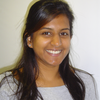
Meera Modi - Guest post #10

Post categories:

Meera ModiMeera Modi|14:55 UK time, Friday, 30 October 2009

Working here in the BBC has really changed my views of it as an organisation.

Everyone knows that it has a good reputation; it's one of the well-known brands. The logo itself is incredibly visual and is known worldwide. I grew up watching BBC programmes. Most recently I enjoyed watching Strictly Come Dancing because of the dresses and make up. What woman doesn't want to dress up?

Before I started working in the BBC, I had no idea what it would be like. As customers we all take it for granted. The BBC is there; we never think about how it works, how television is made and what is involved or how radio and live events happen, they just magically appear!

Now I am on the inside, I realise it has a complex structure with numerous divisions. It is fascinating to observe how the many teams integrate and the amount of people working here.

Before I arrived, I associated the BBC with TV programme-making. It is only now that I have become aware of the huge range of its work. Clearly, Radio doesn't play a part in my life.

I have been impressed by the diversity of the staff which seems very representative of our communities. That's not to say there haven't been issues but that's just like in everyday life.

But, because it's so varied, I realise I still have much more to learn about the BBC.
West One - they're putting the roof on

Post categories:

Chris KaneChris Kane|17:36 UK time, Thursday, 29 October 2009

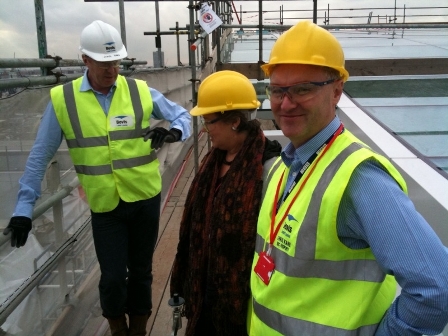
Construction work at West One continues at a great pace and its wonderful to see the start of the installation of the impressive gullwing roof.

Caroline Thomson and I tour the site on a regular basis to get an update on how things are progressing and the photo below shows us on the roof with Bovis Lend Lease project director Paul Sims.

westone.oct09.JPG

Meera Modi - Guest post #9

Post categories:

Meera ModiMeera Modi|16:09 UK time, Tuesday, 27 October 2009

For this blog post, I will discuss how deaf people generally socialise.

You might think that deaf people don't enjoy music, but for many deaf people music is an important part of their lives. Although deaf people cannot follow the words, they do enjoy listening to music, by using the beats and the vibrations.

Many like feeling the vibrations - they can be felt by touching the stereo, or through the air, or via the floor. Try going to a nightclub with a wooden floor and see if you can feel the beats. Groups of deaf dancers exist and they are actually very good!

There is a show similar to Pop Idol, called - surprise, surprise - Deaf Idol! Take a look.

In the UK there are networks of Deaf clubs and societies. Many are initiated and organised by Deaf people, with various goals in mind, according to what the group is about.

There are also many social events that are created by deaf organisers which deaf people attend - they can communicate in their own language (British Sign Language) and meet new deaf people who may have the same perspective of the world. There are events based all across the UK.

A few examples of these are: The Wolverhampton Film Festival - also known as DeafFest. It is the UK's only Deaf-led film and television festival and celebrates the talents of Deaf filmmakers and media artists from all over the world.

Deaf Rave is a deaf festival and an opportunity for deaf people to meet and let their hair down.


Deaf Camp is an all deaf camping experience.

Different regions and cities have "deaf pubs" - pubs where deaf people go on a set day (for example the third Friday of each month) to socialise and hang out with other deaf people. It is not always the same pub - we do like a change!

There are many charities and organisations that supports deaf and hard of hearing people:

NDCS (The National Deaf Children's Society) - this charity ensures that parents can communicate with their hearing-impaired children.


RNID (Royal National Institute for Deaf people) - they support a radically better quality of life for deaf and hard of hearing people.


BDA (British Deaf Association) - The BDA is the UK's largest national organisation run by Deaf people, for Deaf people. They represent the Deaf community. This site really needs broadband for us to appreciate it.

Dering Employment Services (where I worked previously) - this organisation is the UK's only deaf-owned-and-run employment service delivering information, advice and guidance on employment. It provides training and employment opportunities for deaf, hard of hearing and deafblind people across the UK, matching people with the right skills and experience to the requirements of employers.

Television Centre under siege

Post categories:

Chris KaneChris Kane|20:00 UK time, Friday, 23 October 2009

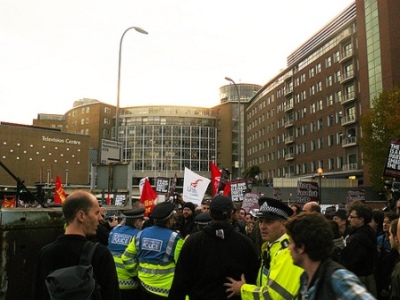
Last night the BBC's controversial Question Time programme came from Television Centre and as a consequence of this the site came under siege as upwards of 500 protestors came to demonstrate against the appearance of Nick Griffin the leader of the BNP.

The pressure on the Workplace team was intense and it peaked when approximately 25 protesters managed to breach the security cordon to gain access to Stage Door reception. Following the swift action of our Wilson James security team they were quickly and effectively ejected.

bnpattvc.jpg

Demonstration at TV Centre (c) Mike Fleming

The night, as I witnessed, was a big challenge for the Workplace team, we were severely tested and were not found wanting. I'm very proud of everyone who contributed to operating Television Centre yesterday - we enabled several other shows to be broadcast including hosting their respective audiences and all in a safe and professional manner. I want to thank everyone who put in a lot of hard work and long hours, not only on the day itself, but into the planning for this event over the last few weeks.

This morning we pick up the pieces, start the debriefing process and return to normality, secure in the knowledge that when called upon to deliver, Workplace can come up with the goods.

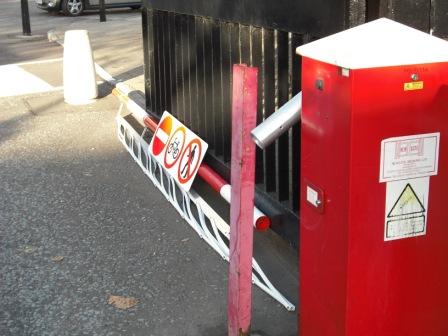
tvcbarrier.jpgThe broken barrier at TV Centre this morning(photo:Teri Kuzminska)

So near and yet so far at BIFM Awards

Post categories:

Chris KaneChris Kane|17:35 UK time, Friday, 16 October 2009

I was at the Grosvenor House Hotel on London's Park Lane earlier this week for the annual British Institute of Facilities Management Awards dinner.

There were 14 awards up for grabs and BBC Workplace was a finalist in two categories including the most prestigious one - Facilities Manager of the Year.

This flagship award is given for outstanding personal performance and career development. I was very pleased to see that Jan Healy was one of five shortlisted candidates from across the entire FM industry. Jan is based at Oxford Road, Manchester and has the BBC in her veins. Having moved to Balfour Beatty Workplace (BBW) last year she has gone from strength to strength.

Jan was recognised as Employee of the Year by BBW and I was not surprised to see her being shortlisted for this award. Sadly it went elsewhere but reaching the final is no small achievement and well done to Jan.

The second award Workplace was involved in was the FM Excellence in a Major Project. For this category VFA were shortlisted and received a highly commended award.

Gary Hills and team have been working with VFA since 2008 to introduce a capital planning tool to the BBC estate. This was recognised by the judges as a major contribution to the operation of our estate. VFA is not well known in the UK but I'm sure this will change over the coming years.

I'm very proud of these achievements and although we didn't quite make it and secure the top awards, being shortlisted is a great feat. As Bonnie McLellan of VFA said to me on the night, "We're only starting out and there is always next year."


Meera Modi - Guest post #8

Post categories:

Meera ModiMeera Modi|13:55 UK time, Friday, 16 October 2009

In previous blogs I have explained about D/deaf. In addition, there are words that will offend some people.

Acceptable terms to use are: deaf, hearing impaired, and hard of hearing. However, each of those terms has different meanings; deaf means a total loss of hearing (but most people who do not have total loss of hearing still prefer to label themselves deaf). Hearing impaired covers the spectrum of deafness, from a slight hearing loss to a severe hearing loss. Hard of hearing means some hearing loss, but not severe.

Unacceptable terms are: deaf and dumb, as a sentence. Deaf is acceptable, but joining it with the term "dumb" is not. This is a very out-of-date term, and very few deaf people are "dumb" these days. Almost everyone who is deaf can manage speech. It is true that their quality of speech varies, but dumb refers to someone who cannot make a sound with their voice. Dumb also hints that that person is intellectually incapable, but possessing intelligence has nothing to do with whether they can hear or not.

Acceptable:

Disability - this is a general term and just means someone's ability is impaired.

Unacceptable:

Normal, when referring to people without disabilities. This implies that people with disabilities are abnormal!

Healthy, when referring to people without disabilities - many people with disabilities are also perfectly healthy. Being deaf does not mean I am unhealthy.

To refer to someone as "the deaf girl/boy/woman/man" - people should not be defined solely by their disability. They may be deaf, but they may also be businessmen, office workers, wives, husbands, mothers, fathers, someone's offspring - they are always more than just being a deaf person.

Afflicted (with deafness) - a disability is not an affliction.

I hope people will be more considerate about what term they use, as it is too easy to use the wrong one and hurt people's feelings. I've had days where I've met someone and they've said "oh, you're the deaf girl?" It makes me feel "is that all I am?"

A big week for Media City UK

Post categories:

Chris KaneChris Kane|16:01 UK time, Monday, 12 October 2009

We get the keys to the first of our new buildings in Salford's Media City this week!. Its very exciting and I plan to do a number of postings on this over the next week or so.

However as a flavour have a look at the new video produced by the Media City team

https://www.youtube.com/officialmediacityuk#p/u

It really supports the vision for the project namely - innovate, inspire and surprise

Meera Modi - Guest post #7

Post categories:

Meera ModiMeera Modi|12:00 UK time, Friday, 9 October 2009

Deafness is something that is quite popular to study; there are several universities in Britain which offer Deaf Studiescourses.

Deafness can be classified into models, according to how they are viewed, but which one you choose is up to you!

The social model of disability
In this model, society is what disables the deaf. Our society doesn't provide equal access for disabled people. Access can be physical for example; no ramps for buildings (for wheelchair users or people with mobility problems), no visual displays or information message boards (for deaf or hard of hearing people). The list is endless! D/deaf people can live normal lives with access through visual information, technology and interpreters.

The medical model
According to this model, disabled people themselves are seen as the problem. They are expected to fit into the world as it is; the medical model looks to cure disability and sees deafness as an 'illness' that must be treated.

The cultural model
This way of looking at 
deafness views deafness as a separate linguistic and cultural minority; deaf people who identify with this group do not consider themselves disabled in that culture.

Which one do I choose? I don't know, I've never really thought about it! Really, I just think, "I am Meera"! I use sign language with my friends and speech with my family. Do I see myself as 'disabled'? I suppose so, but it's a natural part of me - I am so used to being me, that I have never really thought "I am disabled". I recognise that I have barriers to overcome, but all people do at the end of the day. That could come from their religion, ethnicity, gender, age, money status, anything. No one has a truly easy life.

Architecture and the BBC

Post categories:

Chris KaneChris Kane|16:01 UK time, Thursday, 8 October 2009

On occasion I get asked about the BBC and its support for high quality architecture. The BBC is housed in many different types of buildings across the UK and over the decades we have put a lot of effort into bringing the estate up to date and protecting great buildings such as Broadcasting House in London. We are also very proud of our new generation of buildings such as Media Village in London and Pacific Quay in Glasgow plus a whole raft of other regional sites ranging from Hull to Leeds to Liverpool to Birmingham.

In a Times article featuring one of Britain's most accomplished architects David Chipperfield, the BBC is accused of creating a tension between art and money, thereby penny pinching on design. We have to hold our hands up and plead guilty to this charge. Part of the role of BBC Workplace is to watch every penny of licence fee payers' money on our major projects as we believe this is what the public wants.

Meera Modi - Guest post #6

Post categories:

Meera ModiMeera Modi|14:57 UK time, Friday, 2 October 2009

What are some of the challenges you've faced in adapting to work in the W1 team?


There are various areas where I encounter challenges. As part of my job, I am adapting to work with different age groups; they have different expectations and different world knowledge; so I believe it is important that we respect each others' strengths and perspectives.
At the moment, I am working in a fairly stereotypical office setting; lots of successful men with female PAs working for them. It is challenging to face these stereotypes because I am an ambitious person and hope not to encounter glass ceilings.
I feel that my ethnicity plays an important part in my identity; it is what other people see first when they see me. Some people prefer to stay solely in their own culture; of course, this is a generalisation. However, I am Asian but British-born, and move in both worlds. I am Hindu, but although I mix with my Hindu community, I also enjoy mixing with people from other cultures, because I feel this helps to expand my horizons and help me to learn new things.

What are your aims and goals for the future?


I am highly ambitious and open to everything that is new. I have many goals and aims, and I like to do things right from the beginning to the end. I want to achieve my aspirations, live my life and ensure my time has been spent in a worthwhile way. I like to work in multicultural environments because I feel there are always challenges and interesting things to find out.
I was once described as flexible and enthusiastic about thinking ahead, also I like to assist people. One of my aims is to support charity to try and make a difference to people. I would like to do something that has an impact in this way.


I also wish to show in all job situations that I have enormous potential and that I am capable of innovative thinking and using practical tools to ultimately make a success of whatever I do.
My short term goal is to be become a website designer and also to have the opportunity to be part of project management teams. I do not only have a degree; I also have potential and am very adaptable. I believe I have more than some others can offer. I enjoy designing and being creative.


At some point in my life, I would like to travel and explore the world to have a taste of other cultures. I am also keen to work abroad in a voluntary project; teaching children English or deaf people sign language. I have lots of short term goals so the list goes on!
I am not sure about my long term goals as I am still young and want to see what opportunities come my way. I like the idea of setting up and running a multimedia company.


As a deaf person I obviously rely on my sight more than my hearing. This, I believe, has given me more skills when it comes to visually enhancing design. I am able to create and implement sustainable exciting websites. Any job offers are most welcome!

A special occasion

Post categories:

Nisha Jani|12:02 UK time, Thursday, 1 October 2009

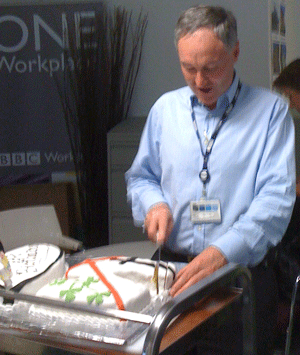
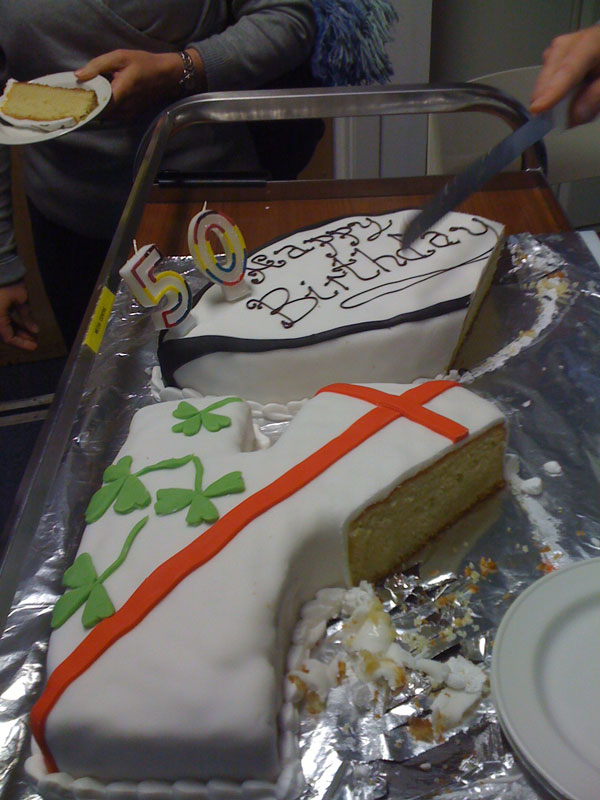
chriscake.gifI recently had a "significant" birthday which I thought I'd managed to get through without anyone noticing - I'm not one for a fuss. However I was pleasantly surprised by the Workplace team kindly arranging a beautiful cake, with the help of our friends at Aramark. Caroline Thomson joined us and I was even sung to! My diary was also mysteriously manipulated by Karen, and I unexpectedly found myself at surprise drinks at a pub on Shepherds Bush Green in the evening, where I was toasted and congratulated. I had a great day and really appreciate the special efforts everyone went to. Many thanks all.

CKcake.jpg

Media of the Future - where will we be in 5 years time?

Post categories:

Chris KaneChris Kane|11:12 UK time, Thursday, 1 October 2009

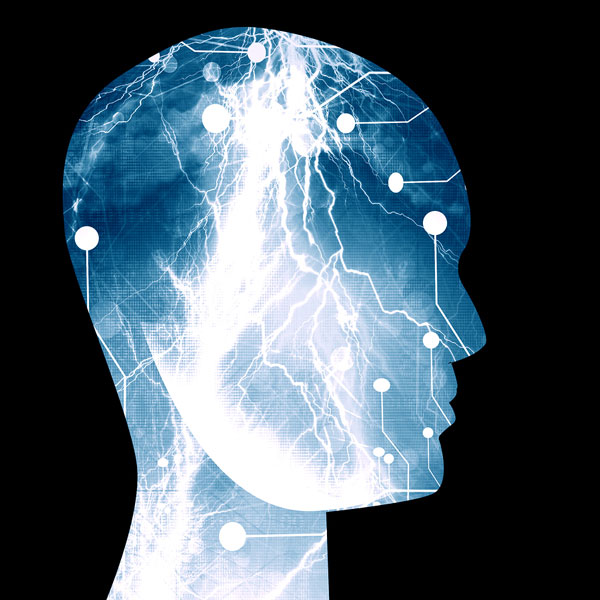
A recent article in MediaWeek by Suzy Bashford got me thinking about how much has changed in the recent past and how technology has utterly transformed the way we live and do business over the last 10 years. It's well worth a read for some idea on how things might continue to change and where the experts reckon we'll be in another five years time. Some of it makes the mind boggle but it's exciting to think of the new opportunities that are waiting to be grasped...as well as all the leisure time to fill with techie gadgets!

techblogpic.jpg

BBC © 2014The BBC is not responsible for the content of external sites. Read more.

This page is best viewed in an up-to-date web browser with style sheets (CSS) enabled. While you will be able to view the content of this page in your current browser, you will not be able to get the full visual experience. Please consider upgrading your browser software or enabling style sheets (CSS) if you are able to do so.