BBC BLOGS - Spaces & Places

Archives for April 2009

Our Workplace Marathon People

Post categories:

Chris KaneChris Kane|09:43 UK time, Wednesday, 29 April 2009

I'm really envious of people who run marathons - its just an amazing achievement! The ancient Greeks who started the whole thing off have a lot to answer for.

Sunday saw the London Marathon and I just want to recognise the efforts of Workplace colleagues (those that I know about) who sweated blood and tears to get round the course.

John Pickles, Finance Analyst, completed the Rotterdam marathon in 4 hours and 28 minutes on April 5. He also took part in the Athens marathon last autumn.

Stephen Killick in the Broadcasting House, W1 team was on his second marathon and achieved it in 4hrs 35mins - you can donate to his charity, The James Baldwin Trust which helps young adults being treated for T-Cell Non-Hodgkin's Lymphoma

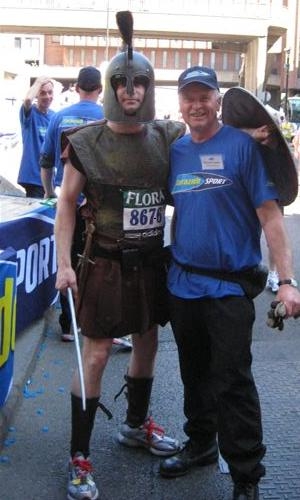
Chris Smith, Risk Assurance Manager completed the 26.3 mile marathon in 5 hours, 46 minutes - dressed as Achilles. He is pictured with Richard Coates, Fire Risk Manager, who provided 12 hours voluntary effort as part of the team at the 23 mile drinks stations.

London_MarathonAchilles09.JPG

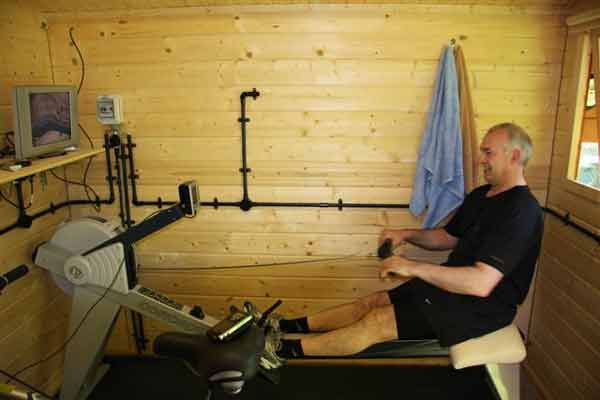
At the same time, Mark Wright, Broadcast and Business Continuity Director rowed the equivalent of the 26.3 miles on a rowing machine in just 3 hours, 45 minutes.

Marathon_row.jpg

What remarkable achievements - is there anyone else out there who participated?

The Out of London Perspective

Post categories:

Chris KaneChris Kane|13:27 UK time, Monday, 20 April 2009

Having completed the integration of English Region Facilities Management last year, I was very keen to ensure a good representation across the entire Workplace operation at the recent Workplace event on 30th March. On the day, I was delighted to see lots of familiar faces and to meet other colleagues for the first time. It's great to see people from Birmingham, Bristol and Manchester joining the London based teams as one BBC.
In discussions following the event, I was struck by the comments of colleagues based outside of London and this is a topic I wanted to return to. I felt that the best way to approach this would be to interview Anne Louise Mazzafiore, Project Manager for the North Portfolio to get her take on what we need to do to be less London-centric

How can we do our bit to operate more on a pan UK basis?
I might as well start with a nod to being a bit cheeky, I know you'd expect nothing less... it sounds obvious, but maybe we take it back to basics. We work for the British Broadcasting Corporation, with British being rather a key word. When you get immersed in the cut and thrust of West London, you're doing part of the British bit. In Birmingham, Belfast and Bangor they're doing part of the British bit too. They might be slightly smaller bits, but they all make up part of the whole. It's really important to recognise that, and work together accordingly. Easier said than done, but not impossible if people feel they are valued and can contribute as being a fundamental part of that whole. But ultimately they have to want to play that part, so it's as much in our gift as it is yours and your management team's.

What's it like for somebody from the regions to work in Workplace?
It's fabulous! But I would say that, wouldn't I?! My own experience is that it can be both empowering and a bit lonely at times. We're fortunate in Manchester that we work alongside the Salford project team so we buddy up with them a lot, but if I was at another BBC site I'm not sure it would feel as inclusive. It's important to build networks with your work neighbours, regardless of which team they sit in, but if you're much closer to them than colleagues in your own department, it can be a bit of culture clash when you do actually meet up at an event like the team event on 30th March. A bit like distant cousins at a wedding, you know you're connected but it's a really thin thread!

How do we ensure that everything is not too London focused?
I'm a big fan of London and all it has to offer in terms of work and play, but not everyone is like me. I know of colleagues who came down for the event on the 30th and they didn't know where Broadcasting House, W1 was, as the only detailed instructions given out were about catching the shuttle bus from W12. As iconic a building as BH is, if you live over 200 miles away, and always have, it's not a given that you know where it is. A long train trip, followed by an unfamiliar tube journey, then navigating your way to a building you've never been to before can be daunting, especially for the more junior and newer members of staff. I guess that's even more of a pertinent issue if you're one of our partners in the regions, as you're probably even less likely to have been to another BBC building than the rest of us. It might sound like I'm just being a whinging Northerner (how we love a good moan with our pint of mild and a pie with our whippet by our side, she says, tongue firmly in cheek), but as people we're all different, and our common ground isn't always the same. My view is that we should keep recognising that and look upon it as a really powerful positive. It doesn't take much to just add a line to an email for us out-of-Londoners. We'd do it for you capital-dwellers if you were heading up our way. We're really friendly like that round these parts.

Can ideas coming from the regions work in London?
Of course they can! What's that dissimilar to all the programme ideas that are generated in the regions and are a rip-roaring success? In broadcasting terms, audiences are always changing, so you need to keep a very beady eye on how to connect with them. It's the same principle in Workplace, but we have to be one step ahead across such a diverse range of areas of the business, as well as in our specialist fields in the wider property world. The more variation in voices we have, in geography and skills base, the better chance we have in meeting the ever-changing challenges we face. It's a well worn phrase, but for me it's still as inspiring and true as ever: great things happen when we work together. Been there, got the t-shirt and still proudly wearing it.

How can we have a debate about these aspects?
I think we're in the fortunate position that we have so many ways to debate. There's email, phone calls, video conferencing, team events, blogging, message boards - there's even decent coffee to drink in cafes these days, to get out of the office and debate. It would also be extremely remiss of me not to mention that great meeting of the minds in the pub. But the choices can become overwhelming and bewildering, so I think it needs to be easy for everyone to see very clearly where the debating is happening and how they can get involved, without too much effort and expertise. You've started that process with your blog and I think it's a great place to start, it just might not be the conversational comfort zone people are used to, so you might need to help them along to get them going. Then we need to act upon what we've debated, otherwise it's all just hot e-air and we might not be that much further forward than where we are today. And where would be the fun in that?!

------------------------------------------------------------------------------------------------------------------------------------

This is just a first step in building our ability to have a chat across the web - why don't you give it a go - I'm looking forward to reading and responding to your comments on this topic.

Chris

So what are you doing on St George's Day?

Post categories:

Chris KaneChris Kane|11:22 UK time, Monday, 20 April 2009

Having lived in England for over 20 years it has always intrigued me why the 23rd April, St George's Day is not more widely recognised and celebrated.

Growing up in the Emerald Isle celebrating St Patrick's Day was a big thing, something to look forward to in the usually damp Spring weather. Being a public holiday, it provided a day out for big sporting occasions, parades and an opportunity to party. Whilst a rainy day is predictable most people managed to do something.

Therefore it came as a surprise to me why England doesn't do much on its patron saints day? The Welsh have their day for St David and whilst the Scots are most associated with Burns Night (where they address the haggis and make many whiskey toasts), I see that they too are pushing for a holiday on St Andrew's Day.

I notice that on the web that there are lots of campaigns clamouring for greater recognition and one that caught my eye was the London Assembly site where Mayor Boris Johnson is pushing out the boat (or is it the bus?) to highlight the day. Plans include celebrations at the Globe Theatre to mark Shakespeare's coincidental birthday but also a concert on 25th April to celebrate English music and culture. Looks interesting! There are other events on across England too which are worth checking out.

At the BBC we do a number of things but these tend to have a local focus. In England, people are becoming more aware of the background and history of St George and seem to be increasingly fond of displaying flags with the St George cross, referencing his famous dragon or wearing a red rose perhaps, whereas in Wales, St David's Day is marked by the wearing of leeks and daffodils. In Scotland, the day has become a focus for a debate about which flag will be flown from various official buildings - the Saltire or the Union Jack.

Given all this debate or rather the lack of it - what do you think? I look forward to hearing your comments and thoughts.

Chris

So what am I going to focus on in this Blog?

Post categories:

Chris KaneChris Kane|12:15 UK time, Tuesday, 14 April 2009

Now that I'm starting to get the hang of this blogging lark, I've been thinking through what topics I could usefully cover, and this posting sets out my initial ideas for the weeks ahead.

However, in setting out my editorial planning I have not forgotten your hunger for greater engagement, and I hope that over time this blog will help me to reach out to the team. But it is a two way street so if this blog is to be truly useful, its readers need to sign on and comment on what I publish.

To do this you need to follow the steps below:

1. Click on green 'Comments'link at top of any post - this takes you to the the green Comments banner at the bottom of the main post 

2. If you have not already done so, you will need to join the Blog Network - this is easy! Click on 'creating your membership'and follow the steps to create a username and password. Remember, this username can be anything you wish, allowing you to post comments without showing your identity, if you prefer.

3. You will need to verify the email address that you use with your username. Follow the instructions in the email that is sent to you by the Blog Network.

4. You are now ready to log-in - follow step 1 above but click 'sign in' and enter your username and password.

5. You can now enter your comments and questions (related to a particular post or not) for my review and response.

Spaces & Places will cover a range of topics over the months ahead and, in keeping with my original ambition for this blog, I want to put forward some thoughts about the link between spaces and places along with some views on how BBC Workplace plays into these General themes. I also want the blog to enable me to share some of the opportunities I've had to do things and see places. There are a number of other topics which I will deal with below but I wonder if there are any specific topics that you would like to see covered - this is your chance, so don't be shy - let me know what you are keen to hear about.

In planning my writing for the weeks and months ahead I see it falling into a range of categories. Now that we're up and running I want to see if we can use this blog as a forum for debate, feedback and information sharing. Therefore I will be publishing my first Feedback posting next week when I want to start a discussion concerning the views and feelings of those members of our team who are not London based - I did take note of some of your comments raised at the Staff Briefing on 30th March!

One Workplace as our gameplan for the future will feature as a regular topic as we develop our thinking around doing things right and doing the right thing. I will also keep you up to date with our One Water projects.

As we deal with the myriad of challenges in operating and changing the BBC's working environment it may be useful to have a category that deals with the Future Workplace. This can be quite wide ranging as I can talk about the future of work, office design and specification, alternative working practices and how we're getting on with the development of our Flex product.

We should also not lose sight of what's happening in the Wider BBC and the Media World (rapidly changing as it is) - the future of Public Service Broadcasting is something we all need to be aware of. I hope that postings in this category will be of particular help for those who don't have access to Gateway.

Finally, as Diversity Champion for Operations Division I couldn't but take the opportunity presented by publishing a blog to include some snippets on this aspect of my role at the BBC.

Have I missed anything? Let me know. I look forward to reading your comments and suggestions so please do get involved as we move forward together.

Chris

One Workplace - What's this all about?

Chris KaneChris Kane|17:33 UK time, Tuesday, 7 April 2009

' So what's this 'One Workplace' all about?' I heard a colleague ask me. Well, when we had our first pan-Workplace Team Session in the Radio Theatre last week, I talked about how it would be great if all 2000 of us were really working as one team.

Given the huge initial impact of the One Water project I thought it was sensible to label our game plan as One Workplace - see previous blog.

Now, I know that many of my readers are not interested in sport but, bear with me; a game plan is simply a list of things a team needs to do to win a game, a contest or a competition.

In Workplace, we're on a journey and I need to ensure that everyone understands where we're heading and the role each person will play in helping me get to our destination.

'So what are you trying to achieve?' you may ask. Workplace does two things, we operate the BBC estate on a day to day basis and we make changes ranging from the massive W1 and Media City projects to replacing windows and moving desks. We are expected by the BBC top table to successfully deliver our big tasks and put money back into programming by spending wisely. Our wider customer base needs us to help keep them on air as well as deliver a range of routine stuff.

We're following the direction given by Creative Future, or as Mark Thompson put it in Oct 2007, "Spend money wisely - saving it where we can give it back to our audiences - in great content"

But what does this mean for the readers of this blog? In a nutshell, we need to work out how Workplace is going to organise itself for the years ahead so we can deliver the right workplaces to support the BBC's Creative Future. Over the coming weeks I intend, with support from my senior team, to seek your input on how we go about helping the BBC become the most creative organisation in the world. I want everyone to have the opportunity to contribute to our plan. This aspiration brings to mind a quote: three people were at work on a construction site. All were doing the same job but when each was asked what they were doing, the answers varied. Breaking rocks, the first replied. Earning my living the second said. Helping to build a cathedral, said the third. It is this awareness of contributing to something bigger, beyond the task at hand, that I want to nurture.

'But shouldn't you management guys have this figured out already?' you ask. Well, we have in part and it's taken months! But we also need your help because we need to raise our game to help us succeed and to do this we all need to be on the same page. Now this brings me to the difficult part - we're a pretty big group (2000 approx), we're spread across the UK and most of us are not directly employed by the BBC. Yet for most of us the BBC is our life and we all want to see it succeed.

So how do you bring together this amazing group of people? There's no easy answer to this but, as with all big moments of inspiration, it came to me whilst shaving! We need some form of common cause that is worthwhile and easy to understand. We need to organise ourselves around focusing on doing the right thing as well as doing things right.

This gave rise to the One Workplace concept - which will in time give us a Workplace in which we are proud to work. We will be operating to six simple ways of working - we will be reliable, flexible, supportive, trusting, creative and fair. We are a good team now but I believe we can become a great team and with your help it has the potential to be amongst the best in the world. But we can only achieve this if we work as One Workplace.

I'm told that many people felt inspired following our first All Staff briefing and lots of you are keen to know more, in particular: what does 'doing the right job' mean?. At its most basic I need your support to help those less fortunate than us. We will be organised about how we do this and for starters we will think about lending our support at a global level, at a national level and at local level. There is still some detail to be worked out but One Water will feature as a global link whilst Children in Need will be our National focus. I will post a blog next week with further details including the team leader for this initiative. Plans for the local initiatives are also still in development but we are looking into linking up with BBC Outreach's Connect and Create scheme and working in a coordinated way.

In parallel, whilst doing the right thing, we need to think about how we can raise our game and do better. This is really all about doing things right and boils down to a drive for better performance in service quality and delivery. I want everyone to think about BBC Workplace as a high performance team, one which we can all be proud of, where service delivery is integrated and where we will truly be able to live up to the BBC value of great things happening because we are working together as One Workplace.

One Water Briefing - Workplace Staff Event - 30th March 2009

Chris KaneChris Kane|10:17 UK time, Friday, 3 April 2009

On Monday afternoon this week we held the first ever pan BBC Workplace briefing event. To mark the occasion we held this session in the Radio Theatre at Broadcasting House in London.

The focal point for this groundbreaking session was a briefing on my trip to Lesotho in February. Having committed to feeding back on this very unusual journey I was determined to do something different. 

Thankfully, lady luck was on my side, and I was delighted that the two key people behind One Water and PlayPumps agreed to join me to share our story.

In securing the Radio Theatre and the services of Mark Diamond and his highly professional Radio Resources team, complemented by Anthony Styles and his Audience Services team, we pushed ahead with an initial 280+ representatives of the 2000 strong Workplace team.

Having completed the integration of English Region Facilities Management last year, I was very keen to ensure a good representation across the entire Workplace operation. On the day I was delighted to see lots of familiar faces and to meet other colleagues for the first time. It's great to see people from Birmingham, Bristol and Manchester joining the London based teams as one BBC.

In discussions following the event I was struck by the comments of colleagues based outside of London and this is a topic I will return to in a later blogpost.

The agenda was split into two parts with the initial session focusing on One Water and the Lesotho trip. The rest of the agenda covered a review of the year gone by, the current state of Public Service Broadcasting and our own plans for the future. I will return to the latter next week; the remainder of this blogpost recounts the One Water story.

I was so pleased that Trevor Field, co founder of PlayPumps, and Duncan Goose, CEO of the One Water Foundation came along to help me present the story. Trevor is based in South Africa so it was extremely fortunate that his holiday to the UK coincided with our event.

Leading up to the event, I was somewhat apprehensive as we had never mounted an event of this scale and size before. It was made all the more fraught given that my bit was in fact a 6 minute video based on an ad-lib piece to camera from a school in Lesotho! I was fine going through the motions during the interview and school visit but as we progressed through the editing process my nervousness grew. How would it look to others? Did I cover all the key points? However, thanks to the talents of Toby Richards (our extraordinary cameraman) the end product was fantastic. We hope to be able to stream this film here shortly - do check back soon.

To give you some further insight into the One Water product have a look at their video clip here.

For me the entire experience of travelling to Lesotho together with learning more about PlayPumps and One Water was truly life changing. This is another topic which merits a separate post shortly.

What does this all mean, I ask myself? When you return from a trip of this nature you want to do more. However I also mulled over questions such as: 'Should we focus on Lesotho or Africa? What about other parts of the world? Should we think about deserving causes closer to home?'

There was no doubt in my mind that the answer to the last is a resounding yes. But we have to start somewhere so I came up with the concept of a three tier framework for worthy causes. At the global level I intend to build on the One Water/PlayPumps relationship. Moving closer to home I want to strengthen the links with Children in Need. Then at a local level we can focus on supporting neighbourhood or community causes.

To ensure we can progress these initiatives, I need some helpers from across BBC Workplace so, if you're interested in lending a hand, or you have any suggestions, please let me know.

There's so much more I want to share on this that I could stay writing for hours! But let's call a halt for this moment and stay tuned for the next episode.

Chris
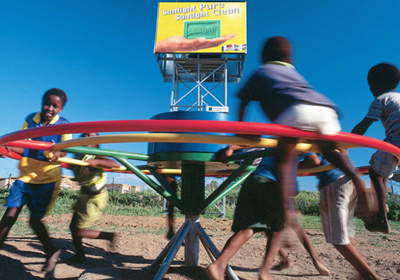
playpumppic.jpg

BBC © 2014The BBC is not responsible for the content of external sites. Read more.

This page is best viewed in an up-to-date web browser with style sheets (CSS) enabled. While you will be able to view the content of this page in your current browser, you will not be able to get the full visual experience. Please consider upgrading your browser software or enabling style sheets (CSS) if you are able to do so.