

US media round-up: Republican election victory
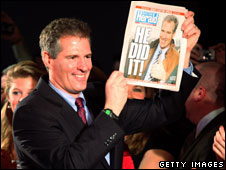 US Republican Scott Brown has won the senate seat of Massachusetts over Democrat Martha Coakley, a victory which could derail President Barack Obama's planned healthcare reform and threatens future Democratic legislation on issues such as climate change. This is how some of the US media have reacted.
Ian Swanson, writing in the Hill, says the election is a clear sign of a diminishing confidence in Mr Obama's agenda which could affect the mood of Democrats when it comes to attempts to pass financial reforms:
"Lawmakers already worried about addressing issues such as climate change and immigration may grow more anxious about taking politically dangerous votes in an election year where voters have suggested they are disillusioned with Washington."
In the Washington Post, Michael Gerson says Mr Brown's victory is a sign that the Obama administration's decision to focus public spending on healthcare rather than economic recovery was "a dreadful error" which does not bode well for the rest of Mr Obama's term:
"Obama now has the highest disapproval rating in the history of Gallup polling for a president entering his second year in office. He has been handed a series of political humiliations. If he takes all of this as motivation to "stay the course," the humiliations have only begun."
Adam Nagourney, writing in the New York Times, says Mr Obama has been humiliated on the first anniversary of his inauguration and is now facing a long list of tough choices:
"Will Mr Obama now make further accommodations to Republicans in an effort to move legislation through Congress with more bipartisanship, even at the cost of further alienating liberals annoyed at what they see as his ideological malleability? Or will he seek to rally his party's base through confrontation, even if it means giving up on getting much done this year?"
But Martin Kady II, on the Politico blog, says that while a Republican victory may be "catastrophic" for healthcare reform, other areas of the Democratic agenda could yet survive:
"A smattering of Republicans may be willing to play ball on their own pet issues, giving the president's party at least a theoretical shot at passing some form of financial reform, an energy bill - without cap-and-trade - and a watered-down deficit-reduction package."
On Real Clear Politics, Jay Cost says all presidents in US history have made political mistakes, but asks whether the "untested, young, inexperienced" Mr Obama has the necessary skill to recover from the Massachusetts defeat:
"The test of a President is how he handles the jam once he has gotten himself into it. Does he continue to do the same thing, hoping against hope that somehow, someway doing the same-old same-old will yield a different result? Or does he recognize that he has made mistakes, try to learn from them, and ultimately make adaptations? That's the mark of a superior political talent."
Several blogs and editorials criticise the pre-election campaign of Martha Coakley, including Brian Mooney, who writes in the Boston Globe that voters' anger towards the White House agenda was compounded by Mr Brown's "vigorous, smart, and error-free" appearances: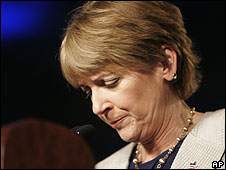
"To be sure, Brown was the beneficiary of the blundering campaign of his opponent, Coakley, who blew a 31-point lead in two months, according to one poll. But in electing Brown, a large segment of the electorate declared that there is little appetite for near-universal national health care, the chief domestic policy initiative of Obama, who carried the state by 26 percentage points only 14 months ago."
EJ Dionne, writing in the Washington Post, says the Democrats allowed Republicans to "define the campaign" in Massachusetts but also turned voters against them by taking too long to pass the healthcare reforms through the Senate they previously controlled:
"The Obama White House should have been keeping a watchful eye on this race, realizing the 60th Democratic vote in the Senate was at stake. More broadly, Obama also needed to create a national narrative that Democrats could proclaim with pride. The narrative has been missing, and conservatives have filled the vacuum."
Katrina vanden Heuvel writes in the Nation that the Democratic defeat should be a signal to the party that they can no longer afford to move cautiously on promised social and financial reforms but should begin making bold decisions:
"There is a generalized anti-establishment anger at loose in this country, reinforced by a White House team that has delivered for Wall Street but not enough for hurting communities. It is an anger also fueled by often savage right-wing anti-government attacks. This special election is a wake up call and should lead to a course correction. The Democratic party can no longer run as a managerial and technocratic party. Going populist is now smart politics and good policy."
Links in full
 Ian Swanson | The Hill | Victory could impact more than healthcare
 Michael Gerson | Washington Post | Why Massachusetts' Senate race matters
 Adam Nagourney | New York Times | Voters Send a Different Message
 Martin Kady II | Politico | All is not lost for Dems
 Jay Cost | Real Clear Politics | What Does Obama Do Now?
 Brian Mooney | Boston Globe | Voter anger caught fire in final daysEJ Dionne | Washington Post | Democrats: stop blaming each other
 Katrina vanden Heuvel | The Nation | Massachusetts Lesson: Go Populist Now

