BBC BLOGS - Peter HenleyHenley's Hustings

Archives for December 2010

BBC South 50th anniversary

Peter Henley|10:28 UK time, Thursday, 30 December 2010

Great excitement in the BBC Library here in Southampton after the discovery of the earliest regional news for the South. We've got shelves of dusty film cans in the huge vault opposite my office, but those are the reports, not the complete programme as transmitted.

Simon Marks, who's been trawling through the old stuff for a series celebrating the 50th anniversary of BBC South, was amazed to find a recording of a section of an early programme - a telerecording made in 1962.

The Newsbelt is done with the camera pointing at a series of cards, but they pack in a surprising amount of information.

You can watch it yourself below... the best bit has to be the film about the village of Avington, near Alresford in Hampshire, narrated by the inimitable John Arlott.

In order to see this content you need to have both Javascript enabled and Flash installed. Visit BBC Webwise for full instructions. If you're reading via RSS, you'll need to visit the blog to access this content.


PS: We've also found another amazing clip of one of the South's MPs in 1971, at a student squat. Behind the long hair and beatnik clothes the interview style is unmistakeable. He's defending the legality of the occupation... any idea who?

Rubbish collection in Dorset

Peter Henley|15:04 UK time, Wednesday, 29 December 2010

Householders at Poole in Dorset will have to wait more than a month for some rubbish to be collected. The Borough of Poole said today that residents who missed a recycling collection on 8 December because of bad weather will have to wait until next Wednesday, the 12 January, before the bin lorries arrive.

A spokeswoman for the council said that they cancelled a week of collections before Christmas amidst fears about the health and safety of their employees in the icy conditions. Because the collection teams work on bank holidays through the year they don't work over the holiday period.

In order to see this content you need to have both Javascript enabled and Flash installed. Visit BBC Webwise for full instructions. If you're reading via RSS, you'll need to visit the blog to access this content.


Collections are now back to normal, but that will mean some weekly refuse collections from the 15 December are only being collected today. Blue and Black recycling bins are on a fortnightly collection and will be the last to get back to normal.

No extra collections are being arranged, but residents are being encouraged to take waste to the Nuffield household recycling centre and the council website states: "Following the major disruption to many scheduled collections, crews will take a reasonable amount of bagged waste alongside bins."

By contrast, councils in Hampshire say there have been few delays.

In Portsmouth Cllr Eleanor Scott, the City Council's Cabinet Member for Environment and Community Safety, said: "Collections are running as planned, and did so over the whole Christmas period. Black sack and recycling collections happened on their normal days, and recycling banks have been emptied as usual.

"Residents quite rightly expect basic services like rubbish collection to be reliable, and I know our staff and our contractors work very hard to provide a good service."

In Surrey collection staff worked extra hours to deal with the backlog. Leader of Guildford Borough Council Cllr Tony Rooth said: "We took an early decision that it would not be acceptable for our residents to keep missing collections at such a critical time of the year."

"We visit nearly 18,000 properties and collect approximately 175 tonnes of recycling and refuse every day. So we decided to deploy extra resources to clear any backlog and get our services back to normal as quickly as possible. This included using five extra vehicles and their crew members to make additional collections all of last week, including collection on two bank holidays.

Rubbish can be a hot political topic. The Local Government Minister Bob Neill has written to local councils to ask them to improve their service. Here's some of his message:

"It is clear that there is widespread public concern at the extent of the disruption to collections. It is particularly troubling that some press reports could appear to suggest a level of complacency and a failure to address the seriousness of the issues.

"Families who have been told to stockpile their rotting refuse inside their own homes by councils are entitled to wonder if their council views the rubbish collection as just a favour, not a right. And the public deserve a better answer than, 'this is not a major problem'."

But Labour's Shadow Local Government Minister Chris Williamson said: "Of course there can never be any excuse for councils failing to collect people's rubbish for four weeks.

"The Government needs to be honest and admit that the only 'savage cuts to weekly rubbish collections' are the ones to come in the next few years as a result of this government's unfair frontloaded cuts to local council budgets."

And we've heard reports of similar situations in other councils across the South. Philip Clark from South Nutfield in Surrey contacted us to say:

Our bins were finally collected this morning after five weeks. I can understand with the bad weather we experienced that the rubbish was not collected, but after that there was no excuse. On our small village road there was a pile of over 100 bin bags, every house had piles of rubbish to be collected. When the refuse collectors came one day, they were overheard saying the couldn't be bother to collect on our road. Not good enough for the high council tax we pay in our area.

The head of environmental and consumer protection at the Brough of Poole, Shaun Robson, said: "We appreciate that this is not ideal, particularly given the time of year and extra household waste and recycling generated as a result."

He said during the icy weather the rounds were largely inaccessible, although waste was collected from communal blocks.

"We are advising residents that they can leave a reasonable amount of extra bags of rubbish and recycling with their next scheduled collection."

What's happening where you live? Have the binmen and women been offering service above the statutory requirement in this icy weather, or does someone need to pull their finger out?


Coastguard closures - the storms ahead

Peter Henley|11:03 UK time, Thursday, 16 December 2010

Helicopter

Coast guard - the clue is in the name. A guard is something you rely on - that doesn't knock off at tea-time.


Anyone living by the sea knows the coast is especially dangerous when it's dark.

And the Coastguard has men and women with a fine tradition of offering that protection.

Staff at Portland were said to be 'shaking with anger' after hearing this morning's news dismantling the current service.

At the moment there are 18 stations. Under the proposals there will be just three 24-hour operational centres - at Aberdeen, in the Southampton/Portsmouth area (perhaps Lee-on-the-Solent) and at Dover.

There will be five sub-centres open solely during daylight hours - at Swansea, at Falmouth in Cornwall, at Humber in Yorkshire and at either Belfast or Liverpool and at either Stornoway or Shetland in the Scottish islands.

Shipping Minister Mike Penning explained the changes saying:

"The Coastguard has a long and distinguished history. But in
common with all public services it cannot stand still.

"Our seas are becoming busier, with larger ships and increasing numbers of
offshore renewable energy platforms making key areas of our seas more congested.
There are also increasing numbers of people using our beaches, coastlines and
seas for leisure activities.

"The current organisation of the Coastguard - which dates back
some 40 years - is not well placed to respond to these challenges. The lack of
national co-ordination between the centres can result in limited resilience and
an uneven distribution of the workload, especially during busy periods."

There's been a running industrial dispute at the Coastguard Agency over pay.

Some earn as little as £13,500 and see themselves as the poor relations of the emergency services.

But at Portland today staff said they had heard rumours of the planned closures but nothing more until today. They were said to be "just milling around the office in shock."

Let them pick fruit

Peter Henley|08:16 UK time, Wednesday, 15 December 2010

Leader of Buckinghamshire County Council David Shakespeare

Leader of Buckinghamshire County Council David Shakespeare

In many policy areas the coalition has stressed what is being done to combat the North/South divide. The list of winners and losers from the Local Authority settlement was always going to be seen as a test. The BBC resilience survey for example showed clearly how Southern councils were less dependent on public money.

But comments like those of the Conservative leader of Buckinghamshire Council David Shakespeare haven't helped.

At an LGA debate last week he echoed Norman Tebbit's "on your bike" comments on the unemployed:

"The North may replace the Romanians in the cherry orchards," he said.

"That may be a good thing."

He says now that it was a joke, replying to another from a Northern member threatening to send people down South.

But this North/South split in council funding could be, forgive me, a banana skin for the coalition. Northern Labour MPs have seized on the remarks. Tom Blenkinsop, Labour MP for Middlesbrough South and East Cleveland, said

"To see northerners in this second class, undermining and disrespectful way is typical for a very southern-orientated political party like the Conservatives. The Tory Party certainly can't claim to be the party of one nation."

Buckinghamshire is having to make £9.2 million of cuts. But Eric Pickles' less than clear rankings of "spending power" certainly seems to suggest that wealthier Southern authorities have done better than Northern ones.

There are exceptions. Take Weymouth and Portland Borough Council with a reduction in direct government funding from £5.145 million to £4.281 million which equates to £864,000 (16.8%) less in the Council's grant for 2011/12 with a further reduction of £587,000 (13.7%) in 2012/13. The total loss in funding is £1.451 million over the next two years.

Portsmouth, a Lib Dem authority, are most unhappy.

Council Leader Gerald Vernon-Jackson said:

"I am extremely disappointed by the settlement, and disappointed that what the minister announced in the House of Commons does not appear to be reflected in fact."

"The implications for the council overall and its budget deficit are still being assessed. The position is expected to become much clearer as further information becomes available over the coming days and weeks."

They say Portsmouth has been disadvantaged by the "floor" mechanism which ensures no local authority can suffer a reduction beyond a prescribed level. Those above the "floor" suffer a reduction which is re-distributed to those below the "floor".

Portsmouth's grant allocation has been reduced by £4.2m as a result of this and this money has been re-distributed to other local authorities that would otherwise have received higher cuts.

Here's the way our local authorities end up at the bottom of the list of "reductions in spending power" on the DCLG figures:

  • Oxfordshire -1.87%
  • Buckinghamshire Fire -1.87%
  • Windsor and Maidenhead -1.06%
  • Poole -0.97%
  • Hampshire -0.95%
  • West Sussex -0.65%
  • Wokingham -0.63%
  • Buckinghamshire -0.60%
  • Berkshire Fire Authority -0.52%
  • Wiltshire Fire -0.33%
  • Surrey -0.31%
  • Dorset Fire +1.15%
  • Hampshire Fire +1.53%


It's true that many southern councils receive less in public funding, up to ten times less. DCLG give the example of Wokingham in Berkshire at £125 per head - compared to a thousand pounds plus of taxpayers money spent on each person in many Midland and Northern councils.

And it's not just the way the cake is cut. Southern councils may be wealthier areas but they have been under real financial pressure in recent years. They've already started to make the economies needed to cut budgets further.

Mergers of services like East Dorset and Christchurch or Arun and Worthing are becoming commonplace down here. But the big city authorities of the North are only just starting to look at the possibilities.

There is a transitioning element to the funding, and there's a lot more to be revealed in the details of the funding. But you can be sure that as services are cut this is only the start of the regional comparisons.

The council funding smokescreen

Peter Henley|18:45 UK time, Monday, 13 December 2010

Along with the press notice on the spending settlement for local councils there was an intruiging .pdf file entitled "A Plain English Guide to the Local Government Finance Settlement for 2011-12".

Amongst the various explanations was one for a new measure called "Spending Power" that Mr Pickles claims was requested by bodies such as the Local Government Association.

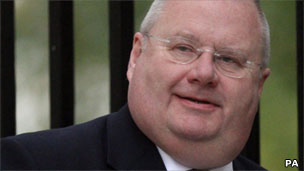
Secretary of State Eric Pickles MP

It includes factors such as revenue from the NHS, but makes it difficult to make direct comparison with the previous grant settlements.

Hmmmm.

I sniff the whiff of a smokescreen.

Isn't it a long way from plain english to describe for example cuts of nearly 15 percent in taxpayers cash for local services as "less than one percent"?

And yet that's what seems to be the true situation in Hampshire. Check out these comments this evening from Ken Thornber, the very experienced, Conservative leader of Hampshire County Council, who said:

"Hampshire will see a cut in its Government grant of £31m or 14.3% which is higher than the average cut announced as part of the comprehensive spending review earlier this year. In 2012/13 the Council will lose from its grant a further £22m or 11.6%.


"This dramatic reduction in our grant is as bad as we expected having known for a while that local government faces significant cuts in its government funding over the next four years"

On the "plain english" figures from DCLG Dorset appears to be the biggest winner in the country with an INCREASE of 0.25% in "spending power".

But tonight they've confirmed that they're pressing ahead with 700 job cuts, whilst scratching their heads at the government figures, this from the press office:

"Unfortunately we still haven't received official confirmation of Dorset's Government grant settlement. Even taking into account announcements which have been made at a national level, we are unable to provide an accurate comment/reaction this evening because of the complexity of the information currently available."

So when this evening an e-mail arrived from Eric Pickles himself entitled Putting You Back In Control and promising freezes in council tax going forward I found myself spending an extra moment or so trying to read between the lines...

This is important. If we really are being trusted with local control we need to hear it plain, simple and unadorned.

David Cameron's happiness principle

Peter Henley|14:50 UK time, Saturday, 11 December 2010

Last month the Prime Minister announced that the government will be spending two million pounds trying to measure the nation's happiness. When we're short of money it seems a strange idea. But today Portsmouth Council went one better. They launched Goodwill Day.

On Saturday 18th December the council is suggesting everyone in Portsmouth should pop into their neighbour, phone a relative, or just give someone a cheery hello in the street.

It's the idea of councillor James Williams who is worried that many people are lonely at Christmas. He wants to encourage more human contact.

There's actually a huge movement starting around this idea that wealth isn't everything in a modern society, something we'll be exploring on Sunday's Politics Show. At Wellington College Anthony Seldon has started lessons in happiness. Here's his take on why it's needed.

In order to see this content you need to have both Javascript enabled and Flash installed. Visit BBC Webwise for full instructions. If you're reading via RSS, you'll need to visit the blog to access this content.


BBC © 2014The BBC is not responsible for the content of external sites. Read more.

This page is best viewed in an up-to-date web browser with style sheets (CSS) enabled. While you will be able to view the content of this page in your current browser, you will not be able to get the full visual experience. Please consider upgrading your browser software or enabling style sheets (CSS) if you are able to do so.