BBC BLOGS - Paul on Politics

Archives for October 2010

Paul Gregg & the benefits conundrum

Paul Barltrop|18:44 UK time, Friday, 29 October 2010

Tackling the benefits system won't be easy.

Understanding it is the first task - there are more than 50 benefits you can apply for and no one seems to really understand how it all works.

Even his detractors give credit to Iain Duncan-Smith for getting out and about on this.

But critics of the changes being planned say we shouldn't underestimate what is being proposed.

According to a former Labour government advisor, it is nothing short of a dismantling of one key plank of the welfare state: a trend, he says, which has been on the rise since the 1960s.

Professor Paul Gregg, of the University of Bristol, worked on the benefit system for New Labour.

In particular, the Employment and Support Allowance (ESA), which has slowly been replacing Incapacity Benefit.

This is a benefit paid at a higher level for the very sick and very disabled.

Admittedly, only after complicated assessments; but it was designed as a support-first, work-second benefit, offering personalised help for those trying to get back into work.

The government wants to move most claimants after a year from ESA and onto Job Seekers' Allowance.

This pays less and has more conditions attached.

Prof Gregg's point is that ESA is one of the last contributions-based benefits being paid out - that you get it in part because of any National Insurance payments you've made in the past.

The idea that you get more from the state if you fall ill because you've paid more in was a founding part of Beveridge's welfare state.

But, like Housing Benefit, it could be seen as a barrier to a Universal Benefit system - hence the attempt to change it.

The government argues that anyone who can't work won't be made to, and that those who need support will still get it.

However if the support you get isn't based on your contributions, but on a residual benefit system designed to protect people in the worse-case scenarios, the question is opened up - why work?

Especially as the shift to means-testing (think Child Benefit) continues.

The debate has only just begun.
A hard sell for Stephen Williams & colleagues

Paul Barltrop|18:24 UK time, Thursday, 14 October 2010

Where do you start on tuition fees for the Liberal Democrats in the West Country?

Martin Horwood in Cheltenham, Stephen Williams in Bristol and Don Foster in Bath: all Lib Dem MPs here - and all in university towns.

They all signed up to the (manifesto) pledge to scrap tuition fees over six years.

There are several ways to view this: the most abstract is as a basic u-turn which will leave many supporters cold.

Like Trident and nuclear power, the beards and sandals brigade will be seething - it's the principle of the thing after all.

But MPs seem to be finding the ubiquitous coalition wriggle room in the argument that Browne's report is "fairer" than the system we have now - and having them in the coalition has softened what the Tories may have done on their own.

Stephen Williams has been his party's spokesman on higher education, so has faced tough questions about their change.

He told BBC Points West: "The report recommends a much more progressive system than we currently have, because if you're a high-earning graduate you'll pay back much more than a middle-earning graduate and lower earning graduates may not pay back anything at all."

Some modelling systems dispute this, but it shows the wider political battle being fought: which party is the more "progressive"?

Labour used this term as a rallying cry at its conference, and at PMQs David Cameron assumed the mantle in his defence of scrapping child benefit for higher earners.

But selling yourself as progressive is a bit like selling apple pie and ice cream: who's not going to buy it?

So the Lib Dems may have to work harder.

On tuition fees, they think they can insert progressive measures into the legislation, such as stopping higher-earning graduates paying off their debt too quickly, thus avoiding lucrative interest repayments which could be used to fund others in the system.

No Lib Dems we've spoken to will say for sure which way they'll vote on this: keeping their powder dry means - they say - they have leverage on these finer points of detail, which they hope will make the news once the headline writers have moved on.

It is worth remembering though that Labour flipped on tuition fees in 1997 - and stayed in power for 13 years.

In part, because while there may be 70,000 students in the west, many of them don't vote here - or even in their home constituencies.

They're transient - and crucially, they're used to paying for their education now.

Togetherness... Don Foster and Eric Pickles

Paul Barltrop|11:51 UK time, Monday, 11 October 2010

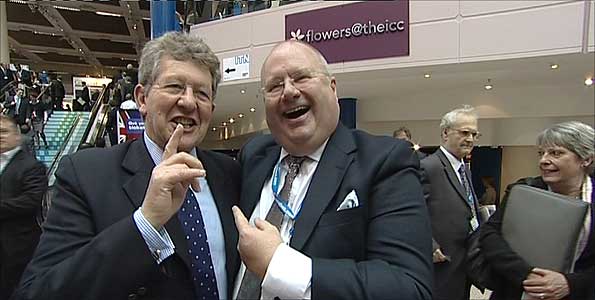
Bath and LibDem MP Don Foster embracing Tory cabinet minister Eric Pickles

Politics never ceases to surprise.

At this year's Tory and Lib Dem party conferences journalists looked in vain for legions of activists angry at the coalition.

Instead, with the Conservatives in Birmingham, I was treated to the strange sight of the visiting Bath MP Don Foster (Lib Dem) embracing Tory cabinet minister Eric Pickles.

They hugged for the cameras.

"We are together!" proclaimed the portly Mr Pickles.

"Forever!" added an aide.

"No, not forever," chuckled Don Foster, their arms still intertwined. "Distinct parties working together in the common interests of the country!"

He found no hardship in spending two days at his former foes' conference.

The political co-habitation has even earned praise from Ian Liddell-Grainger.

Back in May the Bridgwater MP was an instant critic of the coalition, stating he "never trusted the Lib Dems", and poking fun at his neighbours who'd been appointed ministers.

Five months on, the contrast is amazing.

"Dealing with my two local MPs, Jeremy Browne and David Heath, has actually been a revelation. They're doing really well," he told me. "I find that quite intriguing!"

His colleague Jacob Rees-Mogg of North East Somerset has gone even further.

He's proposing a political marriage, saying the two parties should fight the next general election in coalition.

That sort of talk would have been unheard of a few months ago.

And I suspect we won't hear much of it around the time of next year's elections, when local Tories and Lib Dems will do battle for control of the local council.

BBC © 2014The BBC is not responsible for the content of external sites. Read more.

This page is best viewed in an up-to-date web browser with style sheets (CSS) enabled. While you will be able to view the content of this page in your current browser, you will not be able to get the full visual experience. Please consider upgrading your browser software or enabling style sheets (CSS) if you are able to do so.