BBC BLOGS - Paul on Politics

Archives for May 2010

Moving on... in opposition
Paul Barltrop|12:53 UK time, Friday, 28 May 2010

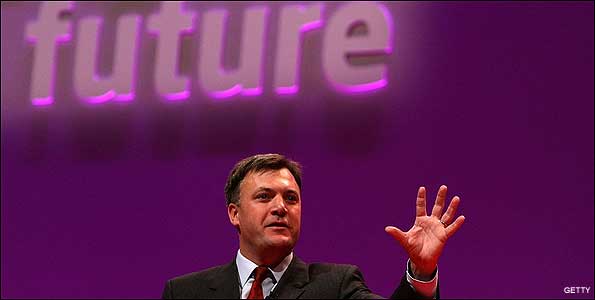
Ed Balls

What do you do once your days in power are over?

A question facing many an ex-Labour MP in recent weeks.

One described the process of losing their seat as "like a bereavement": perhaps unsurprisingly then, many have been reluctant to talk to us recently.
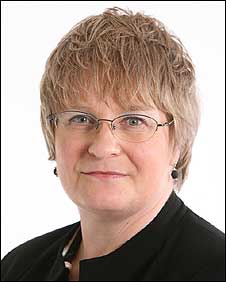
Anne Snelgrove

Anne Snelgrove, the former Labour MP for Swindon South, took some persuading, but eventually let our cameras in.

She has the dubious honour of losing a seat Labour had held since it was created in 1997.

But she says she has no regrets.

"It's sad. I lived with it for five years... But my conscience is clear, I did my best for Swindon."

She defended Labour's spending record, and told us she was worried about cuts - like those to the South West Regional Development Agency - which could impact badly on her town.

Anne is now helping co-ordinate Ed Balls' bid to be Labour leader: a poisoned chalice perhaps, if the coalition survives?

But no real surprise, given that Mr Balls is seen as a close ally of Gordon Brown, whose Parliamentary Private Secretary, affectionately known as his hugger-in-chief, was... Anne Snelgrove.

"Ed has the right mixture of toughness and emotional intelligence," she said.

Although she admits that the contender - like Gordon Brown - may need to change the perception people have of him, if he's to succeed in a media-driven age.

It seems then that you can take the woman out of politics, but not politics out of the woman.
Split over nuclear power

Paul Barltrop|16:46 UK time, Friday, 21 May 2010

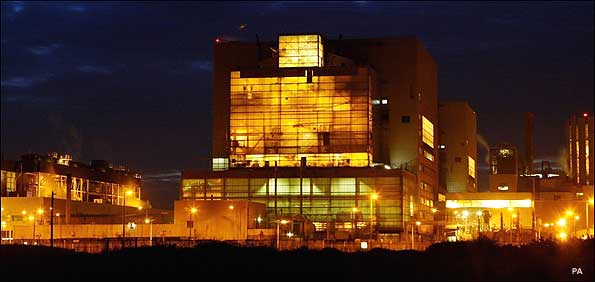
Previous generation of nuclear power station in England

No, it's not so much the coalition which is divided over nuclear power.

Rather it is the Liberal Democrats whose party line is to oppose it.

A substantial minority think it's needed as we move to a low-carbon future; but the party also worked hard for support from green-minded voters.

I quizzed Chris Huhne on it when he visited Wiltshire during the election campaign.

He chose his words carefully - even though he could not have imagined within weeks he would be in charge at the Department of Energy and Climate Change.

He cited two problems: how long new nuclear would take, and how much it would cost.

Yet one of his first acts as Secretary of State could tilt the financial balance in favour of nuclear.

The government will set minimum levels for the charges paid by big greenhouse gas emitters - like coal and gas power stations.

That may push up energy prices, but it will also give a big boost to non-polluting renewables and nuclear.

Every Lib Dem I've talked to admits it is an issue that divides them; one suggested a third of members disagreed with the party line.

So the coalition compromise may be quite a relief.

Lib Dem MPs can stick to their principles and, er, abstain in Parliament.

And their government can stick to its principles and give no subsidy to the nuclear industry - having helped ensure it won't need it.

Toasting the new politics

Paul Barltrop|16:08 UK time, Sunday, 16 May 2010

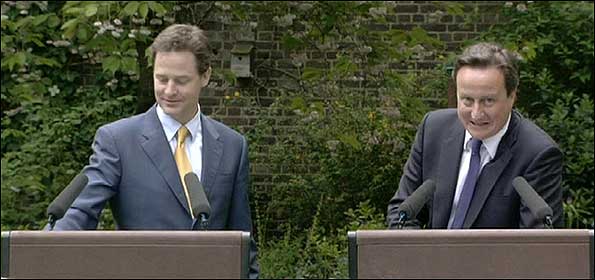
Nick Clegg and David Cameron

Old habits die hard, especially in our tribal, confrontational brand of politics.

Getting a group of Conservative and Lib Dem activisits together to chat on television about their parties' parliamentary marriage wasn't plain sailing.

The Tory club in North West Bristol wobbled a bit when they heard we wanted to bring several of the other side into their bar.

And it took some effort to find party members to go face to face on live TV.

But the end result was an antidote to the normal, cynical view of parties and their members.

Looking at the half dozen sipping drinks together it was hard to guess who came from which party.

Among them: a British Asian woman, who works in the public sector, a male teacher who used to be a Labour councillor, and a middle-aged woman who'd spent 25 years fighting the other lot.

The ice broken, they chatted cheerfully about the challenges facing the coalition.

And under the intimidating glare of a live camera the mood of goodwill didn't wilt (not even when I asked, rather meanly, "What do you like least about the Lib Dems?").

As we handed back to the studio, they toasted the new government.

And as we packed up our vehicles and prepared to drive off, one Lib Dem was still happily inside talking to the Tories who until a week before had been her biggest rivals.

If their leaders can keep it as convivial, maybe this marriage of convenience can last.

Politics certainly does look different these days.

Especially when you put the party labels to the activists: the British Asian woman and the ex-Labour councillor were Tories, the older woman was a Lib Dem.

The mood in the Lib Dem heartlands

Paul Barltrop|14:25 UK time, Tuesday, 11 May 2010

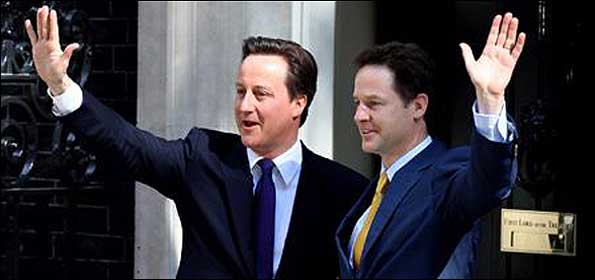
David Cameron and Nick Clegg

As their party's top MPs decide how to form Britain's next government, Liberal Democrat party members must watch anxiously from the sidelines.

The West has always been good for the party; and while Election 2010 was disappointing nationally, in this region they fared well.

Votes for nearly all sitting MPs rose, they won the new seat of Chippenham, and took Wells from the Conservatives.

It has been a rollercoaster of a ride since then, but this is a journey with real dangers.

Members I talked to in Somerset all voiced support for their party leader.

But it's not long before apprehensions appear - especially about putting their old foe into power.

One local party chairman said she viewed the prospect of a Conservative - Lib Dem coalition "with great horror".

Others described how it went against the grain of their campaigning in an area where it's a two-horse race with the Tories.

But all emphasised that electoral reform was THE top priority.

If, as looks likely, that comes, they'll have to get used to making deals with other parties.

Hung Parliament: the lesson from South Gloucestershire

Paul Barltrop|14:25 UK time, Tuesday, 4 May 2010

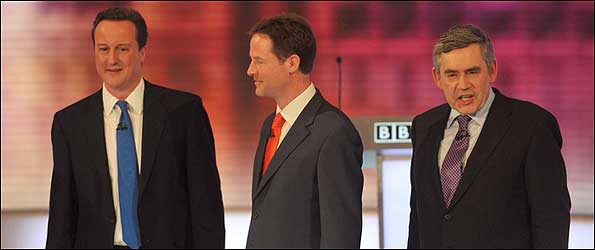
David Cameron, Nick Clegg and Gordon BrownUncertainty.

That's a sentiment that you'll find everywhere in this election.

People are uncertain who to vote for.

Everyone is unsure what the results will be on Thursday night.

Question mark c/o AFB/Getty Images

But for voters there's another big unknown: what a hung parliament would mean.

People can be pretty unaware that elsewhere in the UK there are legislatures in which no party has an overall majority - and yet Wales, Scotland and Northern Ireland are not politically paralysed.

The fact is we in the West should be used to it, because lots of our councils are run this way.

Take South Gloucestershire: the council has been hung for seven years.

The Tories presently run it as a minority administration; previously all three parties had managed to share power very politely (that's something no one could imagine happening at Westminster!).

And the result?

Last year the Audit Commission gave their verdict: a top 4-star rating, and special praise for its cross-party working.

A lesson for Westminster from the West...?

BBC © 2014The BBC is not responsible for the content of external sites. Read more.

This page is best viewed in an up-to-date web browser with style sheets (CSS) enabled. While you will be able to view the content of this page in your current browser, you will not be able to get the full visual experience. Please consider upgrading your browser software or enabling style sheets (CSS) if you are able to do so.