Just in case you thought otherwise, we are not about to read the minutes of the crucial cabinet meetings from 2003 leading up to the invasion of Iraq. This, despite the fact that the Information Tribunal has just ordered the government to release them. [Update 1809: Read the decision here [2Mb pdf].]
 Having first failed to persuade the Information Commissioner (who argued that "release of these two specific and unusual sets of cabinet minutes would not in itself undermine the convention of cabinet collective responsibility") and then having failed to persuade the Information Tribunal the government can still try to persuade a court of its case that releasing cabinet minutes could impede free and frank discussion in the future.
Ministers could also decide to make use of the ministerial veto which was written into FOI legislation as a backstop. It would be the first time it had been used.
Proof that ministers and senior civil servants have taken this case very seriously came when the Cabinet Secretary, Sir Gus O'Donnell, decided to give evidence at the Tribunal. Proof of the historical significance of the case came when the distinguished Whitehall historian Professor Peter Hennessy decided to give evidence against him.
No imminent decision is expected.
Incidentally, if the minutes are published some people may be disappointed since by tradition cabinet minutes list the points made around the cabinet table and do not say who made them.
It's House of Lords quiz time.
What is the difference between a "paid advocate" and a mere "consultant"? The answer is that it's not at all clear. Yet it's a distinction which is crucial to the question of whether Lords are available for hire to rewrite the laws of the land.
"Paid advocacy" is banned under the Lords' own rules which state that members of the house "must never accept any financial inducement as an incentive or reward for exercising parliamentary influence" and go on to say the members "must not vote on any bill or motion or ask any question on the house or a committee or promote any matter in return for payment or any other material benefit".
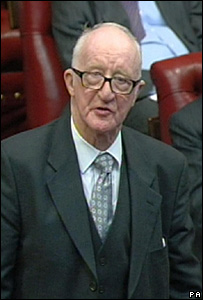 Consider the case of the Labour peer, Lord Taylor of Blackburn, whose private indiscretions to those he thought might be about to hire him were made public yesterday by the Sunday Times.
On the tape of his conversation with undercover reporters, he boasted that he received over £100k for his services and talked about the company Experian, which is advising the government on ID cards, and how he had helped them to amend and delay a particular piece of legislation. He is employed by them as a "a non-parliamentary consultant".
Consider too the case of Lord Hoyle, who was investigated after the Guardian alleged that he had introduced a lobbyist for the defence industry to a defence minister.
Lord Hoyle was, you've guessed it, employed as a "non-parliamentary consultant" by "Whitehall Advisers". His defence - which was successful when his case was investigated by the subcommittee on Lords Interests - was that the meeting had been for social not business purposes, that "Whitehall Advisers" were not lobbyists but advisers to the defence and aerospace industry and that it could not be proven that he had failed to declare his financial interest to the minister.
Consider finally the case of Lord Moonie who, according to today's Telegraph, has tabled 40 technical questions on defence issues since September, compared with six in the previous three years. He is, of course, an adviser to a number of firms with defence interests.
Now, the Lords is not the Commons. Peers do not receive a salary (they get a daily attendance allowance). The "real world" experience peers can bring to the job is valued by many. Many consultancies and advisory jobs stem from that experience rather than being closet lobbying contracts.
However, the distinction between acting as a consultant and as a "paid advocate" which is clear in the minds of many lords and ladies is far from clear to them all or to the public whose interests they are meant to represent.