Four billion pounds (to be precise, £4.1bn). That's the cost of today's Tory pledge to scrap the tax on savings for basic rate taxpayers and to increase tax-free allowances for pensioners. So how will they pay for it? The answer is by spending less starting now.
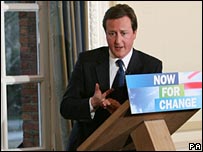 Before Christmas David Cameron had already reversed his policy of matching Labour's planned spending increases for 2010 onwards. Now he's saying he'd spend even less this year too. He hasn't however specified what programmes he'd spend less on. That is not how government works. He has a point.
When any large organisation - the BBC for example - cuts spending its boss announces target savings and his underlings are tasked to identify how exactly they can be found. That however has not been how politics has worked for the past two decades.
For three elections Labour has simply added up Tory "spending cuts" - in fact pledges to increase spending at a lower rate than the government - and then they've told voters how many doctors, nurses or policeman would go as a result. In response, the Conservatives have specified savings in waste or government programmes that they cancelled. In each case the Tories lost the argument and the election.
BCC (that's Before the Credit Crunch), David Cameron and George Osborne concluded that they could not win this battle and that the next election would be all about "it's society, stupid". Today's announcement confirms that they've been forced to return to the fray. Their hope is that the changed circumstances, falling interest rates, rising debts and Labour's acceptance that spending can't go on as it has ,will make their policy an election winner now as it's not proved to be in the past.
Are the Tories about to pledge to abolish tax on savings?
The signs are all there.
 This morning on the Today programme the Tory leader promised to set out how his party would help savers and how they'd pay for that help in a speech he's making this lunchtime.
A week ago the shadow chancellor told the Sunday Times that he wanted to help people "who did the right thing in the age of irresponsibility". The paper reported that he was working on a £2.4 billion plan to abolish the basic rate of tax on savings and spending even more to increase the tax-free allowance for pensioners.
The Conservatives are likely to claim that their proposals will encourage "individual independence" and "social responsibility". Those are the words used by William Hague when he proposed a similar package in February 2001.
If Labour want to save themselves time they could dust off their press release from that day when a certain Alistair Darling declared "This is the same old Conservative Party. Its sums don't add up".
Plus ça change, plus c'est la même chose, you may say.
There is, though, one massive difference between the politics of 2009 and 2001. It's the recession.
The Conservatives can argue now as they couldn't then that savers are suffering thanks to plummeting interest rates. Indeed, they can quote the prime minister himself who told Andrew Marr yesterday that ministers were looking at ways to do "more to help savers" in the run-up to the Budget.
What's more, they can point to the need to build an economy based on saving and not debt.
Labour, of course, will demand to know where the money's coming from. Before Christmas David Cameron signalled that the answer was lower public spending. If he doesn't spell out today what he'd spend less on, ministers are likely to come up with answers of their own.