

Forcing the banks
Can the government force the banks to pass on interest rate cuts and, if so, why won't they? That's the question I put not once but several times to the Chancellor this afternoon.
Alastair Darling's reply was instructive. It's "imperative" that banks pass on the cut he said but the government could not set the price of their financial products.
In order to see this content you need to have both Javascript enabled and Flash installed. Visit BBC Webwise for full instructions
Hold on a second, you may cry. Didn't we the taxpayers bail out the banks? Weren't we told that in return the Treasury had demanded strict conditions? The answer is yes, yes and but.
The government helped every bank in the country by guaranteeing lending between banks. It got no promises on lending in return for that.
It fully nationalised two banks - Northern Rock which is obliged to lose customers and shrink its business plus Bradford & Bingley which is effectivley closed to new business.
It took stakes in three banks - RBS, Lloyds/TSB and HBOS - in return for promises that they stood ready to lend on the same scale as last year, that their loans would be "competitively priced" and that they would be properly marketed.
These conditions were designed to ensure that the banks didn't merely pass taxpayers money onto their shareholders. What they did not do is allow ministers to force banks to pass on individual interest rate cuts.
As shareholders the government clearly has huge power. However, as one Treasury insider put it to me, it's the power a Sainsbury shareholder has to raise concerns about pricing policy not the power to set the price of cabbages in Wigan.
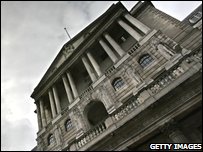 But let's get to the nub of the matter. Ministers don't want to set the price of loans (let alone cabbages). They know that the the Bank of England base rate is not the price banks pay to borrow money on wholesale markets.
They are hopeful that that rate - the LIBOR - will come down.They believe that with the help of a bit of added political pressure the rates banks charge small homeowners and small businesses will come down. They accept that that might take a few days.
What if they're wrong and those rates still don't come down? That's one answer I didn't get.
 I'm
I'm 



Page 1 of 2
Comment number 1.
At 18:16 6th Nov 2008, notsosilentmajority wrote:Looks like the Bank of England has decided it can no longer go along with Gordon's "we are best placed" doctine, and has now admitted that we are very much in trouble.
Complain about this comment (Comment number 1)
Comment number 2.
At 18:18 6th Nov 2008, CarrotsneedaQUANGO2 wrote:Amazing..... not one straight answer.
Time for change, time for renewal.
Time to go.
Complain about this comment (Comment number 2)
Comment number 3.
At 18:23 6th Nov 2008, Dave Manchester wrote:It's a vicious circle - the LIBOR, being a measure of risk, isn't going to come down until economic conditions allow, whilst our debt-based economy is unlikely to improve with out the LIBOR going down...
There is little the government can do, it's a bed of their own making - Browns refusal to deal with a decade of debt - all we can do is hope something breaks the deadlock.
Complain about this comment (Comment number 3)
Comment number 4.
At 18:24 6th Nov 2008, phoenixarisenq wrote:Most people will be relieved and happier if they find themselves paying less interest. Yet, why do I worry if people are not happy? According to a government report issued today people here are mostly happy and optimistic. I haven't given the link here, as I was moderated last time I did that, but here is a small cutting;
Nine out of ten people are happy - and seven in ten optimistic about the future - a government survey suggests.
"This is more like it," I can here Hazel Blears mutter with a grin.
Complain about this comment (Comment number 4)
Comment number 5.
At 18:29 6th Nov 2008, virtualsilverlady wrote:You were right Nick when you said the government had pressed the panic button.
They are now like headless chickens.
No plan! No idea!
We are being kept in the dark again about how bad it really is.
To push the panic button now at the beginning of the recession does not leave enough over to kick start the economy when it will need it most. At the bottom.
All the variables are hicklety picklety and nothing appears to be in any sort of order.
Absolute chaos.
See David Owen's interview with Andrew Neil last weekend.
He has more idea than anyone so far on what is going on.
Complain about this comment (Comment number 5)
Comment number 6.
At 18:30 6th Nov 2008, Ilicipolero wrote:At long last, has Nick Robinson finally got around to asking a Cabinet Minister a seaching question? I'm not exactly bouyed by the answer either!!
Complain about this comment (Comment number 6)
Comment number 7.
At 18:41 6th Nov 2008, Charles_E_Hardwidge wrote:I'm sure the government could regulate if it wanted to. Then again, letting the banks flaunt their arrogance and greed so brazenly might help people get a moment of clarity: the banks don't know business nor do they care for you.
Banks were up to their noses in destroying business and ruining communities because they can't look beyond the numbers or have a stake in whether Mrs Jones down the road gets mugged by heroin addicts.
The way the banks are behaving it's like they're begging to be slapped. When you're at the top and your decisions effect many peoples lives you carry a special responsibility. I think, nobody in the entire banking industry should get a fat-cat bonus until this mess has been sorted out.
Complain about this comment (Comment number 7)
Comment number 8.
At 18:54 6th Nov 2008, ExcellenceFirst wrote:Have you ever thought of asking Mr Darling, or Mr Brown, or ... well, just about any politician really, whether he believes the public's willingness to accept "spin", in all its senses, is something that is at a fixed level. In other words, does he believe that the public's willingness to respond to the wishes of politicians is unaffected by the amount of spin they have been given?
The current rationale is of the truth being redundant, because it is always markedly second-rate in comparison with the spin. It seems to me that this could be poisoning the ability of future, possibly more honest politicians, to use the odd white lie, in extremis, when perhaps there's too little time to establish the truth as being the necessary course of action.
But I suppose it doesn't matter very much if the general population is equally capable of being persuaded either by the truth or by non-truth. Nor, indeed, if it makes little difference if politicians are regarded as sagacious mentors or devious snake-oil salesmen.
It would be an interesting subject for debate though, don't you think?
Complain about this comment (Comment number 8)
Comment number 9.
At 19:32 6th Nov 2008, kaybraes wrote:The banks would be mad to cut lending rates in the present economic climate. They need cash coming in to stay in business not cash going out to prop up failing businesses and negative equity mortgages. If the chancellor is so confident recovery is inevitable, lets have some tax cuts, fuel, income tax or VAT, this would help everyone out, and reduce costs to business; fat chance ! Quote of the week from Jaquie Smirff ; " people have been coming up to me and asking when they can have an ID card " Yeah right !!!
Complain about this comment (Comment number 9)
Comment number 10.
At 19:36 6th Nov 2008, Andrew Z wrote:Trouble is, who can the banks lend to without getting themselves into a deeper hole?
Lending used to be much more of a judgement call, based on personal knowledge of the borrower. Not any more.
Credit scoring works in a commoditised business model until people learn how to work the system, then it breaks down. Now the banks have got rid of the old-fashioned bank manager and they won't get him back in a hurry. They're without a compass and they're understandably scared.
What I suppose the government wants is a return of irresponsible lending to compulsive consumers. Another dose of the same, in fact.
Complain about this comment (Comment number 10)
Comment number 11.
At 19:37 6th Nov 2008, Ed2003 wrote:Which is why, in my view, the base rate cut is too excessive and has the desperate political leanings of Gordon Brown written all over it.
All that will result from keeping policy rates this low is to stoke another boom in asset prices once banks have regained confidence and rebalanced their books.
A big factor in the rate cut being on this scale is simply to provide Brown with something to point to when saying "look I'm doing something" and so he can gloat about historically low interest rates.
The problem is not with the base rate (in relative terms) but with the freezing of the commercial money markets and the overvalued assets of financial institutions.
Complain about this comment (Comment number 11)
Comment number 12.
At 19:40 6th Nov 2008, jonties wrote:Robert Peston on Five Live this evening explained (between giggles and half sentences) that the banks have to pay from 6-9% to borrow from another bank. If they lend to the customer at too low a rate, they will not make the profit that is required and the government will continue to have a stake in a nationalised bank for some time to come.
If I understood him correctly, I can't grasp how the system can work and wonder why this was not all thrashed out at the time of investment by the government.
Complain about this comment (Comment number 12)
Comment number 13.
At 19:41 6th Nov 2008, cyberVoiceofreason wrote:It is mind boggling to think about how much "spending power" this is going to put back into the pockets of the UK consumer.
On a typical mortgage of £100k this will save the borrower £1500 per annum. If that same borrower is on an average wage of say £25k per annum, this drop in base rate is equivalent to them receiving a 7.5% pay rise (when adjusted for tax). Incredible really.
Now we all have to hope that:-
1. The Bank's pass this on (and the signs are good on this)
2. We all go out and spend it and kick start the UK economy.
Oh and by the way, don't think this the last rate cut, another 0.5% by January is almost certain.
Complain about this comment (Comment number 13)
Comment number 14.
At 19:43 6th Nov 2008, MikeSC6 wrote:They're scared of doing anything that could be construed as socialist :/
Complain about this comment (Comment number 14)
Comment number 15.
At 19:50 6th Nov 2008, Papertrail123 wrote:It appears that certain Banks have little interest in their Customer base, nor positive recognition to the Taxpayer (where applicable), for the enormous financial support provided recently.
Apparently some Banks that fail to on-pass the full benefit of recent Interest Rate reductions to their Customers consider that such behaviour is acceptable during this period of financial turmoil, caused primarily by the greed and incompetency of their industry.
Unfortunately the FSA and Politicians, including the Prime Minister and the Chancellor, cannot convince all the Banks of their responsibilities in this current crisis.
It appears that the Banks believe they are negotiating from a position of strength and any loyalty to their benefactors or customers is of little consequence.
(This may be a miscalculation as they rely heavily on their customer base as a source of retail funds.)
I have concerns that the Public, (and Corporate Employers), may demonstrate their disillusionment by withdrawing their funds from those tight-fisted banks who decide to increase their lending margins at this time.
Should this occur then the Government could assist by encouraging Northern Rock to accept any transfer funds and enhancing the role of that institution to provide full banking services.
Complain about this comment (Comment number 15)
Comment number 16.
At 19:56 6th Nov 2008, riverside wrote:Reality dawns for AD. You cannot make demands when there is no effective penalty. The overriding fear is the loss of loaned capital, the interest rate is secondary today. AD is not driving this particular show. The cut in interest rates although good is made too late, it has to be read as reactive not proactive. At least 2 months late. The usual British fear of inflation overriding the risk of recession. What next for AD. We are talking of months not weeks before the fear of compounding failure within the banking sector eases. The cupboard looks a bit bare, in fact the only step available to AD would appear to be borrowing to prop up public spending. This is a somewhat uneasy policy when there is no clear end game in sight - and projections - until there is more evidence - have to be regarded as suspect. What we are seeing is very basic. The government is actually not any good at commercial activities, that is not its job. Its job is regulation, which it has been dismal at, and the commercial sector is not immediately responsive to a regulators instruction on commercial activity. Until the British government clearly understands what its role is and stops pretending to itself that it has influence it does not possess, the game will be a very slow one.
Complain about this comment (Comment number 16)
Comment number 17.
At 19:59 6th Nov 2008, John_from_Hendon wrote:When the head of a big important organisation gets it very wrong, generally he does the decent thing and resigns - Mr. King please consider your position!
How come the Bank's forward view a month ago did not see this coming - they are either incompetent forecasters or duplicitous ostriches!
Please explain why Mervyn King should not resign?
Complain about this comment (Comment number 17)
Comment number 18.
At 20:00 6th Nov 2008, delminister wrote:northern rock was typical half hearted attempt by this government to look good and placate people.
the bradford was a total failure becouse they gave the profitable section to an overseas bank.
this government is afraid to challenge the banks basicly becouse they dont know how to.
if it was to profit them they would do everything and anything to get the cuts required.
but just to help the people forget it we are of no importance to them.
Complain about this comment (Comment number 18)
Comment number 19.
At 20:05 6th Nov 2008, shellingout wrote:Nine out of ten people are happy - and seven in ten optimistic about the future - a government survey suggests.
The only thing this suggests to me is that the government are all so deluded that they are making up their own surveys.
Complain about this comment (Comment number 19)
Comment number 20.
At 20:07 6th Nov 2008, Broadfern wrote:Are the BoE insane or are they doing what their political masters have told them to do? They risk the economy oscillating wildly and going completely out of control. Didn't we get into this mess because people, companies and the government borrowed too much? Cutting interest rates will encourage even more borrowing by desperate people. Th cut may delay the recession but it will only make it even worse when it comes. Interest rates should have been left unchanged (or even raised) to encourage saving and discourage borrowing. Instead of cutting interest rates, taxes should have been drastically cut, but our Labour government would never agree to this. This panic action shows the falsehood of Brown's claim that Britain is suffering from an economic downturn in common with other countries. Clearly our problems are far worse and the government must resign.
Complain about this comment (Comment number 20)
Comment number 21.
At 20:14 6th Nov 2008, power_to_the_ppl wrote:The one thing that we know for sure
Is that Labour will take more and more:
With their lies and their spin
And their hands stained with sin,
Nu-Lab are rotten to the core!
Complain about this comment (Comment number 21)
Comment number 22.
At 20:20 6th Nov 2008, power_to_the_ppl wrote:The vast, vast majority of the public just want to live in peace, get on with their lives and have an honest government looking out for their best interests. I doubt there is anyone here, left or right who thinks otherwise. Why is this really so hard to achieve?
As much as I hate Labour, if they were to change their ways and become honest I would give them my full support. Let us do unto others as we would have them do unto us. Then we would all be happy, surely?
Complain about this comment (Comment number 22)
Comment number 23.
At 20:25 6th Nov 2008, saga mix wrote:Nationalise properly for goodness sake.
Politicians, not bankers, on the Board.
Let's please stop messing about.
Complain about this comment (Comment number 23)
Comment number 24.
At 20:28 6th Nov 2008, DistantTraveller wrote:The Government not only wants the banks to pass on the reduction of interest rates to customers, it also wants to see more lending.
But what the government wants, and what is right for the economy do not necessarily run together. I wouldn't trust Brown and Darling to run a whelk stall, let alone a bank.
Too much lending (without properly assessing the borrower's ability to repay) is precisely what got us into this mess in the first place.
Banks now need to look sensibly at the risk - not bombard customers with offers of loans, or extra credit cards.
Complain about this comment (Comment number 24)
Comment number 25.
At 20:38 6th Nov 2008, JohnConstable wrote:The market works in its mysterious ways but without too much Government 'help', would have punished the feckless banks by slowly draining them of customers.
Already, in the market place, some financial institutions are exploiting the fear and loathing that many people feel for some of the 'troublesome' mainstream banks, who, for reasons that are beyond me, are being bailed out with our tax money and/or printed money - whatever, we the people are still being penalised.
So, for example, I see in the Times today, an advertisement for a bank that explicitly comforts its readers by stating that it only lends 'real money'.
That is money deposited by its savers - one for all you Fractional Reserve Banking haters.
I hope that the millions of people out act accordingly there vote with their savings to punish those banks who have been greedy and downright irresponsible.
Complain about this comment (Comment number 25)
Comment number 26.
At 20:45 6th Nov 2008, sicilian29 wrote:It appears that The Government think they are in charge but in reality have their hands tied behind their backs. Wonderful!
Complain about this comment (Comment number 26)
Comment number 27.
At 21:01 6th Nov 2008, Danricv wrote:Hi
Its crazy
We save the Banking institution and in return they look after themselves and no one has the courage to stand up to them and think of the normal person who has to survive. If they do not help us-they should not exist just for their own benefits.
Complain about this comment (Comment number 27)
Comment number 28.
At 21:01 6th Nov 2008, JohnConstable wrote:cybervoiceofreason @ 13
I do not think that this rate cut is going to put all that much money back into peoples pockets.
According to the Council of Mortgage Lenders website spreadsheets, roughly three-quarters of all borrowers are currently on a fixed rate mortgage at an average interest rate of 5.70%, on just over one-and-a-half million mortgages.
Even for those on BBR trackers and other variable rate mortgages, I would suggest paying down some debt or saving the savings would be more sensible than hitting the high street.
Because in the current climate .. it could be you .. losing your job next.
Recently I even heard of lawyers and their clerks being laid off locally ... which surely must be a very gloomy sign indeed.
Better days will come but we apparently 'have' to suffer this financial hangover first.
Complain about this comment (Comment number 28)
Comment number 29.
At 21:02 6th Nov 2008, Danricv wrote:This comment was removed because the moderators found it broke the house rules. Explain.
Complain about this comment (Comment number 29)
Comment number 30.
At 21:03 6th Nov 2008, Sevillista wrote:Can't come here much - everyone is VERY unhappy
Complain about this comment (Comment number 30)
Comment number 31.
At 21:04 6th Nov 2008, herb_igone_ex_tuga wrote:This comment was removed because the moderators found it broke the house rules. Explain.
Complain about this comment (Comment number 31)
Comment number 32.
At 21:10 6th Nov 2008, T A Griffin (TAG) wrote:Nick,
all you have to do is to look at the history of the former Midland Bank when it took over Crocker Bank in The USA. They let the existing management continue and it left the Midland open to the take-over by HSBC.
It really is that simple, if you put money into an organisation without putting in your own management, then you are seriously stupid. You deserve everything that you get.
This is not rocket science. In the meantime the markets continue to fall, big time. You just don't get it do you. It is the end game, it really is just so over. I wish that I could be more scientific, but it would be very boring, so just understand, Project Griffin, it is over.
Complain about this comment (Comment number 32)
Comment number 33.
At 21:13 6th Nov 2008, UKSportsFan4Ever wrote:I think the Bank of England have contributed to the problems really hitting home in the housing market and now are being panicked into drastic corrective action. My view is based on the fact that they refused to drop rates sooner as they say they saw inflationary pressures in the economy. My understanding of this issue may be limited but, when demand pressures are dominant then the B.o.E. is probably wise to keep interest rates high, or increase them. However inflation has, for the last 18 months, been driven by supply pressures - domestic energy price hikes, oil and petrol price surges and resulting food price prices. The Governor of the B.o.E. should apologise to the British people for doing too little, too late.
Complain about this comment (Comment number 33)
Comment number 34.
At 21:14 6th Nov 2008, Rogerborg wrote:Correct me if I'm wrong - I mean, I'm not a professional political journalist - but as I understand it, the government hasn't put a penny into RBS, Lloyds/TSB or HBOS yet.
What's a few billion here or there though? What matters isn't how much you give, but how many times you announce it.
Complain about this comment (Comment number 34)
Comment number 35.
At 21:26 6th Nov 2008, JohnConstable wrote:I have to correct an error in an earlier post of mine of a few days ago, where I stated that millions would probably suffer when they come off a discount deal and onto a Standard Variable Rate (SVR) mortgage.
The CML data that I have just come across shows that only 4% of mortgagees are currently on an SVR, which is roughly 75,000 families.
Not the millions of people that I had suggested.
I apologise unreservedly for the misleading information in the earlier post.
Complain about this comment (Comment number 35)
Comment number 36.
At 21:34 6th Nov 2008, excellentcatblogger wrote:#7 CEH
You make some good points. I understand your concern with the bonus culture. The thing is the high paid attract obscenely high bonuses generating poor publicity. What is often forgotten is the lower paid workers get lower bonuses, and for them it really does make a difference from keeping the wolf from the door.
Now with poorer financial results I would not expect to see many bonuses being paid this year. Incidentally the Financial Services Authority for the year 2007/2008 did pay out performance related bonuses. Now that is cheeky, in the year that Northern Rock failed. The other issue of course is that their performance is entirely subjective with no clear tangible measure to benchmark their activity. A bit like MPs deciding their pay levels.
Whether Civil Servants should in general receive performance related pay I am not sure about. I would like to see some kind of performance pay for MPs - generous when there is low inflation and unemployment, and stringent penalties when they stuff things up. I suspect pigs will fly first.
Complain about this comment (Comment number 36)
Comment number 37.
At 21:52 6th Nov 2008, Alan Phillips wrote:I have to say well done Darling, well done Brown. As the song goes, You don't know what your doing....
The banks need a mechanism to create a risk free lending culture, they don't believe the Government and as a result they are making the government into lame ducks.
When political will bullies the bankers and their advice like this one has, don't be suprised to see them bite back. They no longer trust the government, shame it took so long to work it out,bigger shame it still is over a year before we can rid ourselves of them.
These rates can't be passed on, this would cause them to go the way of the rest of the country, on the point of going bust...
Complain about this comment (Comment number 37)
Comment number 38.
At 22:01 6th Nov 2008, power_to_the_ppl wrote:re: 35
I apologise unreservedly for the misleading information
The one thing Nu-Lab will never say to us.
Complain about this comment (Comment number 38)
Comment number 39.
At 22:04 6th Nov 2008, Only jocking wrote:Nick
AD talks of the interest cuts being passed on as "imperative" and his intention being to 'ensure' it happens. It turns out "imperative" means" he is "extremely anxious" and "ensure" means he "hopes".
So not enforce, more facilitate and exhort. Why couildn't he tell like it is, perhaps adding that the situation will be reviewed if the banks' response is inadequate?
Asking a question of politicians of any colour is like pressing the play button on a tape recorder. All you get is the pre-recorded line, irrespective of the question.
Complain about this comment (Comment number 39)
Comment number 40.
At 22:14 6th Nov 2008, oldnat wrote:#35 JohnConstable
An honourable post - what I'd expect from an Englishman.
(The Brits, of course, are a different matter altogether!)
Complain about this comment (Comment number 40)
Comment number 41.
At 22:15 6th Nov 2008, power_to_the_ppl wrote:Coincidence that there's been hardly anything on the Beeb about Glenrothes? I think not.
Complain about this comment (Comment number 41)
Comment number 42.
At 22:21 6th Nov 2008, CarrotsneedaQUANGO2 wrote:23. At 8:25pm on 06 Nov 2008, sagamix wrote:
Nationalise properly for goodness sake.
Politicians, not bankers, on the Board.
Let's please stop messing about.
FANTASTIC idea, politicians are just soooo good at running things arnt they, so organised, such clarity of thought, so little waste, such superb financial management. So progressive.
Last one to leave, turn out the lights.
Complain about this comment (Comment number 42)
Comment number 43.
At 22:24 6th Nov 2008, Papertrail123 wrote:Perhaps the Chancellor can introduce an Immoral Earnings Tax - being a tax on the immoral income taken, (not earned), by the Banks in not on-passing the full reduction in Interest Rates to their customers.
Complain about this comment (Comment number 43)
Comment number 44.
At 22:25 6th Nov 2008, mancroft wrote:Crooks. The whole lot of them. Should be locked up for fraud.
Complain about this comment (Comment number 44)
Comment number 45.
At 22:34 6th Nov 2008, DavePrice wrote:Can someone explain why, as a nationalised bank, Northern Rock cannot offer new mortgages at attractive rates?
Surely the Government could take the lead and put our money where their mouth is and get some stimulus back in the housing market by the Rock lending to good bets (i.e. Public sector workers) who may have a 5% deposit but not a 25% one.
Unless banks start lending again we're sunk. People have to move for a number of reasons including getting jobs! So why not use Northern Rock to launch a range of products that would force other greedy lenders to follow suit and bring some competition back. The Rock makes money and the free market and consumers benefit.
At the moment it looks like the banks are in collusion with each other to keep taxpayers money to bail them out but they don't want to play ball with mortgage rates or offer reasonable affordable mortgages 90% of the country would qualify for. I'm not talking about 13% LTV but back to 95% LTV would be a start. There's plenty of people earning enough to get a mortgage based on a 5% deposit but saving a 25% one is nigh on impossible.
Madness.
Complain about this comment (Comment number 45)
Comment number 46.
At 22:43 6th Nov 2008, phoenixarisenq wrote:22
Hey, pal
I share your sentiments, but old cynic that I am, there is as much chance of me winning the Lottery as a decent government coming along in the foreseeable future. Still, must keep on hoping......
Complain about this comment (Comment number 46)
Comment number 47.
At 22:51 6th Nov 2008, higherconfidence wrote:It seems obvious to me that the banks have dragged us into the mess and brought the economy to its knees. The government are working to get the economy stimulated through no fault of their own. The banks are widening their margins by not passing on these interest rate cuts, so as to make the tax payer pay back the loan from the government of tax payers money..... So I think its time now for the public to show the banks who have the real power at the end of the day and withdraw all the cash they have in the banks and lets see how quickly the banks change their arrogant views of their business environment. They really are milking the people un-fairly! All my friends who've asked me for advice have been told by me to hold tight and keep your money in the pension funds, banks etc.. My advice now is to draw the lot out and put it under the mattress. At he end of the day the government run the UK and if the banks don't start to play ball they will and should be forced to play their part, and as Gordon Brown said "we are in un-chartered water with this "type" of economy retailers and almost all other large business's have adapted their business model to suit the economy..
Complain about this comment (Comment number 47)
Comment number 48.
At 22:57 6th Nov 2008, Pravda We Love You wrote:Hooray!!!!!!!!!!!!! At last someone has been pushing a government minister hard on their economic management.
Well done Nick.
Please push the government more. Also please push the Conservative more - what are there plans?
No more tittle tattle - the public deserve answers (not that there were any mind..... but it is a start)
At last....................
Complain about this comment (Comment number 48)
Comment number 49.
At 23:03 6th Nov 2008, dardar wrote:I actually believe that with the electronic era coming of age the financial markets become irrelevant and perhaps counterproductive. Why? Because the basic market rules - supply vs demand, etc - apply when there is free competition. Classically, market rules do NOT work when there there is a cartel, or, to put it simply, price fixing. The internet has helped to create conditions in the electronic financial markets when cartel formation, price fixing, synchronised runs, etc. could be instantaneous and extremenly effective (and very damaging to you and me) yet almost undetectable. Imagine that BA and Virgin did not have the infamous phone conversation about the fuel surcharge, but instead arranged some electronic "price monitoring". The result would have probably been the same, but never detected. I am pretty sure that clever programers in the City are busy arranging market actions that have little to do with market rules.
Complain about this comment (Comment number 49)
Comment number 50.
At 23:10 6th Nov 2008, david wright wrote:Allegedly the funding provided by the government is at 12% interest. This si why the banks want to repay it in 2009/10. But it also means that if they lend it to each other, or us at 5%, they take a massive hit on the lending.
Does anyone in Nu Labour understand finance, economics or even maths?
Complain about this comment (Comment number 50)
Comment number 51.
At 23:13 6th Nov 2008, DarkThought wrote:With inflation at over 5% and interest rates at just 3%, savers are going to lose money. What a miserable reward for being prudent. Those who have borrowed too much are rewarded with cheap loans and the whole economy is being run for the benefit of the profligate, whose foolishness got us into trouble in the first place.
Those who believe that reducing interest rates will stimulate spending should think again. Many people like me, who rely on our savings nest egg, will be cutting back more than ever. An interest rate of 1% hasn't helped the US, has it?
Complain about this comment (Comment number 51)
Comment number 52.
At 23:17 6th Nov 2008, Richard from Croydon wrote:How can the Chancellor expect Royal Bank of Scotland, Lloyds TSB or HBOS to pass on the interest rate cut when the government is charging those banks 12% on the preference shares that it bought in them?
Complain about this comment (Comment number 52)
Comment number 53.
At 23:19 6th Nov 2008, HarryPagetFlashman wrote:30 Ballyhell
You clearly didn't read the whole article.
"The fieldwork was completed before the intensification of the banking crisis in September and October 2008."
Complain about this comment (Comment number 53)
Comment number 54.
At 23:21 6th Nov 2008, demand_equality wrote:I would be interested to know the views of all posters, of all political viewpoints, the answer to one simple question:
Who is accountable for UK financial industry?
i have looked at all angles and cannot see anything but sdevere trouble heading the way of every individual in the UK who currently has any borrowing commitments.
prior to labour's 1997 system, the politicians had control of intrest rates, the economy, etc, and although many complained about this (ie, parties in government manipulating it for their own political benefit) this control was accountable, via the electorate.
if they messed up, they were voted out of office.
* the bank of england reduces interest rates - so what? its not being passed onto anyone.
todays variable standard interest rate on a mortgage, is just under 7%, the bank of england have set rates at 3% now. who can hold the banks to account and use the interest rate mechanism to control how much every mortgage holder is paying?
there is nothing under this government's control to protect the very people the government are supposed to be serving.
* the banks have and can only operate under the criteria a government sets in place.
regardless of how heavy or light the regulation, banks will make money.
the banks know that gordon brown and co will not allow them to fall, as within a week brown and co would be out of office.
the banks have overstretched with the full knowledge that whatever happens is they will be bailed out.
* the FSA or any other regulatory body, havent used any controls over the banks, but even after all the financial problems, they and government are still refusing to answer questions about the roll they have played!
they are nothing more than a talking shop, to be used as and when needed as a blame magnet for failings.
i cannot see who if anyone is "in control" which is an extremely dangerous position to be in for all of us!
Complain about this comment (Comment number 54)
Comment number 55.
At 23:29 6th Nov 2008, DebtJuggler wrote:"People 'can't wait for ID cards'
Jacqui Smith is phasing in the introduction of the new ID card
Jacqui Smith says public demand means people will be able to pre-register for an ID card within the next few months.
The cards will be available for all from 2012 but she said: "I regularly have people coming up to me and saying they don't want to wait that long."
The home secretary made the claim as she unveiled revised ID scheme plans."
Oh dear!...David Ike's suggestion of 'Problem-Reaction-Solution' i.e.....
1) The government creates or exploits a problem blaming it on others
2) The people react by asking the government for help willing to give up their rights
3) The government offers the solution that was planned long before the crisis
....sounds more plausible by the day!
Complain about this comment (Comment number 55)
Comment number 56.
At 23:31 6th Nov 2008, malc_hill wrote:The cut shows that the MPC were lent on by Brown and Darling...No longer independent.As for the bansk passing on the cut why should they Barclays and HSBC are not involved in shareholding with HMG they can go their own way.
LIBOR is the rate the bansk operate on not the Bank Rate that went out with the ark.
Brown has been paniced by the IMF report lets see if the BBC mention it.
How about an interview Nick with Brown and ask him in depth about the IMF report.
regards malc
Complain about this comment (Comment number 56)
Comment number 57.
At 23:36 6th Nov 2008, runskippyrun wrote:Oh heck, can we put them in the Haldron Collider?PLEASE!!!
Complain about this comment (Comment number 57)
Comment number 58.
At 23:36 6th Nov 2008, Charles_E_Hardwidge wrote:That's a good observation. Your comment highlights the fantasy psychology that kicks in at the top and the punishment at the bottom. I don't think that's right or fair.
I'm spitting bullets over this but, as Hazel Blears comments, talk like you get from the likes of Guido et al doesn't help. What's important is developing a better focus.
Mostly, I'm interested in seeing business get more of a clue and folks get jobs. If that knocks the crisis or recession off the front pages we'll all be better off for it.
Complain about this comment (Comment number 58)
Comment number 59.
At 23:39 6th Nov 2008, obangobang wrote:Unless the government is willing to completely nationalise the banking system as per the Labour 1983 manifesto, there is not a hope that this rate cut will be passed on (and it is debatable whether it should be).
Banking in this country is run as an oligoploy, in the interests of the banks, and the government (of any colour) knows it cannot run the country without the support of the financial sector, so will not rock the boat. This is why the banks have been bailed out on an effectively "no strings" basis.
It is no coincidence that Lloyds TSB has offered the full cut. It represents two of the three clearing banks taking public money, which as has been previously pointed out, has not yet been paid over, (and RBS isn't offering it because fundamentally it is a bankrupt institution and cannot afford to). If they already had the cash, I doubt very much whether they would be so generous.
Why do you think Barclays went to Doha for their cash? They don't want any suggestion that they are susceptible to government pressure on any commercial decisions.
As regards Mervyn King and seven out of eight of his colleagues on the MPC, they should be thoroughly ashamed of themselves, their arrogance is quite breathtaking, and if they do not resign en masse, they should be replaced forthwith.
Complain about this comment (Comment number 59)
Comment number 60.
At 23:40 6th Nov 2008, MarkMcIntyre wrote:Hmm, that decision to switch to a tracker back in July now seems inspired. Just checked my contract and our lender are obliged to pass on the cut within 30 days. Now we might just be able to afford Xmas presents - which, presumably, is the sort of news the Govt was hoping to stimulate....
Complain about this comment (Comment number 60)
Comment number 61.
At 23:48 6th Nov 2008, norfolkandchance wrote:#7 .. well done, Charles
... Who are these banking executives who keep posting red herrings about ID cards? Today has shown to all, what I think was obvious a couple of weeks but not necessarily out in the open... that the banks and building societies of the UK dont care a damn about their customers. They are quite happy - of course they are - to take countless billions of the taxpayers money to shore up their share prices and dividends to the shareholders and pay the obscene bonuses to their senior managers. They have no intention of passing anything on to their customers and there's nothing the government can do about it. We, the taxpayers, are being shafted by these unscrupulous idiots who will laugh about it for decades to come. It is, quite simply, the greatest financial scandal ever. So, shall we burn down the banks on our high streets? Shall we march on the HQs of these banks and take out their CEOs and hang them from the nearest lamp standard ? ... of course we wont. We'll blame the government instead.... for Goodness sake, wake up. We're all the victims of the biggest theft in British history.
Complain about this comment (Comment number 61)
Comment number 62.
At 23:56 6th Nov 2008, threnodio wrote:#54 - denzil69
"Who is accountable for UK financial industry?"
Nobody.
That's the whole beauty of it. When it's all going well, it's known a deregulation, when it is all screwed up, it's called buck passing.
Complain about this comment (Comment number 62)
Comment number 63.
At 00:25 7th Nov 2008, notsosilentmajority wrote:Drat! Now looks like SNP have lost...
What a let down for all of us
Complain about this comment (Comment number 63)
Comment number 64.
At 00:27 7th Nov 2008, Sevillista wrote:I'm really, really, scared now.
I've heard a lot of experts warn us about what will happen if Labour win the Glenrothes by-election, on an earlier thread (Agenda Pressure)
"The whole of the British Isles will perish" if Labour win the Glenrothes by-election.
The Thames will turn to blood, a plague of locusts will descend o'er the land, Gordon will tattoo barcodes on all of our necks and we will forfeit our names, being known instead as Citizen 879578567 etc. We will be watched 24hrs a day by Comrade Jacqui Smith and locked up for 28 days should we fail to obey their every whim. Life will not be worth living...
When will this come to pass, pttp? I'm really worried. Should I leave the country? Take to the hills?
Complain about this comment (Comment number 64)
Comment number 65.
At 00:32 7th Nov 2008, Eddie wrote:Gordon Brown has been very clear...
This is a global problem. He told us that he had led the way with his plan to guarantee inter bank lending so as to get the wheels moving again.
It's all very well leading the way but if it is not the right way, in that it does not lead you to the destination that you wish to arrive at, your leadership was worthless.
Of course the leadership came at a price, it has saddled the taxpayer with hundreds of billions of risk. But in return Gordon Brown assured us that he would be clamping down on fat cats.
This was, after all, no time for a novice.
It was therefore with great pride that his Government was able to announce, only this week, advice that would be given to cat owners about obesity - with the threat of fines and imprisonment for those responsible for the fat cats!
Complain about this comment (Comment number 65)
Comment number 66.
At 00:40 7th Nov 2008, JohnD wrote:Assuming the savings rates now drop over a period to 3%, why wouldn't a rational person take their cash out to invest in inflation-linked gilts. Inflation is not dead yet, and will be exacerbated by this reckless interest rate reduction!
This action would also have the effect of robbing the banks of retail deposits to lend to small business.
Brilliant policy!
Complain about this comment (Comment number 66)
Comment number 67.
At 01:07 7th Nov 2008, T A Griffin (TAG) wrote:Nick,
the country has voted, well Glenrothes has anyway, and it is not a victory by the candidate, it is not a victory by the labour party, it is great victory by Gordon Brown, and his wife Sarah. What a couple!
Brown will now have put in his diary May 2009 as the date for his crowning, it is a sure fire thing that he will win. The global economic crisis is good for somebody, even if it is not going to be me.
It is amazing that the Bank of England announces the biggest cut in interest rates for years on the very day that the bye-election is held. What an absolute coincidence.
As for the economy it is such a mess, at this rate we will end up paying the banks to take our money, stranger things have happened, Japan. Of course they've not been nationalised, Darling can't force them to do anything.
Complain about this comment (Comment number 67)
Comment number 68.
At 01:14 7th Nov 2008, MrBBrown wrote:It's frightening how many people on this forum, and even more frightening how many Labour MPs (you know - the people who RUN our country) don't understand how banks lend money!
The banks don't borrow it from the Bank of England at BoE base rates - they borrow it from other banks and financial institutions at LIBOR rates. And right now LIBOR rates are about 3% above BoE base rates.
Yet Labour MPs seem to think we should FORCE banks to lend money to individuals who can't repay it, at rates lower than they borrow it!!
It was EXACTLY that sort of behaviour that got us into this mess in the first place.
I think Robert would spend his time better if he tried educating some ignorant MPs about how the world actually works, which in the long run could be more more beneficial.
Unfortunately too many Labour MPs care not a jot for the problems THEY are responsible for, as long as they can generate a sound bite which the BBC is happy to carry on its news bulletins, no matter how stupid and unthinking that sound bite is.
Surely the solution here is obvious - why doesn't Mr Darling just set up his own mortgage lender and get them to lend at BoE Base+1%?
Complain about this comment (Comment number 68)
Comment number 69.
At 01:16 7th Nov 2008, captainpanick wrote:57 runskippyrun
'Oh heck, can we put them in the Haldron Collider?PLEASE!!!'
We could do, but I don't think it is working at the moment. On second thoughts, a remarkable similarity...........
Complain about this comment (Comment number 69)
Comment number 70.
At 01:40 7th Nov 2008, pammy wrote:66. It will also make the exchange rate drop like a stone. Bad for holidays, but hopefully good for exports.
Complain about this comment (Comment number 70)
Comment number 71.
At 01:42 7th Nov 2008, oldnat wrote:#64 balhamu
"Should I leave the country? Take to the hills? "
As long as it's not the hills I live in!
:-)
Complain about this comment (Comment number 71)
Comment number 72.
At 05:06 7th Nov 2008, sicilian29 wrote:68:
This very point was made to Jack Straw on Question time and he had not a clue!
Complain about this comment (Comment number 72)
Comment number 73.
At 06:56 7th Nov 2008, Pravda We Love You wrote:Poor Old SNP - what a shame!
It is ironic how a mans utter failure (economic crash) can be the very thing that rides to his rescue.
Gordon used his crash to cynically bash the credibility of Scottish Independence and to belittle Alec Salmond and his arc of prosperity.
Has there ever been a similar parallel in the world? Where one man uses his own failures as a justification to suppress others?
If not - Brown can lend his own name to a new word:
Browned: The cynical exploitation of ones own failures, to undermine others. Especially at a large scale.
Complain about this comment (Comment number 73)
Comment number 74.
At 07:10 7th Nov 2008, power_to_the_ppl wrote:We shouldn't be surprised really... Mugabe won elections too.
Complain about this comment (Comment number 74)
Comment number 75.
At 07:53 7th Nov 2008, Crowded Island wrote:Whenever a Government Minster opens his or her mouth it is to utter the word "global" - "global downturn" "global recession". So does Brown have no share of the blame? Of course he does! It was during the Brown Age of Irresponsibility that the Government borrowed to spend when it should have been running a surplus. It was during the Brown Age of Irresponsibility that the banks were not properly regulated. It was during the Brown Age of Irresponsibility that people could borrow 125% of the value of a property. The UK is worst placed to weather the "global" recession and people need to understand that that is indeed the fault of one Gordon Brown!
Complain about this comment (Comment number 75)
Comment number 76.
At 08:00 7th Nov 2008, Voxpop wrote:The Banks will find their own rate levels all in their own time. With tax reductions now on the cards from the Treasury, surely the Government's key interest here is to stoke up electoral support before the recession rot seriously sets in.
I expect an early 2009 election on the same day as the Euro poll.
Complain about this comment (Comment number 76)
Comment number 77.
At 08:25 7th Nov 2008, Nick Walton wrote:The pie chart shows that 51% of people have taken the sensible precaution of protecting themselves from rises with a fixed rate mortgage so even if the banks cut their rates it won't help over half of those with mortgages anyway - it is just a gimick to try to get people to take out new borrowing at a time when house prices are falling and jobs are under threat. If this was the cause of the present problems why would anyone think that starting it all again is going to help?
Complain about this comment (Comment number 77)
Comment number 78.
At 08:44 7th Nov 2008, the-real-truth wrote:The government have a massive conflict of interest.
Brown cut rates (yes bank of england, comitee blah blah - we know it was Brown) to boost bank profits, as a further bail out
of the nationalised banks at further cost to the public.
Cutting BoE rates, knowing it wont be passed on is really just another of Gordons 'stealth tax'.
Complain about this comment (Comment number 78)
Comment number 79.
At 08:56 7th Nov 2008, Eatonrifle wrote:74 PTTP
Correct me if I'm wrong but didn't your "Hindsight Party" lose their deposit?
Now onto the Pre Budget report for some ete catching announcements on Tax.
Be afraid PttP be very afraid.
Ah well there's still the salt pot for those "New Laboor Slugs" to quote one of your wonderful poems.
Complain about this comment (Comment number 79)
Comment number 80.
At 09:05 7th Nov 2008, Steve_M-H wrote:#7 C_E_H
I know I've come into this rather late, but...
Charles: You're saying the banks are acting like they're asking for a slapping. I couldnt agree more, but the plain simple answer is why isnt Brown administering said slapping?? Fear? Lack Of Desire? Doesnt affect me therefore I dont care?
Complain about this comment (Comment number 80)
Comment number 81.
At 09:14 7th Nov 2008, U9461192 wrote:I'm really, really, scared now.
I've heard a lot of experts warn us about what will happen if Labour win the Glenrothes by-election, on an earlier thread
Well there's no denying it. That is an absolute disaster for the SNP and, by iterations, the entire UK. Let's be honest. It wasn't even close.
A swing of 8%? Big deal. The economy in meltdown, record house price deflation, unemployment starting to soar, banks collapsing. And still only an 8% swing.
I could try and take a crumb of comfort that Gordon Brown is a local man. I could try and cheer myself up by suggesting the timing of the by-election resulting in all reportage being wiped out by the US elections and the errrr 'fortunate' timing of the 'independent' BoE reducing the debt payment of the Glenrothes electorate by 30% was a factor.
It might have been. If the result had been even close. But it wasn't.
This is just terrible news.
Gordon Brown, emboldened, will now simply forge ahead with his agenda of ID cards and his other Big brother initiatives. He'll print money until the cows come home and compound his economic destruction to date with more of the same. After all, he'll argue, the people [of Glenrothes] have vindicated his approach.
I'm really worried.
Join the club.
Should I leave the country?
Probably safest. But inertia is a terrible thing. I'm more cross at myself. I knew we had to get out of Scotland and there was a voice yelling in my ear 'Keep on going - get the hell out of here' but I judged that no, we'll be safe in England. The SNP are in the box seat now. They'll get their indepenence and take this bunch of sociopaths with them.
I judged that the SNP would take Scotland independent (after a Tory victory in the UK elections). Then, ultimately Scotland would revert to type ie Labour and their economy would be destroyed. No point staying there.
Imagine. Having finally got the get up and go to actually go I then failed to go the whole hog. What a blunder eh?
Let that be a lesson to y'all.
Take to the hills?
No point. They'll find you eventually and jail you for not having an ID card.
Complain about this comment (Comment number 81)
Comment number 82.
At 09:15 7th Nov 2008, onjournalism wrote:Good question!
It is almost amusing to see how hard the Chancellor is trying to fudge the answer.
Complain about this comment (Comment number 82)
Comment number 83.
At 09:19 7th Nov 2008, T A Griffin (TAG) wrote:Nick,
I am getting really fed up with people who say that why did nobody tell me about the upcoming recession, or downturn as some would prefer to call it.
'May I share with readers what I see happening over the next couple of years in respect of the state of the economy, the reason being that I anticipate a depression the like of which has not been seen for 80 years'.
You may well say that it is easy to have the benefit of hindsight, a large body of people now say what I say in my second paragraph.
That however, is not the full story, you see I used to contribute letters to my local newspaper here in Exeter and the extract I show above was actually printed on the 19th July, 2007, note 2007.
So, Nick, when you interview either a politician, a philosopher or an economist you tell them to just read the local newspapers where there is more hidden talent than anybody can imagine.
In my letter I also suggested that Gordon Brown should hold an election in May 2008, advice which he declined, and we can see the result of that decision, well now I am telling him to go for an election in May 2009, advice which he had better take because people will be very angry when the real problems hit Britain. Go for it Gordon, or there will be a return to Tory boom and bust, rather than labour boom and bust, which is of course totally different.
Complain about this comment (Comment number 83)
Comment number 84.
At 09:20 7th Nov 2008, newtactic wrote:With the recent Bank of England cut in interest rates there will be no excuse for mortgage lenders to refuse to renegotiate mortgage rates with those who are in financial difficulties and unable to meet their current mortgage payments in full. It should help to avoid unnecessary repossessions.
Another point is that banks should be able to offer keenly priced first mortgages to new buyers.
If the recent declines in house values are to be trusted (and many lenders used asking prices to indicate house values rather than selling prices) then this should be a good time for first time buyers to find an affordable mortgage to buy a more reasonably priced first house.
It is also likely with lower interest rates that it could be cheaper to buy on a low interest mortgage than to rent.
These ideally should be the result from the latest cut in interest rates. It is, and should be, up to the banks to set their lending rates. It will take time, but the result should be more affordable mortgages available for first time buyers and fewer repossessions. I really don't see why Government interference would be necessary. when lending is still competitive and potential buyers or current mortgagees are still able to negotiate with competing lenders.
Complain about this comment (Comment number 84)
Comment number 85.
At 09:22 7th Nov 2008, U9461192 wrote:Whenever a Government Minster opens his or her mouth it is to utter the word "global" - "global downturn" "global recession". So does Brown have no share of the blame? Of course he does! It was during the Brown Age of Irresponsibility that the Government borrowed to spend when it should have been running a surplus.
That battle has been lost unfortunately. There was a time when people and the media were seeing through the laughable concept of Teflon Brown and his trolls parrotting 'Global downturn' at every opportunity. Gordon was on the ropes. Hope sprang eternal that we would be rid of his lies.
But I remember the day it all went officially wrong. The day the government had to step in and support the banks. Do you remember how it was reported? I do.
It wasn't a failure of Gordon Brown. It wasn't a failure of the Labour government. It wasn't a failure of his monetary policy. It wasn't a failure of his regulatory policy.
What did we get on the BBC? Yuppies with mobile phones the size of bricks. Girls with big hair and even bigger shoulder pads. The BBC had come home to Labour. It turns out it wasn't the government's fault at all.
After 11 years. A doubling of national debt, record house price falls, soaring redundancies, soaring unemployment and soaring bankrupcies....
..it was a failure of 'Thatcherism'.
Duly reported as such by most of the print media too.
1984 is upon us. Winston Smith would be punching the air with pride. I bed Mandelson and Brown were when they managed to get the whole of the last decade's economic mismanagement reported as 'A failure of Thatcherism'.
If I hadn't seen it with my own eyes I wouldn't have believed it.
Complain about this comment (Comment number 85)
Comment number 86.
At 09:22 7th Nov 2008, MaxSceptic wrote:Perfidious Caledonia?
Complain about this comment (Comment number 86)
Comment number 87.
At 09:25 7th Nov 2008, grand voyager wrote:74 ptppl
Well peeps, ptppl has gone of to have a good cry, but he will be back soon to congratulate Labour on their decisive win,
and to commiserate with the Tories for losing their deposit.
Complain about this comment (Comment number 87)
Comment number 88.
At 09:32 7th Nov 2008, grand voyager wrote:74 oldnat
#Poor Old SNP - what a shame!
#It is ironic how a mans utter failure (economic crash) can be the very thing that rides to his rescue.
Do they grow sour grapes in Scotland or is it only in your part.
SNP are Dooomed!
Complain about this comment (Comment number 88)
Comment number 89.
At 09:33 7th Nov 2008, Charles_E_Hardwidge wrote:This was a convincing win for Labour. The SNP's troll tactics didn't work and the nasty party lost its deposit. Result.
I'm still calling the General Election as a landslide for Labour. It doesn't look so daft after this by-election.
Man, I am so pleased seeing the forces of disunity and nastiness put back into cold storage.
Complain about this comment (Comment number 89)
Comment number 90.
At 09:36 7th Nov 2008, Clive of India wrote:I'd have thought that if they want to force banks to reduce interest rates in line with base rate all that would be necessary would be a simple act of parliament. All protestations of we can't force banks .... is utter rubbish.
Complain about this comment (Comment number 90)
Comment number 91.
At 09:37 7th Nov 2008, phoenixarisenq wrote:If Bank charges and interest went up, rather than down, on the same day as local elections, would the result have been the same?
Complain about this comment (Comment number 91)
Comment number 92.
At 09:41 7th Nov 2008, Pravda We Love You wrote:Watching BBC breakfast news this morning.... Jim Murphy........... I've never seen him before - but what a souless individual...!!!
I felt like I was watching a Harry Potter 'Dementor' on TV.
What a bundle of laughs he must be to deal with.
Complain about this comment (Comment number 92)
Comment number 93.
At 09:54 7th Nov 2008, flamepatricia wrote:All the banks in the world will eventually come under several super banks run by the World Government anyway.
Maybe not in my lifetime but Big Brother is getting its way. Slowly, softly, catch a trillion monkeys or so.
Glad it won't be on my watch. Watch being the operative word. The end of the freedom we know.
On a lighter note, it is incredible the amount of foreign tourists still flooding in (albeit slightly reduced) to see our wonderful English City of London and Windsor. Many have spoken to me of their admiration for our elegant architecture and our superb Royal Family. The Royal Charles will rule not the virtual game player ROFL
Complain about this comment (Comment number 93)
Comment number 94.
At 09:54 7th Nov 2008, obangobang wrote:We are unquestionably now looking at a general election early next year. I had been assuming May, because nobody likes going out to vote in the rain/snow in February if it can possibly be avoided.
However, with Euro elections scheduled for early June, I don't think they'll want two elections in the space of a month, so it will either be April, or brave the inclement weather and go as early as possible.
The advantages to the government of going in February will be maximum momentum from Glenrothes/the 'Brown Bounce' and of course less time for the economy to get materially worse. They might even be able to delay publication of the Q4 growth (!) figures so that we're not even technically in recession when the polls open.
Personally I am extremely disappointed at the Glenrothes result, I thought the people of Fife were made of stearner stuff than to be fooled by this 'Global Financial Superman' nonsense, but actually I suspect it was just a case of 'my grandad was a miner so that must make me a Labour supporter'.
There is no doubt however, that Labour must now be odds on to win a general election in February or April next year and of course that is really a deeply depressing, and frankly quite terrifying prospect.
I wonder what the chances are of being able to emigrate to America. It looks quite exciting at the moment.
Complain about this comment (Comment number 94)
Comment number 95.
At 10:00 7th Nov 2008, U9461192 wrote:If the recent declines in house values are to be trusted (and many lenders used asking prices to indicate house values rather than selling prices) then this should be a good time for first time buyers to find an affordable mortgage to buy a more reasonably priced first house.
Absolutely not. House price declines have hardly got started. They were insanely priced to begin with. Read the wording of the Halifax Press release from yesterday.
Using round numbers the long-term average wage:house price ratio is 4. It peaked at 6 and is currently at 5. So it has to go down by another 15% just to get to its average of 4. And since it is an average then the house price ratio must have spent an equal amount of time below the average. It could easily go to 3. Ie another 30% drop from here. There is a long way (down) to go from here.
Lets do a worked example with some simple numbers....
Suppose your average house price is 100,000. And on Monday you were paying 4.5% interest ie 4500 a year. Today you're paying 3% ie 3000 a year. Hurray. You've saved 1,500 pounds a year.
Unfortunately, chances are, this time next year your house will be worth 15% less. You have 'save' 1,500 in mortgage payments but lost 15,000 in cash. Your hard-saved deposit. Real money you had to work for, do without nights out, walk to work instead of taking a taxi etc etc. Not the pretendy money that folk were remortgaging out of their house for African Safaris because their house 'went up in value' until last year.
That is why low interest rates should reduce repossessions for those already in a house as long as they can hold onto their job. But it is absolutely not going to stimulate the house market back to 2007 levels of insanity any time soon. The cat is out of the bag. House prices can go down. They are going down and historical precedent suggests they'll be going down for the next year or two before plateauing for another four or five years. The time to buy will be 2010/2011. In the meantime it will be much cheaper to rent. In my opinion. For the reasons I've given.
We've seen this all before. It was only 1990 or so when we had our last house price crash. Followed by massive unemployment. Only this time it'll be worse because house prices were allowed to get even more out of control on even higher multiples of borrowed money. By the man who promised to eliminate boom and bust and housing bubbles.
But it's not his fault. It's a global problem. Its the Americans fault. It's the banks fault. It's a failure of capitalism apparently. Couldn't possibly have seen it coming.
He must have slept through the 1990's recession.
Complain about this comment (Comment number 95)
Comment number 96.
At 10:03 7th Nov 2008, flamepatricia wrote:The tactical votes for the SNP were something of a catalyst but hey, McBrown's shower won on their own turf. So what?
As my grandfather used to say (a wise old working class but Committed Conservative supporter):
"Many win this time that won't win next".....
Rock and Roll.....
Complain about this comment (Comment number 96)
Comment number 97.
At 10:04 7th Nov 2008, Pravda We Love You wrote:85 and 81 U9461192
I find my self in broad agreement with both your posts.
On a slightly lighter note, I assume this was a typo:
"I bed Mandelson and Brown"
Something to laugh about on a bad day for all our futures ;-)
Complain about this comment (Comment number 97)
Comment number 98.
At 10:05 7th Nov 2008, Charles_E_Hardwidge wrote:My guess is it's taking them a while to absorb the banks gall and some things are probably best dealt with behind closed doors. The risk is hammering the good along with the bad, and making the problems worse.
Competition law isn't working, and that's created a bit of arrogance at the top. Plus, there's other stuff like staff training, greed, and a bunch of other stuff. Getting management to develop a clue and level everyone else up is a bit of a challenge.
It's hard telling folks what to do as they can start kicking off. But, as management have seen the folly of arrogance and more disadvantaged people see the benefits of getting over their insecurities, I see scope for the circle to be squared.
This is my general philosophy:
* Management must go down to the staff if they require assistance, spend more time on the frontline, and eat their own dogfood.
* Staff must aspire, develop a proper service mentality, and accept the customer knows more about what they want for themselves than they do.
* Capital growth is a function of these two things. Worrrying about it is just a distraction and doesn't increase profitability or growth by a single penny.
There's plenty of books and real world examples kicking around and, I'm sure, people can relate to some of what I've suggested from their own experience.
Complain about this comment (Comment number 98)
Comment number 99.
At 10:08 7th Nov 2008, Pravda We Love You wrote:88 Grandantidote
I noticed that many of the McCain supporters were positive about Obama following the Republican defeat.
I would like to say well done and go forth to Labour............
......but I can't help but feel that this result signals the countries malaise and that we may well soon find ourselves voting for the UK equivalent of "4 more years of George W Bush"
Complain about this comment (Comment number 99)
Comment number 100.
At 10:11 7th Nov 2008, T A Griffin (TAG) wrote:Nick,
when will people understand the difference between a bank and a building society.
A bank will lend you money for your business, at a commercial rate and then share in the profitability of that business.
A building society would lend you money to buy a home, a place to live and bring up your family, and depositers would get a return on their savings but it had an element of altruism about it.
When building societies started to be banks then the rules changed, the building societies went to the wholesale markets and people were given money to make money, which they did by treating their home as an investment rather than a place to live and raise a family.
Banks are not altruistic, they are are money makers, it is not the business of a real bank to be altruistic, just as building societies should not be banks then neither should banks be building societies, they are not charitable institutes. Trust me, they should not pass on the interest rate cuts, if they stop acting as banks then we really all ought to take to the hills.
Complain about this comment (Comment number 100)
Page 1 of 2