

Contrasting speeches
I'm brooding on the contrast between the two speeches at the Mansion House last night. The chancellor's message, indeed his peroration, was to be confident, although, of course, he insisted that he'd never be complacent. He ridiculed comparisons between today's inflation rate and that of the 1970s - not only is it lower, he said, but inflation now comes from abroad rather than being home-grown.
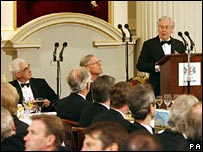 Mervyn King, the governor of the Bank of England, on the other hand, had a very austere message. Average take-home pay would stagnate this year, he said. He and the bank would do whatever was necessary when it came to interest rates. In other words, if you put your pay up in order to counter inflation, the governor was warning he'd put up interest rates to curb it. Either way you pay in the end.
So why the softly softly approach from Alistair Darling? Was it an agreed soft cop hard cop routine? Is the chancellor concerned about talking us into recession? Has he made the political calculation that it is better to invite the unions into a confrontation with the bank rather than with a Labour minister? Whichever it is, it makes a stark contrast with chancellors of the past who would have told us all to tighten our belts and prepare for difficult times.
 I'm
I'm 



Page 1 of 2
Comment number 1.
At 10:57 19th Jun 2008, skynine wrote:I can't help noticing the similarity of the Chancellor's Mansion House Dinner speech with the Mad Hatter's Tea Party.
Anyone who seriously believes that inflation is 3.3% is living in a Wonderland of his own. The RPI has been higher during the last 15 months than at any time in the last 4 years of the Tory Government yet Darling still clings to the belief that everything is going just fine.
The real inflation for those of us not on generous expense accounts is closer to 10% and rising.
Join the real world Alistair.
Complain about this comment (Comment number 1)
Comment number 2.
At 11:06 19th Jun 2008, The view from here wrote:Somebody please fire Mr Darling and put anyone else in his place. The man inspires no confidence whatever in his abilities to wrestle with issues before allowing them become crises.
Complain about this comment (Comment number 2)
Comment number 3.
At 11:08 19th Jun 2008, RussellHolmstoel wrote:So AD says its not that bad and if it gets bad it not our fault…. It must be much worse than we suspect then.
Just how much adjustment do you have to apply to get the inflation figure to 3.3% … just knock the one off the front I guess.
Complain about this comment (Comment number 3)
Comment number 4.
At 11:08 19th Jun 2008, Dayvine wrote:"shadow chief secretary to the Treasury Philip Hammond called the chancellor's speech a "missed opportunity".
"What Britain needed from the Mansion House speech was a display of economic leadership. Instead all we got were rehashed announcements and no new ideas,"
This is pretty rich when you look at what has actually been said by both the chancellor and the governor.
Haven't the Tories said this about absolutely every speech or policy proposal for the last 3 months?
Complain about this comment (Comment number 4)
Comment number 5.
At 11:09 19th Jun 2008, canttakeanymore wrote:as per post#1, the CPI ( which excludes both council tax and mortgage interest payments) is about as relevant to me as tractor part manufacturing update in Gordistan. I did note with a wry smile that in the latest CPI survey the cost of DVDs has come down...so as long as I can build a house out of them and eat them I should be OK then...
The RPI is nearer 5% and the Daily Telegraph has calculated the Real Cost of Living index (RCLI) at 9.5%- which out of the three seems far more realistic.
Complain about this comment (Comment number 5)
Comment number 6.
At 11:11 19th Jun 2008, NickAnstead wrote:Nick, can I ask a question about news coverage? Every where I have seen, including your blog post and Newsnight last night, led on the tone of the two speeches and the projected economic climate.
But last night the BBC website was leading on a different aspect of the speech, and Alistair Darling's announcement that the B of E would no longer have the sole goal of meeting inflation targets but instead in maintaining "economic stability". Isn't that an absolutely huge story which demonstrates a fundamental shift in the ordering of government priorities? I'm a bit confused as to why it didn't cause bigger headlines. Is it a re-announcement that I just haven't heard? Or was it not considered as newsworthy as the other items in the speech that did lead?
Complain about this comment (Comment number 6)
Comment number 7.
At 11:13 19th Jun 2008, RobinJD wrote:Why are you brooding?
One of them is a govenrment minister whose predecessor and boss is responsible for this mess. He is bound to paint a rosier picture and indeed his forecasts are considerably rosier than all independent authorities.
The other is the governor of the indepedent Bank of England and he intends to maintain its independence and distance from bogus government forecasts and statistics.
Who would you believe? The govenrment has meddled with the infaltion calculation; fudged the targets in the NHS; won't reveal the full cost of Northern Rock or the huge off balance sheet PFI expenditures; shifts the agenda about benefits payments the 'not employed'; has lowered educational standards across the board to meet targets on pass rates; in short has been spinning about numbers for eleven years. I repeat the question - who would you believe and why the brooding about who to believe.
The truth is all over the carpet - the car crash tthat is the result of eleven years of wasteful spending. Lee Jasper and the LDA are a drop in the cean relative to the amount the government has showered over worthless causes.
I'll back the man preaching that the era of cheap credit is over not the one pleading to have one last fix of public sector cash.
The NEwLabour project is over and Gordon Brown's hopes of re-election with it. It's legacy is one of boastfulness and waste and a culture of entitlement that has ruined us. Blair and Brown's repeated grandstanding shouts of no more boom and bust to the cheers of NewLabour supporters will go down as the biggest act of hubris in history.
Complain about this comment (Comment number 7)
Comment number 8.
At 11:16 19th Jun 2008, ScepticMax wrote:Who's word would you trust to 'tell it as it is'?
The long-term Governor of the Bank of England. (He was previously Deputy Governor from 1998 to 2003, and Chief Economist and Executive Director from 1991).
or
The Chancellor of The Exchequer, career politician (aka Gordon's glove puppet).
Complain about this comment (Comment number 8)
Comment number 9.
At 11:21 19th Jun 2008, Pravda We Love You wrote:Darling at heart is a coward and yes man.
Mervyn King is right to confront the public with the issues and choices at hand. Anything less is a dereliction of duty.
Darling patronises the public by trying to soothe us. We know times are bad and are going to get worse. Mervyn King instead goes for the jugular and tells us core behaviour that we should adopt during tough times.
Hopefully the media will pick up on Mervyn's message and repeatedly get this across to the public (the media prefers short term salacious headlines which worry the country into recession)
The Unions are increasingly holding the governments 'Ed Balls' in their hands. Gordon would help himself vastly if he forced through some legislation to allow public funding for political parties.
Gordon should be focusing on policies which help the country, not those that protect his political situation.
Complain about this comment (Comment number 9)
Comment number 10.
At 11:24 19th Jun 2008, stevegarner wrote:Mervyn King's speech sounded to me like read my lips, higher interest rates coming. As for Darling, if ever a man looked out of his depth it is he.
Complain about this comment (Comment number 10)
Comment number 11.
At 11:25 19th Jun 2008, doctor-gloom wrote:Yesterday it was reported that energy prices could rise by another 40% this winter. I heard elsewhere that this amounts to an extra 1% inflation. Expect interest rates to go up sometime during the autumn.
Complain about this comment (Comment number 11)
Comment number 12.
At 11:37 19th Jun 2008, vagueofgodalming wrote:To answer your question, Nick, my hunch would be to look to the reactions of Labour backbenchers: they are the most obvious short term factor Darling has to worry about, that King can ignore.
Complain about this comment (Comment number 12)
Comment number 13.
At 11:40 19th Jun 2008, thegangofone wrote:Is it just the cynic in me? Thats what politicians do - let the official be the bad cop.
The trend these days is towards Quangos allows the government to firewall problems. In this case its "global issues" and its probably no coincidence one of the Banks No. 2's jumped ship right now - Northern Rock was not a factor.
On a sunny day when its all going well they claim the credit.
That structure of the Bank of England is actually sensible but one of the issues not apparently in any journalist or politicians in train is cost, accountability and cronyism in the vastly increased Quango estate.
But I'll bet getting the right figures would be a nightmare.
Complain about this comment (Comment number 13)
Comment number 14.
At 11:44 19th Jun 2008, D Dortman wrote:The road to (economic) Hell is paved with after dinner speeches.
The thing I just cannot accept is the difference between telling someone on minimum wage to keep swallowing pay cuts year on year (probably for 3 years already) compared to someone on a politicians or higher wages (basic pay - ignoring the massive expenses swindle).
They have lead us to this era (whether they like it or not - they were happy enough to claim credit for the good time - again a world based phenomena), and yet they expect those with the least, to give up the most.
Complain about this comment (Comment number 14)
Comment number 15.
At 11:50 19th Jun 2008, Ian Watson wrote:We have been led here by the greedy New Labourites who have forced this country onto its knees for its own ends.
What time will tell though is how that Blair sold the very infrastructure out from under our feet so that we will own very little.
And someone must pay the price of accepting the toxic US debt and forcing us into an illegal war that has cost us billions for little return.
I say we should direct our politicians to reassert control over essential assets in this land, take back our military infrastructure, health infrastructure, education infrastructure, stop wasting billions in Afghanistan and Iraq and begin investing in the UK, it will be slow, it won't show dividends at first but it will mean that our country will once again be in control of its own destiny and not working for the corporate interests of other nations.
And what we should really, really consider here right now is a divorce from the US, break the special relationship if need be, they are more responsible for bringing us down to our knees than our own inept politicians, they are supposed to a friend, an ally, with friends like that.... who needs enemies.
If America is going to flounder, why should we be dragged down into the same abyss? Why should we for little reason I can see impale ourselves on the same sword?
What we have witnessed is one of the greatest robberies in the UK of all time folks, Blair robbed the coffers whilst we were all watching, he has put the UK into an untenable condition and placed the UK into a vicelike grip from America that will take strong politicians to solve.
It will take men of vision and courage to sort this mess out, not bought men who try to appease the US and putting our interests at the bottom of the list.
Isn't it time we had politicians that put OUR needs, desires and wants first?
Complain about this comment (Comment number 15)
Comment number 16.
At 12:14 19th Jun 2008, AqualungCumbria wrote:What is needed to judge inflation are a set of figures based on the monthly basics a family needs.
I dont buy fridges every month or tv's and i cant eat dvd's no matter how cheap they are.
bread ,milk and other necessities have all rocketed way above the figures that are given out yet our masters in parliament still believe inflation for most families is 3 - 4 % .
The way inflation was calculated in the 70's has changed do they believe that we cant tall the difference ???
My guess is we are already in double figure inflation and with energy set to double again and its knock on effect we are going to stay that way for a very long time.
The chancellors budgets were based on a certain amount of money being collected from energy revenues he must be chuckling when that take has gone up by a third it will help pay for the northern rock and other banks failures no doubt but can he look people who are going to lose their homes in the face and tell them that.
I doubt it.
Complain about this comment (Comment number 16)
Comment number 17.
At 12:18 19th Jun 2008, DataHog wrote:Nick, I wouldn't brood on this but two things occur to me.
1. Why is the BoE now being given control of 'financial stability'. It sounds to me like the job of the government and the treasury - isn't that partly why they are there? Could it just be a belated ploy to try to shift the blame to the Bank when the economy goes completely belly up over the next few months?
2. There seems to be a general acknowledgement that a significant proportion of the inflation problem is imported (especially energy and food). If that is the case, how can raising UK interest rates force down prices abroad? Or are the powers that be simply assuming that a corresponding rise in the value of the pound makes imports cheaper and to hell with the fact that no-one can pay their mortgage?
Complain about this comment (Comment number 17)
Comment number 18.
At 12:21 19th Jun 2008, contrasmug wrote:It looks as though the gov't will pass the buck on inflation as it did with interest rates. How anyone in this day and age thinks that inflation can be counteracted by curbing consumer spending is living in cloud cookoo land. If the consumer was using their own money, and not credit cards, then this would be the case. Modifying tax burden so that it is more proportionate to a persons wealth (see G B Shaw, Pygmalion) would certanly help, both short and long term.
Complain about this comment (Comment number 18)
Comment number 19.
At 12:29 19th Jun 2008, jeremykhodgson wrote:To quote from your article ..."if you put your pay up in order to counter inflation, the governor was warning he'd put up interest rates to curb it. Either way you pay in the end." Wrong, wrong, wrong, some of us don't have silly mortgages and will actually greatly benefit from a rise in interest rates. Can we please have an honest debate about the role that interest rates play in a market economy? High interest rates encourage savings and prudence, but maintain a lid on asset prices raging out of control.
Complain about this comment (Comment number 19)
Comment number 20.
At 12:30 19th Jun 2008, markthename wrote:Alister Darling was given the job because Gordon brown needed a puppet
Complain about this comment (Comment number 20)
Comment number 21.
At 12:39 19th Jun 2008, pimpernelsmith wrote:Dear All, Actually I fully agree with the result of the calculation of RPI being 3.3%. Pause whilst the reader stops choking!
What I disagree with is the method used to arrive at the figure. As stated on a business item on the BBC Radio 5 Live the other day. We can all achieve the inflation rate of 3.3% if we buy the same basket of products as used to calculate the RPI. This method assumes the purchase of a widescreen TV among other things. So providing we all buy one a month, as the price of widescreen TVs and associated computer equipment is falling we will achieve an RPI of 3.3%.
That is the stupid aspect of this calculation. For the Darling / Brown to tote this is totally misleading.
Complain about this comment (Comment number 21)
Comment number 22.
At 12:41 19th Jun 2008, jacook_uk wrote:I agree with earlier comments that Alistair Darling looks out of his depth, but can't really see how the tried and tested approach to curbing inflation in previous times (raising interest rates) is going to work this time. Real inflation (as felt by normal people) is being driven by higher oil prices, worldwide food shortages and higher interest rates caused by the credit crunch. Just how is a cap on pay rises or raising Bank of England Pay rises going to bring inflation down in these circumstances?
Complain about this comment (Comment number 22)
Comment number 23.
At 12:44 19th Jun 2008, symonh wrote:It seems to me that AD is simply passing the buck - if the final decision is down to Mervyn King - he has now become a fall-guy for failing policies.
Complain about this comment (Comment number 23)
Comment number 24.
At 12:49 19th Jun 2008, Sevillista wrote:To all those saying 'food is increasing in price significantly, so the inflation rate must be nearer 10%' consider:
* The ONS Expenditure and Food Survey estimates that food expenditure makes up 11% of total household expenditure (this is from 2002/03, it may have changed since then) https://www.statistics.gov.uk/STATBASE/ssdataset.asp?vlnk=7567
* Therefore, if food increases in price by, say, 25%, total household expenditure will increase by .25*.11=2.75% for the average household (assuming that the increases in price don't encourage families to waste less food and choose cheaper options)
The calculation of the inflation rate is a highly complicated task done by specialists. There are various technical reasons why the Bank of England might want to target an inflation rate different to that faced by people - e.g. use an index that excludes mortgage repayments, as a rise in interest rates (to deal with inflation) will increase inflation in the short-term, so such a target would provide misleading signals which would cause the BoE to over-react and add volatility to the economy.
The actual inflation rate you face as an individual is different for everyone depending on what you actually buy with your wages. I think the ONS do have a tool that enables you to calculate your 'personal inflation rate' https://www.statistics.gov.uk/pic/
Complain about this comment (Comment number 24)
Comment number 25.
At 12:50 19th Jun 2008, Colin wrote:Can someone explain to me how this pair of chancers get away with it?
Complain about this comment (Comment number 25)
Comment number 26.
At 12:50 19th Jun 2008, labourbankruptedusall wrote:yep; real inflation for most people is more like 10% when you consider what people need to spend their money on to stay alive.
My council tax shot up by around 10% this year because the central Labour government actually took money away from our non-labour council in absolute terms (not just in real terms, but in absolute terms) and then enforced extra costs on them too, so we got hit twice.
So when it comes to deciding between Brown or Darling, I'd choose neither thank you very much as they're both as incompetent and full of lies/obfuscation as each other.
Anyway, Darling's just a puppet; nobody believes for a moment he's actually running anything at all; we all know he's just rubber-stamping whatever Brown tells him to do.
The comparison with the 1970's is a good one; technically a lot of the points are different, but generally the same issues apply in that in the 70's and in the 90's/00's labour severely broke the economy by their massive mismanagement/waste/overspend/stupidity and left us bankrupt with no cash left in the kitty, a mind-blowing national debt, and insane levels of tax.
In 1997 people hoped that labour wouldn't repeat the same mistakes they did back in the 70's, but those people have had their hopes dashed and I don't think anyone now who's in their right mind would trust labour to run anything ever again.
Complain about this comment (Comment number 26)
Comment number 27.
At 12:55 19th Jun 2008, swedwards wrote:Same old same old from the Chancellor!
The economic miracle was all the result of Labour's efforts (not a global boom from emerging economies such as China and India and domestic growth based on unsustainable borrowing (both public sector and private sector).
Now things are going wrong I am not sure of his message....it seems it is a global commodities problem over which they have no control....they are not going to take their eye off the ball...it's not as bad as in the really bad days (which I along with a lot of the electorate don't remember and don't care about)!
Time to go....!
Mervyn King has one target....keep inflation under control and he needs to raise interest rates soon otherwise real inflation (not the CPI) will be north of 6%.
I am seeing the value of everything I have saved for my families future being eroded....perhaps I should by some oil....!
Complain about this comment (Comment number 27)
Comment number 28.
At 12:59 19th Jun 2008, GavinH wrote:It occurred to me-what other business involving huge amounts of money would have had Gordon Brown an academic historian by background running the show for 10 years thereafter followed by Alistiar Darling a lawyer.
The job of the Chancellor is not necessarily to dream up new fiscal policies,his main purpose is to set UK fiscial policies after consultation with Treasury senior officials and then test proposals that eminate from the Treasury Civil Servants for their robustness against the policies he is charged with being custodian off.
So with degrees in history and law how can these two gives us with any confidence that they understand economics and that I'm afraid to say is why the Chancellor is so weak.
He just does not understand.
Complain about this comment (Comment number 28)
Comment number 29.
At 13:01 19th Jun 2008, labourbankruptedusall wrote:Regarding choosing between King or Darling/Brown, I'd choose King any day of the week; he's basically saying that labour mucked things up just like they did last time and that now the economy is facing disaster because of them.
You can almost hear King groan each time Brown makes a policy decision, poor old King's trying to do his best, and is doing pretty well given what he's allowed to do, but with Brown doing everything he can to destroy what's left of the economy it's not an easy job for King.
analogy: if you were employed as a cleaner, and your boss kept throwing rubbish on the floor and then spitting on the furniture, you'd start to get a bit miffed; there's a limit to how much you can do when your boss keeps making things worse.
Complain about this comment (Comment number 29)
Comment number 30.
At 13:07 19th Jun 2008, Red Lenin wrote:There is a very simple rule regarding inflation and pay that the better off and the politicians HAVE ALWAYS got wrong and have got wrong yet again.
Inflation hits the low paid hardest. More of their income goes on essentials and less on luxuries than the better off. As an example use the current 'threat' of increases in electricity and gas etc along with the constant rise in petrol. That has a massive impacy on people on a low salary.
Now then, what is a 'low salary'. Well currently the average wage in this country is 18.5K gross. Howevwer the average WORKING wage is considerably lower - some 14.7K gross. This is why 70% of the children in this country live in families relying on tax credits. And as for pensioners, people on disability etc?
Now then, a 1% rise on a mortgage? 10% on petrol? possibly 40% on gas/electric? Eggs alone have gone up 33% iin the last 12 months.
A dramatic effect on their lifestyle. They expect a payrise that at least allows them to tread water. If they don't get it they get resentful and resentful workers are more prone to industrial unrest. A government that cannot guarentee jam today let alone promise it tomorrow is morally bankrupt.
I predict a marked increase in strikes over the next 12 months.
Complain about this comment (Comment number 30)
Comment number 31.
At 13:08 19th Jun 2008, Sevillista wrote:https://www.statistics.gov.uk/articles/nojournal/Interpreting_inflation_figures.pdf might also be interesting to explain the differences between different inflation indices.
Obviously people are right when they say they are clear political attractions to choose the index with the lowest rate. My point was that there are technical reasons why you would wish to target a 'core' inflation rate in developing anti-inflation policy rather than something else.
RPI inflation is running at 4.3% for information (and that includes most things - food, energy, mortgage repayments).
Complain about this comment (Comment number 31)
Comment number 32.
At 13:09 19th Jun 2008, Kolgon wrote:The Governor of the BoE in these unstable times should be set an inlation target x% below the average for the EU. This will then float on the tide of events.
Complain about this comment (Comment number 32)
Comment number 33.
At 13:13 19th Jun 2008, tykejim wrote:#24 balhamu: how nice to see a sensible post. I despair when I read that some people think that either the CPI or the RPI are based on everybody buying a 42" TV every month.
Complain about this comment (Comment number 33)
Comment number 34.
At 13:14 19th Jun 2008, Chris Klein wrote:Nick,
As has been said before, there is no need to brood. Darling has to chase votes, the Governor doesn't and can therefore take a detached and objective view.
The real problem is that the effect of rising prices on household incomes can't be mitigated with tax cuts because of the Gordon Brown's prodigality of the last 10 years. The train crash has been slow in coming, but it was no less inevitable or plainly visible for being so.
Complain about this comment (Comment number 34)
Comment number 35.
At 13:24 19th Jun 2008, princebullett1 wrote:I see the bar room tory activist are on this forum in force. When is the BBC going to stop these cyber space bullies from operating on here?
May retail figures are just out and it looks like its not all doom and gloom and the end of the world, as these people will have you believe.
Complain about this comment (Comment number 35)
Comment number 36.
At 13:26 19th Jun 2008, labourbankruptedusall wrote:re 24: that's a cool link; thanks for that.
I've just tried it out, and according to my details my real inflation level is currently around 7%, but it peaked at 12% in the middle of last year. I'm guessing they haven't factored in the most recent fuel figures though which'd probably bring mine back up to around 12% again.
Complain about this comment (Comment number 36)
Comment number 37.
At 13:29 19th Jun 2008, Sevillista wrote:#24 jimbrant - we share a surname, brants are obviously wise people :)
Complain about this comment (Comment number 37)
Comment number 38.
At 13:34 19th Jun 2008, ScepticMax wrote:princebullett1 @35 wrote:
"I see the bar room tory activist are on this forum in force. When is the BBC going to stop these cyber space bullies from operating on here?"
Why stop at censorship? Why don't you have us detained without trial for up to 42 days?
Your Blessed Leader would surely approve.
Complain about this comment (Comment number 38)
Comment number 39.
At 13:36 19th Jun 2008, Sevillista wrote:#36 - glad you appreciate it. Something I always feel that blog debate lacks (especially from some of the more idealogue anti-Labour voices) is a grounding in hard facts. Also true of a lot of economic issues, which many journalists simply do not grasp, so the debate is often ill-informed.
Complain about this comment (Comment number 39)
Comment number 40.
At 14:08 19th Jun 2008, tykejim wrote:#24, 36: Mine is 5.6%, which seems about right given my pattern of expenditure.
Complain about this comment (Comment number 40)
Comment number 41.
At 14:11 19th Jun 2008, tykejim wrote:balhamu: "#24 jimbrant - we share a surname, brants are obviously wise people :)"
Especially the Yorkshire Brants! Though come to think of it there are exceptions.
Complain about this comment (Comment number 41)
Comment number 42.
At 14:17 19th Jun 2008, metric tonne wrote:What so many people have noticed finally, is that CPI is a fraud. It has been very clearly designed to dampen out major swings in inflation, and therefore to ensure that governments don't get accused of 1970s style inflation. The side effect of this is that the BoE are required to manage interest rates against the metric of CPI, so have been unable to control rampant house price inflation which is a key contributor to this downturn. Let me explain why the CPI is a fraud.
The most obvious thing about CPI, and the most oft cited issue with it, is that it fails to include housing costs. Most people spend between a quarter and a half of take home pay on housing costs. This problem can be fixed by using RPI, but even with the RPI, inflation figures seem absurdly low compared to what the general population is reporting. This leads us to the second major issue, the fact that luxury and essential goods are mixed in the same basket. Many in these forums and elsewhere comment that the fact that DVD prices have fallen don't really help to put food on the table, but that this is a fraud is not clear. The problem arises from the fact that one class of goods is essential and the other not. Most people have little choice about buying food, power, insurance, petrol (or other commuting costs), clothes etc. There will always be a proportion of the population who only have money for these essentials, and nothing else. As the price of these things rise, the number of people who only have money for essentials dramatically increases. These people are experiencing exceptionally high inflation at the moment, at least double digits, if not a lot more. The luxury goods manufacturers are left with the situation of reduced demand which they can handle by reducing production or price. Reducing production involves laying off staff, and is the last option you will tend to take; therefore, prices tend to come down. Mixing baskets of luxury and non-luxury goods is therefore a self-damping system. Increases in prices in essentials will almost always have a degree of offset caused by decreasing prices in luxuries.
Unfortunately for the government, eventually people stop believing the figures and start believing their wallets. That is the situation we are in now. Gordon Brown and Alistair Darling are now in a desperate effort to make those people who aren't feeling the pinch really badly believe that things aren't as bad as they are. They have already lost the vote of many of those who are feeling the pinch, and it is a damage limitation exercise. Unfortunately, thanks to the borrow during a boom methodology of Gordon Brown's period as Chancellor, expect things to get far worse before they start to improve.
Complain about this comment (Comment number 42)
Comment number 43.
At 14:40 19th Jun 2008, Sevillista wrote:#42 - CPI is not a fraud, depending on how you try and interpret it.
It probably is a better tool for developing anti-inflationary policy than measures that include mortgage interest repayments, for reasons I outline above (the RPI, which includes mortgage interest, is in the short-term strongly correlated with interest rates, which would mean a rise in interest rates increases the RPI, which would to the Bank of England over-reacting to inflation increasing volatility in the economy).
It may not be as good a headline inflation rate describing what people's experience of inflation is, as it excludes mortgage interest repayments, which as you say form a large part of some people's household budgets (the two indices would be quite different for home-owners paying off a variable-rate mortgage).
The RPI includes everything, and there is a lot of highly technical material on the ONS website if you wish to dispute the methodology used. You can also calculate your personal inflation rate based on your own expenditure (see comment #24) if you wish to get a rate that corresponds more with your personal experience of inflation.
I don't think your other points re RPI including luxuries is valid. Each item in the basket used to calculate inflation is weighted so it corresponds with what 'the average' household purchases - therefore something that form a significant portion of expenditure (Food) will be far more important in calculating the RPI than will be, say, Rolls Royces.
Another point is about the bleakness of the whole discourse aroung the economy - yes, inflation is high and real wages stagnant for most people this year (on the back of a 10-year boom) and house prices are slipping (in the context of doubling in value since 2003 I think, and so benefiting FTBs and other non-owners immensely), but the economy is still growing (slow-down, no recession) and unemployment still at historically low levels (on post-1970s standards). More positive than many would have you believe
Complain about this comment (Comment number 43)
Comment number 44.
At 14:48 19th Jun 2008, Sevillista wrote:in post #43 I meant inflation is higher obviously, 4.3% RPI is not a historical high by any means. Inflation is high for some items (e.g. fuel and food), but is very low or negative for others which cancels out some of the impact of this
Complain about this comment (Comment number 44)
Comment number 45.
At 14:55 19th Jun 2008, paulmhudds wrote:There is no such thing as an "imported inflation". The Bank of England has an inflation target. It can only have an inflation target because it has control of the thing it is targeting. The Bank of England controls the money supply and this is the sole cause of inflation. The terms of trade have declined and the this has caused a slowing of economic growth. Britain has to export more to pay for the same quantity of imports at higher prices. The increase in the stock of money is being spread over a smaller than expected increase in the output.Control the stock of money in your own country and you can have any inflation rate you want whatever is happening to the price of oil etc. An in a free deregulated "flexible" labour market how do "we" "put up our wages". The vast majority of workers are price takers and their real wages are determined by marginal productivity. The part of the cake going to the little people has been falling since the 1980s. The Mansion House speech is a yearly propaganda set piece from the BBC. Some fat Tory banker jowells tuck into a feast while the little people are warned about alleged "wage inflation", "inflation busting wage demands", "need for wage restraint" etc
Complain about this comment (Comment number 45)
Comment number 46.
At 14:59 19th Jun 2008, RobinJD wrote:#43
Another point is about the bleakness of the whole discourse around the economy?
Why would that be?
Could it be connected with the fact that over eleven years of the Blair/Brown hosing with cash all that happened was that the rich got richer and the poor got poorer?
Real wages for the bottom half were falling during this period - the only reason there wasn't a revolution about it is that interst rates, food prices and energy prices were falling and people were eating their houses adding totheir mortgage equity withdrawals. The whole thing was a charade which the governor has signalled must never happen again.
'We don't know how far it may fall' Caroline Flint was told about the housing market and quite right too; never in history has their been such an expansion of easy credit over such a long period which is now going into reverse.
So it is not the discourse that is bleak; it's the reality for anyone who got sucked into the Blair/Brown bubble land economics which is extraordinarly bleak. You've just taken away the lifestyle they thought they had a 'right' to.
The bleakness is the recognition that the decade of 'entitlement' is over; it's payback time. Welcome to the real world where prices go up and you have to work harder to earn more.
Complain about this comment (Comment number 46)
Comment number 47.
At 15:01 19th Jun 2008, Onlywayup wrote:In my opinion both speeches were near enough the same. They both preached caution and that the BOE which is now independent will not accept high increase in pay packets as it will dry them with higher interest rates.
The difference between now and then is that the BOE cannot be manipulated in a way to target something for just before an election, and then we suffer the consequences straight after.
The Government must NOT give in to higher increases, but people should change their habits and belt up, just like what the German, French, Spanish, and Berlusconi's Governments are all asking from there people, so as to save their manufacturing industry, as otherwise they will go bust.
The other difference is that this time we have GLOBAL problems not structural problems as we had in the 80s and 90s where we were the only country going from one recession into another. As M. King had said, there is nothing much that a Govt. can do to stop imported inflation especially when this is a Global problem.
Something that one can also notice is, that certain people who were complaining when the housing market was buoyant, they are the same people crying out that house prices are now going down. Is there a hidden agenda behind all these crocodile tears?
At least we have low interest rates or rather nowhere to what they were in the 80s and 90s, and therefore, we thank God, not that we have a Labour Government, but that we do not have a Tory Government which would plunge us into the biggest recession we could ever have, with 15% interest rates, + 3.6 unemployment, + a much higher % of National Debt vis a’ vis our GDP. Have a nice day Nick.
Complain about this comment (Comment number 47)
Comment number 48.
At 15:03 19th Jun 2008, Cynosarges wrote:Now I understand why Gordon had bags under his eyes at PMQ on Wednesday. He had to write the speech for his puppet to read out.
Does *anyone* still believe that Darling is anything other than Gordon's puppet?
Complain about this comment (Comment number 48)
Comment number 49.
At 15:32 19th Jun 2008, mikepko wrote:I'd like to say something in support of Alastair Darling.
At least he wore a DJ and dickey-bow unlike scruffy Brown.
That's it. I've said my piece.
Otherwise I agree with all of the critical posts.
Complain about this comment (Comment number 49)
Comment number 50.
At 15:42 19th Jun 2008, Ziggy_Stardust wrote:This contrast tells you everything you need to know about the Labour Party.
Every statement is based on spin, tells you nothing and basically tries to pull the wool over the eyes of the electorate.
Previous chancellors in difficult times told it straight.
Labour doesn't know how to.
Complain about this comment (Comment number 50)
Comment number 51.
At 15:44 19th Jun 2008, waldorf29 wrote:47:
Noone denies the fact that the Global Economic downturn is something that cannot be blamed on the Government. The Public Spending which was allowed to rip from 2001 onwards is however the fault of GB in his role as Chancellor and is the reason that we have nothing left in the coffers to stimulate The UK economy in times of trouble.
Complain about this comment (Comment number 51)
Comment number 52.
At 15:46 19th Jun 2008, grand voyager wrote:#15 ian watson, I may be wrong but I get the impression that you must be very young, get out your history book then turn to Margaret Thatcher then you will find out what happened to the infrastucture of this country, when she left she left with everything.
Complain about this comment (Comment number 52)
Comment number 53.
At 15:49 19th Jun 2008, DukeJake wrote:I still fail to understand why the government isn't being a lot more pro-active in dealing with the economic crisis that is unfolding. We all know we don't have any money left after 11 years of tax, borrow and spend, but how about cutting back on all the unnecessary spending? We are involved in two foreign wars yet I have still to hear convincing reasons why we are involved at all. What do we have to gain from "winning" them, and how long is this expected to take? Why are we giving a huge amount of money in benefits to people when economic immigrants seem to be able to enter the country and find work easily? What's with all the quango's? Why are we spending £500k per year to keep tabs on someone who wants to destroy us? What happened to our long term energy policy if people can't even afford to heat their houses? What are they doing with the extra tax they are raking in thanks to the rising cost of fuel?
Ordinary families are being stretched to their financial limit so what do they do?
They cut back on non-essentials.
All we hear from Gordon an his cronies is the usual blathering about eradicating child poverty, buying mosquito nets for africa, etc. It seems they are more interested in using our money for political grandstanding and social engineering than actually helping out the people who give them the money to spend in the first place.
Complain about this comment (Comment number 53)
Comment number 54.
At 15:54 19th Jun 2008, thok1969 wrote:Re 47.
The recessions of the late 1980's and early 1990's affected the USA at the same time and were prompted by Black Wednesday in 1987. France and Germany were both in recession for 4 years in the 1980's and again had recesssions shortly after the UK in the early 1990's. To suggest that Thatcher was to blame is wholly inaccurate. After being the "sick man of europe" in the 1970's it was probably inevitable.
The 1992 recession was in part due to the ERM and being linked to the German mark but I have yet to find a Labour supporter to say what a Labour goverment would have done differently, as all EEC countries were linked to the ERM and all parties at the time were in favour.
If Labour were trying today to peg the pound to the euro paving way for single currency, interest rates would fluctuate just as much as they did then. This is why Brown will not take the gamble. Personally I felt we should have joined the euro back in 1999.
Complain about this comment (Comment number 54)
Comment number 55.
At 16:00 19th Jun 2008, JohnConstable wrote:Let us be totally clear about this.
In 1997, Gordon Brown took away a vital 'over-sight' role from the BofE and gave that responsibility to the newly created FSA.
The Northern Rock debacle shows just how foolish that decision was.
The BofE was effectively left 'flying blind' and by the time they realised what was going on at NR, it was too late.
I have some sympathy for Mr. King, having to deal with these ultimately treacherous politicians.
Brown and Darling, as has been pointed out, are respectively an academic historian and lawyer by trade.
These people are 'in charge' because they are elected politicians, but their scope for meddling in specialised areas such as finance, health, education or the military, when they are amateurs, should be very, very circumscribed.
Complain about this comment (Comment number 55)
Comment number 56.
At 16:13 19th Jun 2008, Balls Deep wrote:I'm starting to wonder whether Labour is feeding bad news on the economy so that Brown looks like a hero when things dont turn out to be so bad.
I'm not saying that things wont get bad but all we hear is doom and gloom and all good news stories are ignored. In my industry I have seen absolutely no sign of slowdown, in fact it's busier than ever.
Complain about this comment (Comment number 56)
Comment number 57.
At 16:17 19th Jun 2008, Onlywayup wrote:@50:
"Previous chancellors in difficult times told it straight".
Is that so. Why does one think that other people in the community are such imbeciles.
Listen to this then and be reminded.
"The Sterling is still strong and unlike what the newspapers are saying, other Central Banks are not disposing of our currency, in fact Sterling is keeping it's value well, because the economy is strong enough and this will be acknowledged by the financial institutions" This was Lamont in 1992.
This was at 12.00 on a miserable day in September 1992. Fifteen minutes later Sterling was worth 40US cents and interest rates had to be pushed up to 15%. We had the biggest recession on record because according to ALL financial experts around the world, the UK economy had STRUCTURAL problems and was weak, for a whole decade.
Guess who the expert for all those blunders was? David Cameron, leader of the present Tory party. He was the main advisor to the Chancellor.
Next time I will let you know what Lawson had to say at Mansion House, when we had 13% interest rates, + increase in VAT from 8% to what it is today 17.5%.
You cannot base an argument on inaccurate information.
Complain about this comment (Comment number 57)
Comment number 58.
At 16:20 19th Jun 2008, grand voyager wrote:#25Sunny sideview, " can some one explain to me how this pair of chancers get away with it."
Although I dont accept your discription of the people involved, I'm able to deduce through this manic Tory Speak, that you refer to GB and AD. well it happened like this there was a general election in this country in 2005, at which time the Labour party won the election with a overwhelming victory much to the chagrin of the Tory party, Gordon Brown was the then chancellor and Tony Blair the PM. Tony Blair decided that he wished to retire, Gordon Brown threw his hat in the ring to be the new PM and was overwhelmingly accepted by the rest of the party, to be the new PM in a similar way to john Major after the departure of Mrs Thatcher.
Once establised as the new PM he appointed AD to be the new chancellor, and thats how these two gentlemen are in the position they are in today, and it does'nt matter a damn how many Tories on this and other blogs scream and shout about the situation sometimes with opposing views, thats the way it will stay until Gordon Brown says otherwise. Now did you understand that Sunnyside if not I'll say it again. sorry about the grammar but I'm stupid or so some like to think.
Complain about this comment (Comment number 58)
Comment number 59.
At 16:21 19th Jun 2008, Sevillista wrote:re #51 - 'putting something away for a rainy day' argument.
I thought Government debt is now lower than it was during the previous administration (with a 40% ceiling), and the current budget balancing (or almost balancing) over the economic cycle [the 2 Golden Rules]. Is this not making sure something is put away for a rainy day?
I'm not sure you would be happy if the Government had been charging you taxes over the previous 10 years to create a 'rainy day' fund.
Complain about this comment (Comment number 59)
Comment number 60.
At 16:35 19th Jun 2008, Red Lenin wrote:I seriously believe that the Govenment intend to re-take control of interest rates. They - for popularist electoral resons - need interest rates to go down in the short term.
The Bank of England however, requires them to go up to counter inflation.
Bit like the Dr Doolittle film with the Pushme-Pullyou creature.
So, how does the Government wrest back control of interest rates? Simple. Give the Bank Of England an impossible task that it cannot decline - make it responsible for UK financial stability.
When it fails (which it will, through no fault of it's own), declare it 'Unfit For Purpose', take that task off it along with control of interest rates pending the results of 'a substantial review and reform'. And Presto! Interest rate cuts in time for the next General Election.
In other words a slow coup.
Complain about this comment (Comment number 60)
Comment number 61.
At 16:36 19th Jun 2008, JohnConstable wrote:# 56 Balls Deep.
I am glad to hear that your industry is busier than ever.
Now let me guess which industry that might be :
a) the sex industry - always 'up'
b) the QUANGO industry - yes it is booming
c) insolvency practitioners - they are very busy right now
Complain about this comment (Comment number 61)
Comment number 62.
At 16:37 19th Jun 2008, Onlywayup wrote:This is what some of you should try doing, and get out of your imagined misery.
Close your eyes, and go into a very deep sleep. Imagine going back to the magnificent past of the 80s and 90s. Imagine you are living the dream all over again.
Then all of a sudden your wives are calling you and give you a slap on the face, while shouting, “wake up, it’s only a dream, wake up”.
You finally wake up all sweaty and tell your wives.” What a terrible, horrible dream I had” “ I thought we have 15 % interest rates, over 3.5 million unemployed, our elderly frozen to death and our graduates are now cleaning the streets, Hospitals are closing down, our doctors are going to the USA and there are no more nurses to care for us”
Your wives give you a kiss and say in a soft voice, “ But darling, this is 2008, and we do not have a Tory Government”
Oh, thank God for that!
Complain about this comment (Comment number 62)
Comment number 63.
At 16:38 19th Jun 2008, grand voyager wrote:# 54 Thok 1969. So Thok Mrs thatcher did'nt sell the oil or the gas and electricity, or the steel and the water or Bt or the bridges,and a number of other things that I cant bring to mind, I know I was doing a bit of travelling but I must have moved out to a parallel world admittedly it was after her departure that the railways were sold in great haste, but she did untold damage.
I have to agree with your last sentence it reflects how I feel exactly,not many Tories would agree with us though.
Complain about this comment (Comment number 63)
Comment number 64.
At 16:41 19th Jun 2008, Pravda We Love You wrote:53 Dukejake
This government are infuriating - I agree.
When Gordon Brown came into government he promised a 'Bonfire of the Quangos'. Instead as Chancellor he presided over an increase from £79.6Bn in 2003 to £123.8Bn in 2006 spent on Quangos Whitehall pen pushers. An increase of £44Bn
The annual defence budget is circa £34Bn. I'd rather see a few faceless bureaucrats cut from the mass of useless Quangos and the money given to fund much needed equipment for our frontline troops.
After that give some of the Quango savings directly to hospitals, schools and the police.
With some more cash the armed forces might be able to complete the job they have been asked to do (I'm not getting into the legitimacy debate for either war).
As for Gordon Brown talking about aid for Africa - I think we have a responsibility to help other countries, but only an out-of-touch idiot like Gordon Brown would publicise announcements of this nature when millions of people in his own country are worried about their financial future.
Darlings speach yesterday was all about political positioning and had nothing to do with leadership of the rapidly fragmenting UK.
As of 2008 Labour have become a total joke.
Complain about this comment (Comment number 64)
Comment number 65.
At 16:45 19th Jun 2008, Ziggy_Stardust wrote:#57, Perhaps you would like to quote what Alistair and Gordon said just a few months ago about Britain being able to withstand the global downturn because of their prudent record.
Or how about quoting from the OECD report last week (strangely hard to find on the BBC website by the way) that said Britain was uniquely placed to suffer badly because of the breach of Gordon's own golden rules?
Complain about this comment (Comment number 65)
Comment number 66.
At 16:47 19th Jun 2008, grand voyager wrote:38 sceptic it seems that I am getting censored every time I answer you so perhaps its the tory mafia who are leaving documents on trains quite accidently of course and posts wiped out, perhaps there's a little industrial espionage going on, maybe we should get Gordon to have a look,
Complain about this comment (Comment number 66)
Comment number 67.
At 16:56 19th Jun 2008, ScepticMax wrote:Onlywayup @57 claims:
"Guess who the expert for all those blunders was? David Cameron, leader of the present Tory party. He was the main advisor to the Chancellor."
David Cameron was a 26 year old junior official in the Lamont's office - one of many bag carriers - not the "architect of Black Wednesday"
Do you really believe the myths you peddle, or are they too convenient to discard?
Complain about this comment (Comment number 67)
Comment number 68.
At 16:57 19th Jun 2008, Roll_On_2010 wrote:#17: DataHog
Could it just be a belated ploy to try to shift the blame to the Bank when the economy goes completely belly up over the next few months?
-----------------
I completely agree with your analysis but believe there is another reason why NuLabour want to use this ploy!
In 1997 NuLabour shunted its members and affiliated members, the trade unions, into the sidings. They wanted to distance themselves from their past TU and Nationalisation image.
Over recent times the Trade Unions have quadrupled their donations to the Labour Party, purely to stop it going belly up! But in doing so they say there is price that has to be paid for their economic support.
Recently a group of greedy workers, tanker drivers, held this country to ransom and Brown and NuLabour did very little to castigate or deplore their actions! Indeed the government actually voiced support for their actions in obtaining a 14% pay award. John Hutton said the deal reflected the particular conditions in the industry.
The NuLabour ploy with the BoE would indeed put a buffer between them and those trade unions keeping them afloat!
Complain about this comment (Comment number 68)
Comment number 69.
At 17:01 19th Jun 2008, grand voyager wrote:#35 Prince bullet, yes I have observed the same thing myself better not make a rude remark or I'll get reported to the moderaters, we have had all this for years. Tony blair according to the media faced his most critical vote on a weekly basis and the times I've heard the experts on TV telling us that Gordons got a black hole and he wont be able to get out of it are times without number.
The Tories are once again jumping on the band wagon of high oil prices and the massive increase in the price of food world wide but thats a tipical tory policy, its the only one the've got so I suppose we cant blame them for getting excited, just have faith in Gordon he's pulled us through times almost as bad before. keep the faith prince bullet we'll be the ones laughing next year.
Complain about this comment (Comment number 69)
Comment number 70.
At 17:02 19th Jun 2008, Sevillista wrote:NB - Historical Government Debt figures are available at [Unsuitable/Broken URL removed by Moderator] When Labour took over in May 1997, Net Public Sector Debt stood at 43.3% of GDP on this measure (having been 27.6% of GDP in March 1990); in May 2008 it was 37.2% of GDP. I'm not sure if there are better measures than this (I thought there was less headroom under the Golden 40% level), but the direction of travel since 1997 seems clear. Interesting. Which administration was more successful at saving for the rainy day?
Complain about this comment (Comment number 70)
Comment number 71.
At 17:02 19th Jun 2008, Ziggy_Stardust wrote:#57, Perhaps you might additionallly want to quote from Harold Wilson's pound in the pocket speech in 1967?
Complain about this comment (Comment number 71)
Comment number 72.
At 17:05 19th Jun 2008, grand voyager wrote:# 62 only way is up, I love it as they say in parliament More! More !
Complain about this comment (Comment number 72)
Comment number 73.
At 17:19 19th Jun 2008, tykejim wrote:#65 chrisbowie "#57, Perhaps you would like to quote what Alistair and Gordon said just a few months ago about Britain being able to withstand the global downturn because of their prudent record."
No need to go a few months back. Just last month the IMF said:"For over a decade, the United Kingdom has sustained low inflation and rapid economic growth - an exceptional achievement. More recently, the economy grew by 3 percent in 2007, and inflation returned to target after a temporary elevation. All this is the fruit of strong policies and policy frameworks, which provide a strong foundation to weather global shocks."
Complain about this comment (Comment number 73)
Comment number 74.
At 17:22 19th Jun 2008, uncivilisedservant wrote:Hooray! for an independent Bank of England at last - now that the two Treasury stooges calling themselves Deputy Governors have been given their marching orders.
Complain about this comment (Comment number 74)
Comment number 75.
At 17:31 19th Jun 2008, Onlywayup wrote:scepticMax @67 : David Cameron was a 26 year old junior official in the Lamont's office - one of many bag carriers - not the "architect of Black Wednesday"
Do you really believe the myths you peddle, or are they too convenient to discard? - unquote.
Can one please kindly ask you not to ridicule this blog anymore.
Do you want the proof, I shall give you the proof, and guess where the proof comes from.
The BBC and Nick Robinson. Ask Nick, he'll give you the whole story, and in what capacity Cameron worked at the treasury.
One does not wish to waste time with people who have their heads buried in the sand.
Take it from an ex Tory, Cameron was one of the main advisors.
Complain about this comment (Comment number 75)
Comment number 76.
At 17:38 19th Jun 2008, Pravda We Love You wrote:69 - Grandantidote
I hope you are correct and that Gordon Brown can pull off an economic turn-around.
I think one of his biggest problems is that he doesn't portray confident leadership. That trait makes the public jittery and does nothing for economic stability.
I am a doubting Thomas in this case and I think the public at large are extremely angry with the government. Depending on which way you look at it, the Government has either Over Promised or Under Delivered.
I think that subsequent generations are going to have to pay a high financial price for the profligacy of the last 10 years.
Which ever government is elected next has got its work cut out.
Complain about this comment (Comment number 76)
Comment number 77.
At 17:49 19th Jun 2008, ScepticMax wrote:Nick,
You'll should enjoy this one:
Liberty director Shami Chakrabarti is threatening to sue a Cabinet minister she says "set out to smear" her dealings with ex-Tory MP David Davis.
Ms Chakrabarti said that she would sue Culture Secretary Andy Burnham if "you continue down the path of innuendo and attempted character assassination".
Complain about this comment (Comment number 77)
Comment number 78.
At 17:57 19th Jun 2008, ScepticMax wrote:Onlywayup @75,
Nick's got enough on his plate. Just refer me to an appropriate authoritative website please. (Not a blog or someone's 'opinion', but documented, contemporaneous narrative.
(I well remember the day itself and do not recall DC's name ever popping up until many years later when he made a bid for leadership of the Tories).
Complain about this comment (Comment number 78)
Comment number 79.
At 17:58 19th Jun 2008, ScepticMax wrote:Onlywayup @75 wrote:
"Can one please kindly ask you not to ridicule this blog anymore."
You ask in vain.
Complain about this comment (Comment number 79)
Comment number 80.
At 18:19 19th Jun 2008, Onlywayup wrote:ScepricMax, it's all over the internet. This one is from The Times and was the onr on top. Now read, learn and REMEMBER:
Eurosceptic who once argued for single currency.
By Andrew Pierce:
ONLY six weeks after Black Wednesday, when the pound was bundled out of the exchange-rate mechanism (ERM), David Cameron wrote a secret memorandum for the Prime Minister advocating closer ties with Europe.
Mr Cameron, who was a special adviser to Norman Lamont, the Chancellor, also argued that there were benefits to Britain joining the single currency.
In the memo, a copy of which has been passed to The Times, Mr Cameron said: “There is no doubt that a single currency would have a number of benefits. Transaction costs and exchange-rate risks would be eliminated and, as a result, trade would increase subtantially.
“Also, a central bank and a single currency, if established in the right way, could help to make Europe a zone of permanently low inflation.”
Eurosceptics will seize on the memo to try to project Mr Cameron as unsound on the critical issue of Europe. David Davis and Liam Fox, two of his leadership rivals, are implacable opponents of the single currency.
Mr Cameron, whose supporters maintain that he is a genuine Eurosceptic, added an important caveat in the memo. “We have always recognised that there are potential drawbacks, which is why we have negotiated an opt-in, opt-out clause,” he wrote.
Mr Cameron had been asked to write a memo with a distinct “political slant” on the options facing John Major, the embattled Prime Minister whose opinion poll rating had collapsed after the humiliating withdrawal from the ERM. The Tory party was in danger of descending into civil war on Europe.
Mr Cameron, who was 26 at the time and a highly regarded adviser in Whitehall, was attempting to walk a diplomatic tightrope. When Mr Major took over from Margaret Thatcher 18 months earlier, he pledged to put Britain back at the heart of Europe.
After Britain left the ERM, after a run against the pound, Mr Lamont was reportedly so happy that he was said to have been heard “singing in the bath” at No 11 Downing Street. Yet in his memo, Mr Cameron appeared to be advocating sterling’s return to the ERM straitjacket. While not speculating on timing, he wrote: “Will return to the ERM when it is in Britain’s best interests to do so and not before.”
He then turned his attention to negotiations within the EU, with Britain’s partners preparing to ratify a treaty committing themselves to monetary union.
He wrote: “We have two choices. Either we can participate in that process, secure in the knowledge that our opt-out clause means that we do not have to join a single currency. Or we can simply stand aside and let others determine the future of Europe.”
A senior Tory who was embroiled in the negotiations said: “This memo means that Cameron effectively was digging John Major into a deeper hole. The majority of the Tory party was delighted to be out of the ERM. They were angered that Thatcher had even gone into it.” He said it suggests that Mr Cameron did not consider that there were other options “such as not joining a single currency and not going back into the ERM”.
Mr Cameron’s memo also described benefits to Britain of the ERM. “Britain’s membership of the ERM helped us to reduce inflation from 11 per cent to under 4 per cent in just two years,” he wrote.
Good night Nick!
Complain about this comment (Comment number 80)
Comment number 81.
At 18:27 19th Jun 2008, fairlyopenmind wrote:Life is going to be tougher for a while. No doubt.
Financial hits from fuel and food costs in particular won't just go away and cannot really be controlled by a local government.
Brown and Co seemed pretty pleased with themselves when global prices were less volatile, but disclaim any responsibility for current problems.
Energy is a big issue.
How many power stations have opened over the last decade?
How many have been approved and contracted for delivery soon?
France gets a big proportion of energy for "static" consumption (factories, businesses, homes..) from nuclear. We don't even have replacements lined up to cope when our current stations are decommissioned.
How is that a long-term investment strategy that Brown claims as his main focus?
National Debt is lower as a percentage of GDP than in 1997. But it has been growing since 2002/3 (National Statistics). We currently owe UKL 539BILLION. Government forecasts are for that to grow to UKL 581 BILLION in 2009. (That's almost an 8% increase!)
If this government just stopped introducing new laws, regulations and the quite unnecessary "jobs" to monitor them, focused on getting value for money (OUR money) they spend, the UK would be in reasonable shape.
My standing order for electricity has gone from UKL 68 to UKL 92 - with no household increase in electrical gear and having had a fairly mild winter and spring.
In normal life, if you don't have it, you can't spend it. This government sets a very bad example, living on credit and taking our money, whether we like it or not, to spend on vacuous projects.
Complain about this comment (Comment number 81)
Comment number 82.
At 18:31 19th Jun 2008, ianrthorpe wrote:Just as all Blair's foreign policy birds, not chickens but big ugly vultures, are coming home to roost on Brown's head, so all Brown's economic vultures are coming home to roost for Darling.
And not a Phoenix in sight. Peter Kay for Prime Minister I say.
https://greenteeth.blog.co.uk/2008/06/18/dear-darling-4332378
Complain about this comment (Comment number 82)
Comment number 83.
At 19:05 19th Jun 2008, enneffess wrote:What really got my back up was Alistair Darling telling us all not to ask for above inflation, but then stating that the recent tanker drivers' 14% deal is "exceptional"!
It just shows how much influence the unions still have over Labour.
Complain about this comment (Comment number 83)
Comment number 84.
At 22:01 19th Jun 2008, ScepticMax wrote:Onlywayup @80
Thanks for the 'chapter and verse (if selected elements) - truly appreciated.
Firstly, I could claim that he (DC) was young and silly to even support closer ties with the EU. (Heck, at that time Blair was possibly still signed up to CND, and just a few years earlier half the future New Labour cabinet were flirting with communism...).
Secondly, DC is no hero of mine. I wouldn't have chosen him for Tory Leader (not that I'm a Conservative Party member) and I don't rate him highly at all. Except, of course, compared to absolutely everybody on the government benches....
Let's make a deal: Let's look the current political and economic situation and at the current government, lead by a man who was Chancellor of the Exchequer for the past decade, New Labour's legacy (for better or for worse), and the Opposition's strengths and weaknesses.
If you don't mention 'Black Wednesday' (which actually - and paradoxically - liberated the British economy), I'll promise not to mention the 'Winter of Discontent'. I mean, how far back is relevant? The peasants' revolt? Agincourt? the Ark?
Thanks, Max
Complain about this comment (Comment number 84)
Comment number 85.
At 22:04 19th Jun 2008, U2898892 wrote:Apologies, but I really cannot take Alistair Darling seriously. He would make an excellent ventriloquist's dummy, repeating verbatim whatever his master demands. There is, however, always the dreadful thought that he could emulate Brown, and in the event of the Great Master departing Number 10, taking his place. That is too horrible to contemplate. Far better, let little Alistair take a lesson from Barrie's famous Darlings and fly away with Peter Pan to the Never-never-Land!
Complain about this comment (Comment number 85)
Comment number 86.
At 23:04 19th Jun 2008, grand voyager wrote:84 sceptic max you say your not a tory correct me if I'm wrong but did'nt you tell mikepko last week that you were now a signed up Tory the same as mike, as I say correct me if I'm wrong but I seem to remember the both of you being on a high over your enrolment.
Complain about this comment (Comment number 86)
Comment number 87.
At 23:44 19th Jun 2008, newtactic wrote:If there is one criticism I would make about this Government and its fiscal policies it is its habit of taking statitics and averages to indicate the general state of individual finances.
I have been working full and part time for 44 years and in that time, my income has almost always been below average. Therefore I have had to organise affairs to fit within the Micawber recipe for happiness. I have no mortgage, I ditched that in the Thatcher years (against most advice at the time).
Since the millennium I have been one of the majority (63%) of UK citizens who does not run a car, although I have a licence if I need to borrow or hire a car.
I share household expenses with a working relative. I drink alcohol on special occasions and have never smoked.
And I am not entirely stumped for more rationlisation of personal finances if needed. I have planted some vegetable seeds in the garden and am trying to find more time for home cooking and baking (although the results are not always successful)
My point after boring you with all this personal detail?
Don't worry about things you can't do anything about... i.e. the budget, economic downturn, the Bank of England and the Chancellor, but sort out the things you can do something about.
Then, when the time comes for an election join and lobby for the political party which you think will best protect those things you can't do anything about.
Complain about this comment (Comment number 87)
Comment number 88.
At 00:14 20th Jun 2008, ScepticMax wrote:grandantidote @86, you are too quick off the mark. Mikepko and I were discussing our respective (and independent) decisions to 'put our money were our mouths are' and donate to David Davis's re-election campaign.
A gentle suggestion: Before you post a comment, try thinking about what you want to write, and check your sources of information. Double check. Then check again. When you're certain of all the facts, then - and only then - start keying in your post. It will save a lot of embarrassment.
Complain about this comment (Comment number 88)
Comment number 89.
At 08:55 20th Jun 2008, TerryNo2 wrote:#84. You're more defensive than you need to be on the issue of the ERM.
The UK entered the ERM in 1990 and suspended its memembership of it in 1992. This was a policy commitment of the Tories, Liberals, Labour, CBI and TUC. At the time of entry Lamont was the Chief Secretary to the Treasury responsible for spending decisions. I don't know how old Cameron was in 1990, but I suspect it was younger than 26 (probably 24 by all accounts). If at that age he was capable of turning the ship of Government in a particuklar direction then he must have more powers of persuasion than Paul McKenna.
The architect of Britain's disaster from the ERM was therefore entry into it in the first place. A policy supported by Brown, funnily enough.
The idea of the ERM and single currency and its advantages are blindingly obvious to anyone financially literate. But so are the disadvantages. What Cameron appears to be saying is there are advantages but lets look at an opt-in and opt-out strategy. It was a wait and see approach later referred to by John Major, who was much derided for it at the time. Later, Brown adopted his collection of conditions for entry into the single currency which were so vague they amounted to - wait and see!
This idea then of Lamont and Cameron being the architects of Britain's ERM debacle is therefore a gross misprepresentation of the facts - and an often repeated one. They were simply in the wrong place when the music stopped. However, since it was Labour policy to join the ERM I sometimes wonder if they too would have withdrawn from it in 1994 or struggled on.
As it goes, Labour was all for the EEC at one stage but by 1983 wanted to withdraw from it. They were against ERM but were later all for it.
Here's a link on the subject. This is an extract. Take a look at page 144 in particular. Happy reading!
https://www.andymullen.com/downloads/research5/labour.pdf
Complain about this comment (Comment number 89)
Comment number 90.
At 09:01 20th Jun 2008, smfcbuddie wrote:Nick,
Have you learned anything from this particular topic because I haven't? What is the purpose of so much specualtion and bias, when there are many more fundamental issues which can be explored and fought over. We all know that Darling has his work cut out both as a politician and as the Chancellor. We all know that the Governeor has tight targets to meet in the medium term. Nothing posted so far has further illuminated these facts.
Oh for a real debate.
All the best.
Complain about this comment (Comment number 90)
Comment number 91.
At 09:59 20th Jun 2008, Sevillista wrote:#46 - I'm not sure the facts support some of the assertions that you are making.
There is neither evidence that the 'poor got poorer' or that 'real wages for the bottom half of the distribution were falling'. In fact, there is considerable evidence that the reverse was true. The absolute poorest have benefited massively from the minimum wage. And families with children have benefited immensely from the Government's tax credits (though this programme has been poorly administered). See the Labour Force Survey https://www.statistics.gov.uk/STATBASE/ssdataset.asp?vlnk=7934 for evidence on real wages; the DWP Households Below Average Income Series would be another source for hard facts on this.
There is evidence that inequality may have been at best constant over the time period though, as the Government has been quite relaxed about the rich getting richer, so long as the absolute standard of living of the poorest has been increased and poverty has been decreased. Pensioner poverty has been dramatically reduced; so has child poverty (though not on the same highly ambitious path that Labour hoped to achieve).
House prices falling are only a problem for those (particularly any FTBs) who got suckered into buying during the past 3 years, when they have been massively over-valued. They will lose maybe £30,000 - £40,000 in the short to medium term - though this is a paper loss. In practice, it is only a problem if they also took on an unaffordable mortgage and were gambling on the bubble continuing. For everyone else, it is a reversal of 'paper gains' - not really making them worse off at all. It is a boon for people not on the ladder - and may see a reversal of the large transfer of wealth from young to old that the crazy increases in house prices has caused.
It's hardly 1992. Or the early 1980s. Or the late 1970s.
Complain about this comment (Comment number 91)
Comment number 92.
At 10:40 20th Jun 2008, RobinJD wrote:#91
how can there 'be evidence that inequailty may have been at best constant...' and at the same time 'the government being ralxed about the rich getting richer'....?
Have you looked at the percentage of wages to profits? It's at a thirty year low. How does that equate with the poorest keeping pace with the richest. All the benefits the poor experienced in the last eleven years were down to low interest rates (attributable to globally weak inflation) and lower food, clothing and energy prices. Now the days of cheap Asian imports are over and there is a shortage of food, energy and credit the porr will be hit hardest thanks to this governments inability to address the fundamental questions of security of food and energy supplies over the past eleven years.
Eleven years without a single power station being commissioned despite billions spent on three energy reviews. This is a national disgrace and our government is responsible. A few more doctors and teachers is not an economic policy; economies need infrastructure spending to survive and NewLabour are not responsible for a single one. Not one. Everything built in the past eleven years was already on the drawing board when you came to power. there's now nothing in the pipeline and no money to pay for it.
Of course it's not like the 70s or 80s or 92; it's far worse. There is a mass contraction of credit in the financial system thanks to wastd excess caused by lax legislation- NewLabour Tripartite legislation.
Complain about this comment (Comment number 92)
Comment number 93.
At 11:03 20th Jun 2008, Sevillista wrote:#92 - any facts to support these assertions?
And far worse now than these earlier economic difficulties? No recession but a slowdown, inflation at 4.3% and not a historical high, interest rates far lower than the rates that caused such difficulties in the early 1990s. And a Government that does not talk about "unemployment as a price worth paying to beat inflation". We are far, far away from this.
The Institute of Fiscal Studies publishes indices of inequality (the Gini Coefficient) - I don't have a link but I am sure that it does not paint the picture on inequality that you assert it does. I think the picture is one of slightly increasing 'market' income inequality, but the Government's tax credit programmes have enabled it to maintain post-intervention inequality at constant levels.
Complain about this comment (Comment number 93)
Comment number 94.
At 11:20 20th Jun 2008, RobinJD wrote:#93
Here's a fact - state hand outs cost money. Look at the record PSBR yesterday - £11bn in May boosted by the £2.7bn hand out to take people back where they were in the first place. This is back foot policy making not the foresight that an economy needs and this one lacks.
Thanks to this blunder and the £11bn PSBR market interest rates rose again yesterday making this government responsible for more expensive mortgages. So we're actually not back to where we were because of state hand outs - everyone with a mortgage will be worse off. What next? Mortgage subsidies? That will cost mroe money, more borrowing and put interest rates up again.
You can't win this one - intervention is costing us all very dear indeed and it's only just begun. It's all very well when you start having inherited a flush Treasury but after eleven yers of non stop spending without investment every time the government spns will make it more expensive for the rest of us. Crowding out, is the technical term. Incompetent is the reality.
Complain about this comment (Comment number 94)
Comment number 95.
At 12:07 20th Jun 2008, Onlywayup wrote:Nick, is there a chance wecan talk about something else? Maybe regarding the fuel tax on fuel which some are stating that the Govt. should reduce, thereby giving rise to more increases in fuel prices from abroad!
Have a look at this, out now from the EU:
Quote - Brussels is today expected to send out a clear message to EU leaders that lowering taxes on fuel to mitigate the current price spike does not make sense in the long term and should be avoided.
Although member states were permitted to take measures to help badly-hit sectors of the economy and low income families to cope with the current fuel crisis, permanent reduction of VAT or other taxes connected to fuel would not solve this big problem.
"We need to adapt to the new scenario where oil prices are likely to remain very, high. The solution is alternative energy, new technology and new consumption habits" - unquote.
Have a nice day Nick.
Complain about this comment (Comment number 95)
Comment number 96.
At 12:13 20th Jun 2008, Sevillista wrote:#94 - The national net debt is now smaller as a proportion of GDP than it was in 1997. The Government has managed (or just about managed) to meet its Golden Rule of balancing current expenditure across the economic cycle. There has been record levels of investment in schools and hospitals - some of this has been 'wasted' in getting salaries of teachers etc to where they would have been were it not for years of stagnancy which was necessary to enable high quality staff to be attracted to the profession.
I'm not sure I understand all your comments - what your essentially saying is that there is more Government debt now than 1997 (not true I add)) which is pushing interest rates higher than they were in 1997 (again, not true. I thought real interest rates were quite low - with global factors ie the credit crunch, leading suppliers of credit to increase the risk premium they place on lending).
I would have more sympathy with your view if you were talking about increases in tax leading to crowding out of private expenditure. That would lie on the empirical evidence on whether tax is too high - and I think the Government itself has acknowledged that the size of the public sector is bigger than perhaps it should be (hence tight pay settlements for the public sector)
Complain about this comment (Comment number 96)
Comment number 97.
At 12:37 20th Jun 2008, RobinJD wrote:#96
Of course there is more government debt - it's just all off balance sheet in PFIs and the Northern Rock.
If you think this is a successful way to run a government - look at what has happened to the banking system as a result of all their off balance sheet 'assets'.
It doesn't matter where they hide the debt, it will still have to be repaid. The random diving into government coffers to correct their mistakes is making this worse.
Government borrowing crowds out private sector borrowing and as this is happening concurrent with a contraction in the balance sheets of the banking system there is a double negative for the private sector. Interest rates are going up as a result of this profligacy.
The overall tax burden in this country has never been higher thanks to the myriad stealth taxes introduced by grasping Gordon. It's pointless arguing about state hand outs to compensate because they are not helping anybody hit by the fuel price escalator which the government refuses to cut.
Sadly, the evidence is mounting by the day as one independent body after another downgrades its estimates for the busted UK economy. Even Alan Greenspan, Gordon's confidant and admirer thinks the housing crash will be worse here than in the US.
I'm not asking for sympathy with my view, I'm asking for NewLabour supporters to try and understand that you can't run an economy with a few better paid teachers and doctors. They are essential workers but the wealth creating section of the economy is being bludgeoned by an incompetent government. And I am still waiting for the block buster order form China that will pay for Gordon's visit there last year. He simply doesn't get it, British companies need a prime minister that supports them and wins them orders. This government let rover go bust and then gavee it away to th Chinese. Congratulations.
Complain about this comment (Comment number 97)
Comment number 98.
At 12:41 20th Jun 2008, grand voyager wrote:88 Scepticmax, Unlike you I am not always right and dont feel any embarressment at being wrong, when wrong, again not like you, I am happy to admit it, I was relying on memory and was'nt certain, thats why I put in my small post twice, "correct me If I'm wrong."
I am sorry sceptic max but you are probably the last person that I would take advice from gentle or otherwise.
Complain about this comment (Comment number 98)
Comment number 99.
At 12:41 20th Jun 2008, D_H_Wilko wrote:How many times have governments said they will save money to cut taxes by cutting back on waste? It never happens.
This subject is too complicated for me and for most people on this blog. The economy has so many variables that has taken on a life of its own. It almost like trying to model the climate(Cue ScepticMax).
Inflation seems to me to be down to oil prices, which has a knock on effect on transporting food. I think the idea of 'saving money for a rainy day'(patronising even for me!) Which I think means give tax cuts to help people suffering from inflation. Would put more money into the system, reduce its value and cause more inflation!
I think people who say the conservatives are better at the economy are living in the 1980's and comparing the Conservatives then with labour of the 1970's that comparison might be true.Only because Labour at that time were really really bad. But what other evidence do they have that it is still the case? It seems to be just a brand image like law and order at the moment.
Complain about this comment (Comment number 99)
Comment number 100.
At 12:43 20th Jun 2008, ballycarn13 wrote:Turn off your lights and heating as much as you can, reduce the kids pocket money, go easy on the booze/fancy food and head to a sunny spot in Britain for your holiday this year would of been a much more appropriate message.
Complain about this comment (Comment number 100)
Page 1 of 2