I mentioned yesterday a documentary I've made for Radio Four called What Does Gordon Really Think? You can hear it by clicking  here - but you might be wondering why we put the programme together.
The reason is simple: Gordon Brown's character and views are now under the most intense scrutiny. They are all that could stand in the way of him fulfilling not just his dream but what he’s long believed is his destiny. For more than a decade political journalists, like me, have obsessed about the Blair/Brown dynamic (who, by the way, would now argue that it didn’t matter or that we were making it all up?) Now though the question that needs to be answered is what the man who would be Britain's next prime minister would be like in the job.
In the years BC (Before Clarke), no-one who really counted would go on the record to list the alleged character flaws which until then had only filled journalists notebooks anonymously. Now in the weeks AD (After the Disaster) they’ve gone silent again.
David Blunkett discloses that Brown is so driven that he sometimes barely sleeps or eats : “I was sitting next to him in Cabinet bemoaning that I’d only had five hours sleep and Gordon thought that was rather a lot. If he’s got an idea in his head, he’ll be up writing, scribbling. When you stay with Gordon and Sarah…Sarah has to drag him out from his study in order to be able to eat. He’s politics, politics, politics”. That’s proof to some of Gordon Brown's commitment and dedication. It’s evidence for others that he's an obsessive and is psychologically flawed.
So, friends and foes agree that Gordon Brown isn't an easy man to work with. What divides them is whether they believe his other qualities make the effort worthwhile. That and their hopes or fears about what Gordon really thinks.
At the root of Brown’s views are the teachings of his father. The themes of the Reverend John Brown's collected sermons are recognisably Brown-ite - “Towards set objectives”, “Making the best use of time” and "The vision of duty". As a young man Gordon Brown wrote about the need to tackle the gap "between what people are and what they have it in themselves to become". Neil Kinnock has a neat way of summing up that mission. He labels him not “Capability Brown” but “Justice Brown”
So, what might “Justice Brown” do in office? His political challenge will be to convince voters there's been a change from the Blair years whilst reassuring his party that there's enough continuity to counter charges of betrayal. The agenda for change is becoming increasingly clear.
First, a package of reforms designed to break Labour's reputation for spin, sleaze and control freakery. Brown has spoken of the need to re-invigorate the constitutional reform agenda - giving Parliament the power to declare war, completing the reform of the House of Lords and devolving more power to the regions and to local councils. Brown believes that his decision to make the Bank of England independent restored trust in the setting of interest rates by preventing politicians interfering. He’s now considering repeating the trick for the running of the NHS. The government would still set the overall budget and strategic policy but a new independent NHS Board could take over the day to day running of the health service.
Those hoping for an end to Blair’s wars or a libertarian shift away from Blair’s laws are likely to be disappointed. Yet, alongside the war on terror there’s likely to be a war on the global poverty which Brown believes feeds support for terrorism. The chancellor has campaigned to wipe out third world debt. Less well known is his proposal for an economic plan for the Middle East. “Justice Brown” believes that economics lies at the root of most problems. Brown’s known to be scathing of Tony Blair’s handling of the EU - believing it to be long on charm and short on strategy. One prediction by Ed Balls, a close ally and fellow Treasury minister, is likely to send a shiver around Brussels and produce a groan in the Foreign Office. Balls told me that Brown’s negotiating style will mirror Margaret Thatcher’s before hastily adding “in the early years” (the years she got “Britain’s money back” and helped shape the single market) Balls says :
“Going to an international meeting, the easiest thing to do is draft a fudge communique and go home, but if you want to make change that’s not good enough. It’s the people who are banging the table and saying ‘it’s not good enough, we’ve actually got to do something’, they’re the change makers.”
The issue that has most divided Gordon Brown from Tony Blair is public service reform. Brown has been infuriated by the endless talk of the “need for reform” fearing that it has undermined morale in the NHS and risks convincing the public that only privatisation will cure the health service’s ills. What is not yet clear is whether as prime minister he’d merely change the rhetoric or the reforms themselves. It’s an uncertainty fuelled by a speech he gave – or rather didn’t quite give - to a private dinner at the TUC Conference. Journalists were told he would make a statement of unequivocal support for Tony Blair's NHS reforms. It would have been an important signal had he said it. No-one I’ve spoken to can recall him saying that or anything like it.
For the dozen years since Tony Blair became leader of the Labour Party, Gordon Brown’s ideas have been shrouded – sometimes by baffling jargon, occasionally by tactical silence, always by a tendency to work through ideas in secret with a few close friends before springing surprises on voters and colleagues alike. There may not now be much longer to find out what he really thinks.


 Of course, not in the context of leading the Labour Party - perish the thought - but rather leadership for the country, against the threat of terror. But he knew exactly how we'd interpret it. (Watch the speech - and draw your own conclusions - here.)
 Maybe the most significant thing about Tony Blair's speech (watch it in full
  Even between interviews - as he consulted his notes or asked for a drink - zoom lenses were pointing at him. Throughout this everyone knew that he was not being asked to defend his actions or his policies or his beliefs - but his personality. That is also how his speech today will be judged.
  This is me standing in front of one of the nation's most famous Rollers. The number plate AMS1 should give it away. It's Sir Alan Sugar's motor. The entrepreneur (and hirer and firer of apprentices) is, I've discovered, a chum of the man who would be Britain's next prime minister.
 To his activists he's saying, "we are not a party of symbolism".
 Ming began the week, you may recall, with a photo opportunity with "Campbell's crackers" (er, women MPs to you and me). Later he declared that he knew the Arctic Monkeys had sold more records than the Beatles (which they haven't).
 Their evidence is not just what Charles Clarke called the "terrible picture" of Mr Brown grinning in his car as he left Downing Street, not just his well known closeness to the minister who resigned, Tom Watson, but also a more serious allegation. One Blairite told me that on Wednesday morning before anyone had resigned the Chancellor used the threat that they would resign to try to extract concessions from the Prime Minister.
 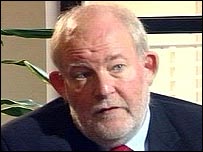 Foremost amongst those is Charles Clarke, who gave an interesting lecture this morning expressing scepticism about the need to renew Trident or build nuclear power stations; backed green taxes and the completion of House of Lords reform and much more besides. You can read his speech
  I'm
I'm