BBC Blogs - Will & Testament

Archives for October 2010

Religion and ethics in the news this week
William Crawley|17:30 UK time, Tuesday, 26 October 2010

relig.jpg

This is my list of the top religion and ethics news stories of the week (so far). Use the thread to add your links to other stories worth noting. If they are interesting, I'll add them to the main page. We might even talk about them on this week's Sunday Sequence.

Religion news
Pope Benedict says migrants have duty to integrate.
Pope urged to denounce archbishop's 'political stunt'.
Catholic leader calls for independent inquiry into Lockerbie bomber conviction.
Gay kissing protest for Pope's visit to Spain.
Roman Catholic church facing £8m payout over child abuse claims.
Tony Blair's sister-in-law converts to Islam.
The power of Lausanne.
The Abrahamic faiths at the New York Public Library.
The Simpsons are not Catholic after all.
Israeli anger over Catholic bishops' statement.
Politician says spike in polls was due to prayers.
Singing success for Belfast choir.
Richard Dawkins sues his webmaster.

Ethical issues
Landmark ruling on questioning powers sparks law change.
Black Watch: play reflects on the reality of war.
The morality of tasers.
Legal challenge expected over same-sex marriage.
Moral philosopher Alasdair MacIntyre on money.
Burma's media ban.
Should we pay drug addicts to get sterilised?
Can money make you happy?
German report reveals war-time diplomats' 'Nazi role'.
Contraceptive gel shows promise as alternative to Pill.
NHS 'suspended whistle-blowers' in London.
NPR criticized for firing Juan Williams.
Obama posts his own It Gets Better video.

Thinking allowed
Philip Larkin's love letters.
How to scandal-proof your church.
Is Low Libido a Brain Disorder?
Could you stay silent for eigth days?
Do human rights exist?
Mohammed Arkoun obituary.

Choirboys

Post categories:

William Crawley|11:50 UK time, Monday, 25 October 2010

Yesterday on Sunday Sequence, I was joined by Fr Hugh Kennedy from St Peter's Cathedral in west Belfast, to hear more about the new BBC TV series Choirboys, which begins tonight at 10.35pm on BBC One NI. We talked about why Irish Catholic churches have struggled historically with the place of singing in the liturgy. Yes, we have a famous trio of Irish priests with a much-publicised record deal, but most Sundays in most parishes you won't hear anything close to that sound. So ... in the first episode of Choirboys, Nigel McClintock has his work cut out for him. Nigel is a brilliant musician and an equally brilliant music director, but his task is to create a successful choir for a cathedral practically out of nothing. That makes him the Gareth Malone of St Peter's Cathedral. Choirboys promises to be a big hit with the public: we love this kind of musical rags to riches story, probably because it allows us to imagine ourselves making the kind of journey Nigel and his choir are making. But there's jeopardy here too, because success is never guaranteed. If you're out tonight, set the VCR.


Cara O'Doherty has written about how the series cam about here. You can also watch a clip here.

Making Connections: A Festival of Radio

Post categories:

William Crawley|13:27 UK time, Saturday, 23 October 2010

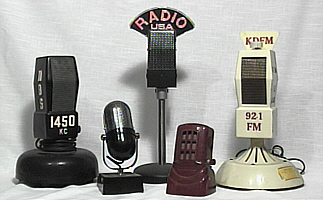
Those mics from the early days of radio are now museum pieces, and if you want to find out just how high-tech our business is these days, read on. There's a big radio event coming to Belfast next week, and I know many of the Will & Testament regulars will want to be part of it. It's open to the public -- and it's really quite unique. The BBC and RTÉ will be joining forces to give the public and chance to step inside the world of radio. The BBC's Blackstaff Studios in Belfast will be transformed into a broadcast and exhibition centre for Making Connections: A Festival of Radio.


Here's how the organisers describe the event:

"The large-scale event, running from Thursday, October 28 to Saturday, October 30, will feature live programming from the BBC and RTÉ, as well as lots of interactive opportunities and displays. There'll be advice on how to get the most from your radio listening and a chance to meet and chat with some of Ireland's most popular presenters. The festival will feature all of the latest gadgets, technology and studios in which you can try news reading, radio drama and presenting. With over 20 exhibits, including a specially commissioned display about the history of BBC radio, this free event will have something of interest for everyone.

BBC Radio 1, BBC Radio 4, BBC 5 Live, BBC Radio Ulster, BBC Radio Foyle, RTÉ Radio 1, RTÉ 2fm, RTÉ 2XM, RTÉ lyric fm, RTÉ Pulse will all be bringing programmes to Belfast as part of the celebrations. And you can enjoy a front row seat as BBC and RTÉ radio presenters broadcast live programmes side-by-side at the festival. You can watch some of your favourite presenters at work in the festival radio studios and see what goes on behind the scenes of some of your best-loved shows. Don't miss out on the chance to be part of Making Connections: a Festival of Radio. Tickets to the event are free of charge and issued on a first come, first served basis."

For tickets click here or call 0370 9011227 (standard geographic charges from landlines and mobiles apply).

Read more about Making Connections.

'Celebrating 100 years of free-thinking Christians'

Post categories:

William Crawley|13:54 UK time, Thursday, 21 October 2010

The Non-Subscribing Presbyterian Church of Ireland is celebrating its 100th anniversary with a grand centenary dinner tomorrow night, Friday 22nd October, at The Belfast Commissioners Office. Will & Testament readers will already be typing a correction to that statement: surely this denomination's roots stretch back as far as 1725, when the first non-subscribing presbytery was formed? Quite true; and, in fact, you could trace its roots back even further to the arrival of Presbyterianism in Ireland. Then came the great debates about whether ministers should be required to subscribe to the Westminster Confession of Faith -- while is still the main doctrinal creed of the Presbyterian Church in Ireland. Some ministers opposed subscription because they were unitarian, others because they opposed any creed taking the place of the Holy Bible. Thus was born a tradition of Presbyterianism that held, under one roof, both trinitarian believers with a high view of Scripture and unitarian 'free thinkers'. But it wasn't until 1910 that the denomination came into existence as a denomination.


More than 100 guests are expected at tomorrow night's celebration, including representatives from the Presbyterian, Methodist, Roman Catholic churches and the Church of Ireland.

The church's press release explains:

"The Moderator, Rt Rev Sam Peden, will be on hand to give a warm non-subscribing welcome to all our guests, which also includes The Lord Mayor of Belfast, Cllr Patrick Convery. Since 1910, The Non-Subscribers, as they are affectionately known, have been giving witness to the principles of free enquiry and love of liberty. The NSPCI have played an important role in the history of Belfast city. Its adherents have been noted figures, including the Titanic shipbuilder Thomas Andrews. They have shown throughout the ages their opposition to injustice and support for freedom. Many Non-Subscribers supported Catholic Emancipatio; indeed Daniel O Connell stayed in the NSPCI Manse in Dunmurry. They opposed commercial gain from the slave trade and made sure that Belfast played no role in such business. Later they were one of the first denominations to ordain women. Many Non-Subscribers have been dedicated to the development of integrated education and have given continuous service to such visionary educational projects. The Non-Subscribing Presbyterian Church is a small but significant denomination with a historical witness to liberal Christianity. Although a separate denomination in its own right, it is unique to Ireland and within the tradition of Irish Presbyterianism and has a close association with The General Assembly of Unitarians."

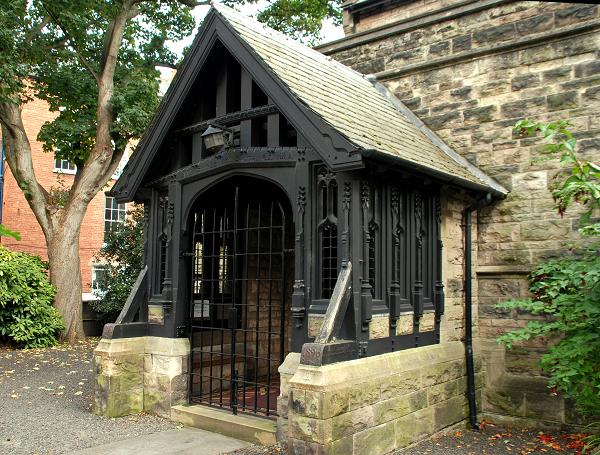
Picture: All Souls' Church in Belfast's university quarter, one of the denomination's best-known churches.

Cardinal Brady fights back on education

Post categories:

William Crawley|12:42 UK time, Thursday, 21 October 2010

The leader of Ireland's Catholics has responded robustly to First Minister Peter Robinson's attack on state-funded faith-based education. In a keynote speech this morning at the Irish Inter-Church Meeting, Cardinal Sean Brady made a strong case for the place of "Christian education" in Ireland, north and south, and claimed that 'recent suggestions that schools in Northern Ireland should be forced into one single state system are a stark warning to all those who respect diversity and the rights of parents.' Without naming the Northern Ireland First Minister, the cardinal clearly had Peter Robinson in his sights, who recently described the Northern Ireland educational system as "a benign form of apartheid". He said these 'comments set back the discussion about the future of education'.


Peter Robinson's comments, made in a speech last Friday, have also been challenged by the head of the Council for Catholic Maintained Schools, and the deputy First Minister, Martin McGuinness, has warned the First Minister against 'taking on' the Catholic Church over the provision of education.

Religious leaders are typically very careful about becoming involved in a political spat with politicians, and Cardinal Brady has chosen his words here very carefully. But in ecclesiastical terms, the gloves are off: the cardinal plainly feels the need to reassert the moral case for Catholic education in the face of what he appears to regard as a backward-looking and politically-charged salvo from Peter Robinson. He has done so in the language of equality and rights: Catholic schools are welcome in England, Scotland, Wales and the Republic, why shouldn't they be welcomed and protected in Northern Ireland too? You don't need to read between the lines of this speech to realise that Cardinal Brady is concerned that Catholic schools should not become a political football to be kicked around in a public debate which can only, in his judgment, breed 'distrust and suspicion.'

Key quotes from the cardinal's speech:

"Recent suggestions that schools in Northern Ireland should be forced into one single state system are a stark warning to all those who respect diversity and the rights of parents. It seems strange that people in Northern Ireland are being told that they should accept a lower standard of rights and freedoms than they would have if they lived in Britain, Scotland or the south of Ireland. People in Northern Ireland deserve to live in a normal society. Diversity is part of a normal society, including diversity in the range of schools available for parents to choose from."

"Such comments set back the discussion about the future of education, north and south. They create distrust and suspicion rather than a constructive atmosphere of collaboration, sensitivity and mutual respect. Today is an opportunity for us as Christians, with our own particular histories on this issue, to demonstrate that sensitivity and respect for each other. It is an opportunity to explore what opportunities might exist for greater co-operation and sharing in the mission of Christian education in Ireland today. It is an opportunity to identify how we can work to support each other against efforts to remove our legitimate rights and interests in education."

Read his speech in full.
BBC news coverage.

Axe Wednesday

Post categories:

William Crawley|10:34 UK time, Thursday, 21 October 2010

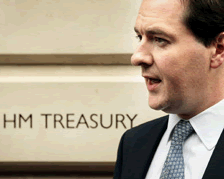
George Osborne has published the detailed break-down of the comprehensive spending review (read it in full), what is widely seen as the blueprint for a new 'age of austerity' in Britain. The NHS budget is protected, as is the English schools budget, and Britain will increase its commitment to overseas aid. But everywhere else: cuts. An additional £7bn in welfare cuts, a rise in the retirement age to 66 by 2020, and an average of 19 per cent cut in across all Whitehall spending departments.


Every cut in government spending is not only a financial decision, it's also a moral decision. Cuts in spending reflect our values, our commitment to a certain kind of society. If we decide to invest in a new generation of nuclear weapons while cutting incapacity benefits, that is a decision that merits some moral analysis. The chancellor's spending review document includes a 'distributional' analysis, which tries to assess the impact of the cuts across society: it's worth a look. Do these cuts hurt poorer people disproportionately? How do they impact upon working families? And what kind of society will be the consequence of these cuts? Will our streets be safer -- or less safe? Will our children be better educated -- is less well-educated?

Some commentators say we should embrace the age of austerity: many of these cuts are good for us. The government say we can't afford to send as many people to prison; many prisoner reform campaigners say we've already been sending too many people to prison, so that's progress. The government says we need to move from 'military intervention to conflict prevention': peace activists say that's a long-overdue step in the right direction. The government says we need to help people out of welfare and into work: many tax-payers say that's progress too, because it will incentivise full participation by more people and dis-incentivise 'opting out'.

What's your response to the chancellor's announcement? Do you see a silver lining or two in the fiscal cloud? Is it fair?

Some relevant links:

BBC summary analysis of the spending review.
Spending cuts 'are reckless gamble' says Alan Johnson.
Chancellor defends the 'fairness' of the cuts.
Spending review: the nation responds.
Institute for Fiscal Studies: the cuts are 'regressive'.
Adam Smith Institute: the government has made a 'decent start'.
Child Poverty Action Group: 'short-sighted and profoundly unfair'.

There will be full analysis of the morality of the cuts on both Sunday Sequence (Radio Ulster, 8.30am) and Sunday Morning Live (BBC One, 10.15 am) this week.

Religion and ethics in the news this week

Post categories:

William Crawley|17:01 UK time, Tuesday, 19 October 2010

relig.jpg

This is my list of the top religion and ethics news stories of the week (so far). Use the thread to add your links to other stories worth noting. If they are interesting, I'll add them to the main page. We might even talk about them on this week's Sunday Sequence.

Religion
The Anglo-Catholic exodus begins.
NI First minister takes on segregation in schools.
Is atheism a new religion?
Government opposes tax breaks for Scientology.
The miracle of San Jose?
Methodist leader defends rise in university tuition fees.
Pope condemns violence 'in God's name'.
Christine O'Donnell's church and state gaffe makes voters laugh.
Supreme Court rules in favour of pre-nuptial agreement.
Barred Chinese leaders send greetings to Lausanne Congress.
Ugandan teens turn to religion rather than HIV treatment.

Ethics
Spending Review: Osborne wields UK spending axe.
Charity offers UK drug addicts £200 to be sterilised.
Wednesday is "wear purple day".

Thinking allowed
William James on religion.
Neuroscience and free will.
Robots don't feel. Why pretend they do?

Celebrating the life and legacy of Jim Dougal

Post categories:

William Crawley|11:09 UK time, Monday, 18 October 2010

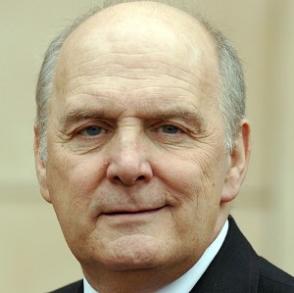
Journalists and broadcasters from across Britain and Ireland will today bid farewell to one of our most respected colleagues. The news of Jim Dougal's death on Friday shocked us all, but no-one can be surprised by the warmth and affection of the tributes that were paid by politicians across the political spectrum, every sector of the media, and members of the public who have admired a lifetime of Jim's broadcasting. Jim also stood in for me a number of times as presenter of Sunday Sequence and regularly reviewed the Sunday papers with me after the news at 10 o'clock; and our programme began this week with a tribute to Jim from fr Brian D'Arcy. Jim was a very special journalist and broadcaster because he was a very special person, and all the tributes we've heard this weekend pay attention to those characteristics that we all associated with him: integrity, honesty, intelligence, charm and good humour. Northern Ireland journalism has lost one of its greatest ambassadors.


My Sunday Sequence producer Martin O'Brien was a very close friend of Jim's. I asked Martin to share some of his memories of Jim:

"I extend my deepest sympathy to Jim's wife, Deirdre, daughters Nicola, Tara, Emma and Tina and son, James junior and family circle. They have lost a great husband and father. And I have lost a dear friend and I will greatly miss him. Jim was one of the greatest journalists of his generation and a true gentleman. He was admired and respected right across the political spectrum and in London, Dublin, Washington and Brussels for his integrity, authority and innate fairness.

He excelled as a political correspondent because he made it his business to really get to know the politicians of all parties and the senior policy makers in Government and used his high intelligence and analytical skills to get to the heart of the story. To accurately interpret what they told him, to gently but incisively put them on the spot when necessary, weigh the evidence and present to his audience the most informed and authoritative analysis to be found anywhere.

He brought his considerable skills also to analysing religious affairs and made a typically insightful contribution to our Sunday Sequence special programme on the future of the Catholic Church last February which can still be accessed on our website.

He was a much valued mentor to a generation of young journalists in BBC, RTE and UTV who are in his debt for his advice and guidance. They and his more senior colleagues admired his cool head, unflappability and balanced judgement during some very difficult times. Jim was also a skilled and canny political operator as representative of the European Commission in Belfast and later as Head of the Commission in the UK based in London and deployed his legendary diplomatic skills to discharge his responsibilities with distinction although he found the bureaucracy of the Commission sometimes quite maddening.

He bore his illness with great dignity and right to the end continued to make a sterling contribution to broadcast journalism through his work on UTV. I will miss his wisdom, unrivalled insights, wicked humour, sartorial elegance and above all his invaluable friendship. May he rest in peace. "

A Mass of Thanksgiving for Jim Dougal is to be held today at 1pm in Saint Brigid's parish church in south Belfast.

Religion and ethics in the news this week

Post categories:

William Crawley|08:17 UK time, Wednesday, 13 October 2010

relig.jpg

This is my list of the top religion and ethics news stories of the week (so far). Use the thread to add your links to other stories worth noting. If they are interesting, I'll add them to the main page. We might even talk about them on this week's Sunday Sequence.

Religion
New hope for Presbyterian Mutual Society savers.
Islamic preacher in High Court challenge.
Chilean miners: Rival churches claim credit for the miracle.
Nick Clegg and the Catholic school row.
Having faith 'helps patients live longer', study suggests.
HIV-positive church members.
America's 'best theologian'?
Francis Campbell to give 2010 Tablet Lecture.
Howard Jacobson wins the Man Booker Prize for The Finkler Question.
The religion of the Tea Party.

Ethics
The 'trolly problem': an ethical test.
Does morality stem from science or religion?
Thinking about human rights with Conor Gearty.
First trial of embryonic stem cells in humans.
Scientists discover Garden of Eden in Argentina (well, sort of ...)
US ban on openly gay military personnel is suspended.

Thinking allowed
Consider the ant: an evolutionary parable.
Mario Vargas Llosa: an unclassifiable Nobel winner.
Religion vs science: can the divide between God and rationality be reconciled.
Politics as religion.
Mark Tully on the art of fables.

Radio Ulster: the best in Irish radio

Post categories:

William Crawley|10:02 UK time, Monday, 11 October 2010

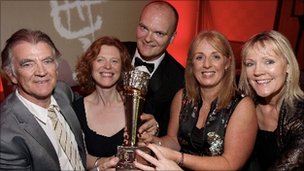
Congratulations to all my friends and colleagues at Radio Ulster. This weekend, we were named Station of the Year at the Irish broadcasting awards. Our listeners always knew it, but now it's official: we are the best in Irish radio. That industry accolade was won by hundreds of hours of hard work, bags of creativity, and mountains of passion from producers, presenters, editors, sound engineers, web developers, managers, production and content staff -- and technical wizards with job titles I'm still trying to work out. If you worked in Broadcasting House in Belfast you'd know what I mean when I say that Radio Ulster is unlike most other stations. I make programmes each week with some very special people, some of the brightest, most imaginative people I've ever worked with in any professional context. Like many others, I think I take all that creativity for granted much too often; but this award gives me, and others, a chance to acknowledge what makes Radio Ulster unique: the people who make the programmes, and the affectionate and intimate connection they have built with our loyal listeners.


The picture was taken after the winners were announced at the PPI Awards this year. Don't they look remarkably sober? In the picture: Gerry Anderson, who picked up an award for his wonderful documentary "Failed Christian", about the guitarist Henry McCullough; Susan Lovell, the head of Radio Ulster, looking proud as punch; Ralph McLean, whose encyclopaedic knowledge of music helped him scoop a Silver Award for specialist music broadcasting; and our editors Jackie Neill and Maggie Doyle, who work with Susan to get us on air, keep us all on air, and keep us "on" while we're on air. A hat-tip also to the Nolan Show team, who picked up a Silver for Current Affairs, the Blas team, who took Silver in the Craoltareacht le Gaelige category, and Across the Line, who were bronzed by the end of the evening in the music programming awards.

That's an armful of awards for Radio Ulster, including the biggie: Station of the Year.

Equipping Northern Ireland for the Digital Future

Post categories:

William Crawley|17:16 UK time, Wednesday, 6 October 2010

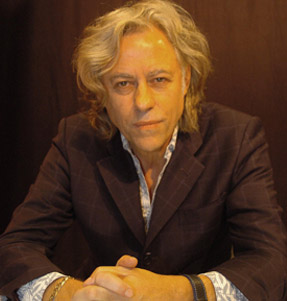
Sir Bob Geldof is perhaps better known to the public as a musician and anti-poverty campaigner, but the former Boomtown Rats star is also a major figure in today's media. He began his career as a journalist on Canada's premier underground rock journal, before writing for Melody Maker and New Musical Express, and subsequently co-founded the TV production company Planet 24 which pioneered early morning television with The Big Breakfast. Planet 24 was sold to Carlton TV in 1999. Factual media producer Ten Alps (Planet spelled backwards) was founded the next day and has grown to around £80m turnover. In September 2009 Ten Alps Asia was launched, in Singapore.


Bob Geldof has a wealth of experience in business and the creative industries and will be sharing some of his wisdom with Northern Ireland's present and future media leaders at the first-ever Belfast Media Festival, which takes place tomorrow at the BBC's Blackstaff Studios. In a keynote address launching the festival, Peter Johnston, the head of the BBC in Northern Ireland, will outline the challanges facing one of the fastest growing, and most important sectors to the Northern Ireland economy. We'll also hear from the BBC's chief tehnology officer, John Linwood, and the Controller of BBC Two, Janice Hadlow.

The Belfast Media Festival is a one-day event that will consider and debate the digital future for Northern Ireland and examine how to future-proof our local creative community. We will discuss how technology will change the way content is produced, the skills which will be needed to do this and the changing needs of the local audience. In addition to keynote address and in-depth worskshops, participants can visit the Digital Street to get hands-on with the latest technology from the BBC's Blue Room and be the first to see some prototype work from the BBC's Future Media and Technology team based in Manchester. They can even speed date a TV commissioner. At the end of the day, we'll stage our very own version of Question Time, which I'll be chairing. On the panel: Ailsa Orr: Head of Programmes, BBC NI, Jannine Waddell: Managing Director, Waddell Media, Kate O'Connor: Executive Director, Skillset, Steve Carson: Director of Programmes, RTE, and Michael Wilson: Managing Director, UTV.


You can find out more about Belfast Media Festival on the official website, follow it on twitter (@belfastmedfest), and use this thread to leave questions for our experts, or share your experience of the media in Northern Ireland. What does the term "digital future" mean to you? How does "the media" connect with your life? How does the media in Northern Ireland succeed? How would you like to see it change in the future?

Update: You can watch the keynote addresses at this year's Belfast Media Festival on the festival's website. I'm told the addresses will be available on the site from Monday. Bob Geldof's address gripped the conference by the lapels and shook us around a bit. It was a tour-de-force which led me to coin a new word: the verb "to geldof", which means ... well, why don't you watch his address and tell me what you think the definition of that new verb should be.

Religion & Ethics in the news this week

Post categories:

William Crawley|22:56 UK time, Tuesday, 5 October 2010

relig.jpg

This is my list of the top religion and ethics news stories of the week (so far). Use the thread to add your links to other stories worth noting. If they are interesting, I'll add them to the main page. We might even talk about them on this week's Sunday Sequence.

Religion
Druidry is recognised as a religion by Charity Commission.
UK gets its first Centre for Intelligent Design.
The Eddie Long Scandal: It is About Anti-Homosexuality.
Young people have 'faded memory of Christianity' says new book.
Methodist preacher to sue his own church over claim of anti-Israel bias.
Park51: Is it a 'mosque' or isn't it?
Is Lord Patten to be Britain's new Vatican ambassador?
West Bank mosque 'set alight by Jewish settlers'.
British Methodists launch their first e-book.
Beyond Belief: Islam in America.
Is religious freedom in Britain under threat?

Ethics
Nobel Peace Prize to be announced Friday.
Father of Test Tube Baby wins Nobel Prize.
'Test tube babies': God's work or human error?
IVF opened 'wrong door' to treating infertility, says Vatican official.
Why Anti-Gay Bullying is a Theological Issue.
The Scope-Severity Paradox: Why Doing More Harm Is Judged to Be Less Harmful.
European churches press EU on poverty reduction policies.
"It Gets Better' campaign tries to tackle teen suicides.
US senate candidate's election ad says "I'm not a witch".

Thinking allowed
Do Space Aliens Need Baptism?
What are books good for?
US senator says gays and unmarried women shouldn't be teachers.
More or Less: how accurate are official stats on sexuality?
Humanists search for this year's 'enemies of reason'.

A theology of testosterone

Post categories:

William Crawley|12:05 UK time, Monday, 4 October 2010

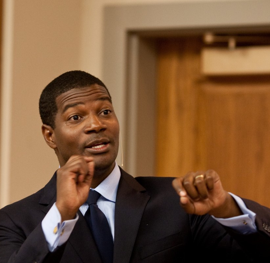
We talked about the Eddie Long scandal on Sunday morning with Jonathan Lee Walton (pictured, left), assistant professor of theology at Harvard Divinity School and author of Watch This! The Ethics and Aesthetics of Black Televangelism. We talked about testosterone-driven ministries and whether the theological character of the American mega-church movement can help explain how the kind of pastoral abuses alleged in the Eddie Long story (if they prove to be true) are facilitated. Jon Walton offered us a very thoughtful analysis, which is worth considering. Listen again here or in this week's Everyday Ethics podcast.

Update: Pastor Eddie Long has obliquely addressed the questions facing him in a sermon at New Birth Missionary Baptist Church on Sunday morning. Watch the service here.

Should we keep God out of politics?

Post categories:

William Crawley|19:09 UK time, Friday, 1 October 2010

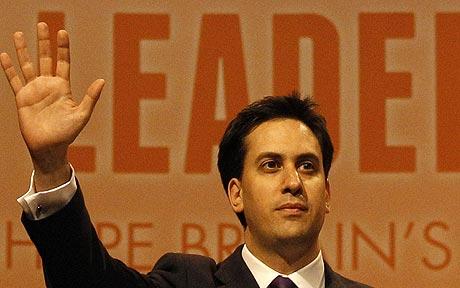
In the US, any candidate for the presidency who announced that he or she was an atheist would lose. Full stop. For all its talk of a constitutional wall of separation between religion and politics, the reality in the US is that a religious test is applied by the public and the media in respect of any major elected political office. Even those non-believers who get elected to congress do so by remaining quiet about matters of faith ("those are private matters") rather than proclaiming their views. In the UK, things are quite different. The Labour Party has been led by three self-avowed "public" atheists: Michael Foot, Neil Kinnock, and now Ed Miliband. The Lib Dems are currently led by an atheist, Nick Clegg. Even the Prime Minister, David Cameron, who says his Christian faith is important to him also adds that he doesn't attend church regularly.


Read the rest of this entry

BBC © 2014The BBC is not responsible for the content of external sites. Read more.

This page is best viewed in an up-to-date web browser with style sheets (CSS) enabled. While you will be able to view the content of this page in your current browser, you will not be able to get the full visual experience. Please consider upgrading your browser software or enabling style sheets (CSS) if you are able to do so.