BBC BLOGS - Mind The Gap

Archives for January 2011

Mind the Gap's mind your wallet travel tips!

Post categories:

Tom EdwardsTom Edwards|11:54 UK time, Wednesday, 26 January 2011

Comments

In order to see this content you need to have both Javascript enabled and Flash installed. Visit BBC Webwise for full instructions


Getting around the capital on public transport is becoming more and more expensive and there's little end in sight to the rises.

So I've decided to try and save us all a few quid and help compile a list of money saving tricks - all legit and above board.

There are actually quite a few ways you can save cash getting around the capital on the Tube and trains.

Here are a selection to hopefully get the list started:

Season ticket Gold card

A BBC cameraman colleague of mine Peter Kendall (and all round good egg) is an absolute master at saving money on fares. (Cameramen always like a bargain especially if it's good grub).

Peter also writes to the The Times now and again complaining about rail fare increases. Anyway I digress. Peter travels off-peak (after 10am) using First Capital Connect.

His tip is get a Gold Card - it's normally given to anyone who buys a season ticket. The bonus is you can get a third off the off-peak ticket price.

Now the trick is getting the cheapest Gold Card. And the cheapest season ticket is on the Isle of Wight. He bought one for £132 and he reckons it saves him £450 over the year.

And when it comes to the Gold Card there are other bonuses.

Railcard benefits

One of the new benefits was only introduced at the beginning of the year.

It has not been publicised at all well and I only found out about it by trawling on TfL's website. In fact, many staff members themselves don't know about it even though it is on the back of one of the booklets. And it will probably take some persuasion to convince the ticket clerk that it actually exists.

However, if you have a Gold Card you can get a THIRD off off-peak Oyster Pay As You Go on Tube fares.

So, for example, you get an off-peak single fare for £1.25 instead of £1.90. And it gives you a third off the off-peak cap.

In effect you get an off-peak travelcard for a two thirds of the cost. Peak hours are 0630-0930 and 1600-1900.

You have to take your Gold Card and Oyster card to a ticket office so they can add the discount to your Oyster profile.

The discount was made available to TfL services to bring in consistency across transport services in Greater London. This is what the TfL site has to say.

If you have either a:

  • Senior Railcard
  • 16-25 Railcard
  • Disabled Persons Railcard
  • Gold Card
  • HM Forces Railcard

You can get:

34 per cent off a off-peak Pay As You Go single fares on Tube, DLR, London Overground and National Rail (previously was just National Rail and London Overground).

34 per cent off off-peak daily price caps on the Tube, DLR, London Overground and National Rail.

To get the discounted Oyster fares you need to add your Railcard details to your Oyster card. You can do this at all Tube, London Overground and some National Rail ticket offices.

See the new National Railcard discounted off-peak fares.

Incidentally, London TravelWatch say:

"The ticketing system can be incredibly difficult for passengers to understand, and the discounts incredibly hard to find. We'd like to see companies work harder to ensure that passengers are properly informed about the best and cheapest tickets, and we always advise passengers to do plenty of research."

New off-peak Zone 1 fare

This is another little addition to the ticketing system.

Clearly it only applies to those who can move their day around a bit.

The TfL site says:

"If you're travelling into Zone 1 on Tube, DLR, London Overground or some National Rail services between 16:00 and 19:00 on Mondays to Fridays, you will be charged an off peak fare when using Oyster pay as you go.

This could save you up to £2.50 per trip. Remember, you're charged according to when you touch your Oyster card on the yellow card reader at the start of your journey. So if you touch in at the start of your journey between 16:00 and 19:00 and touch out in Zone 1 at the end of your journey, you will be charged an off-peak fare."

If there are any others as I'm sure there are then please add them below and if I've saved you a few quid please also let me know!

Follow me on Twitter: @TomSEdwards
Moving hire bikes around harming other cyclists...

Post categories:

Tom EdwardsTom Edwards|00:01 UK time, Tuesday, 25 January 2011

Comments

Another day, another Freedom of Information response lands on the desk here at the Mind the Gap blog.

Thanks to Laura Cox who is studying journalism at City University for this one. (Any stories always welcome).

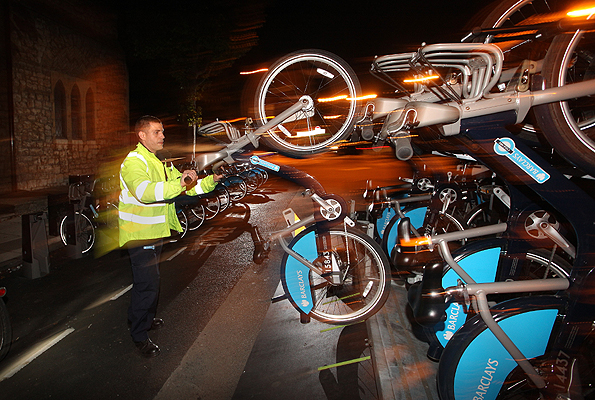
This request reveals that in six months since the bike hire scheme launched, the trucks that move the hire bikes around have been involved in 24 incidents.

Nine of those were minor prangs including scratches and dented wing mirrors. Eleven involved other vehicles.

However of those, four involved collisions with cyclists.

I'll write the headline now: Cyclists' public enemy number one - bike hire trucks. (Ok I admit that needs some work)

Whether the number of accidents involving cyclists is high for one company it's difficult to say.

It's certainly embarrassing for the operators Serco, although we don't know the circumstances of the accidents.

Also revealed in the documents are the number of trucks being used by Serco. As I've highlighted before, much of the distribution is carried out by Ford Mondeos, Nissan diesel vans and three 7.5 tonnes trucks.

All of which again raises questions about the green credentials of the redistribution fleet.

Here is the full list of the vehicles being used:

INFORMATION ABOUT VEHICLE FLEET:

  • 14 electrically powered Alke vehicles. These are used for the redistribution of bikes and pull the trailers which hold 20 bicycles. These vehicles are exempt from Congestion Charging and produce zero emissions.
  • Six Ford Mondeo and four Ford Focus diesel cars. These are used for the redistribution of bikes and pull the trailers which hold 20 bicycles. The vehicles are subject to the Congestion Charge and produce the following levels of CO2 emissions: Ford Mondeo - 139 g/km, Ford Focus 1.6 - 114 g/km and Ford Focus 1.8 - 137 g/km.
  • 10 Nissan diesel vans. These are used for engineers and technicians undertaking regular and reactive on-street maintenance work. They are subject to the Congestion Charge. These do not carry bikes except when picked up for repairs. The level of CO2 emissions produced is 137 g/km.

In addition to the permanent element of the fleet, Serco are temporarily using some additional vehicles. These vehicles do not form part of our normal operational fleet, but they have been used recently as we test alternative redistribution arrangements.

  • Seven Sprinter vans which carry 16 bicycles. These vans are subject to the Congestion Charge and emit CO2 levels of 222 g/km.
  • Three 7.5 tonne Iveco and DAF trucks which carry up to 50 bikes each and are subject to the Congestion Charge and emit approximately 263g/km CO2, subject to load.

The number of vehicles used varies in accordance with the usage of the scheme.

Eight to ten vehicles are despatched in the morning through to late evening in the centre of London.

Three to four Ford Focuses and/or Mondeos are despatched to the outer areas of Zone 1 in the morning and overnight.

Five to six Sprinter vans are primarily used to cover any shortfalls in the Alke vehicles or Ford vehicles.

The trucks are used primarily for the mass distribution of bikes at hub sites. They are also used in the event of tube strikes when demand is high.

Reading the list, what becomes very clear is Serco vastly under estimated the challenge of distribution initially.

So much so that seven vans and three trucks are being used on top of the number of vehicles they thought they'd need.

I'm assuming the trucks are mainly used to move bikes from the hub sites at mainland trains stations like Waterloo and Kings Cross.

Is that sustainable though? Isn't the scheme meant to find it's own level and become balance itself in terms of where bikes end up?

A Transport for London spokesman said:

"There have been just four very minor collisions involving Serco distribution vehicles and cyclists since Barclays Cycle Hire launched six months ago, resulting in no serious injuries and no more than scratches to vehicles.

"Although it is of course unfortunate that any incidents have occurred, in the context of several hundred journeys these vehicle make each day and the half a million daily cycle journeys made on London's roads, we believe Serco have a good record of safety."


Contact and follow me on Twitter: @TomSEdwards

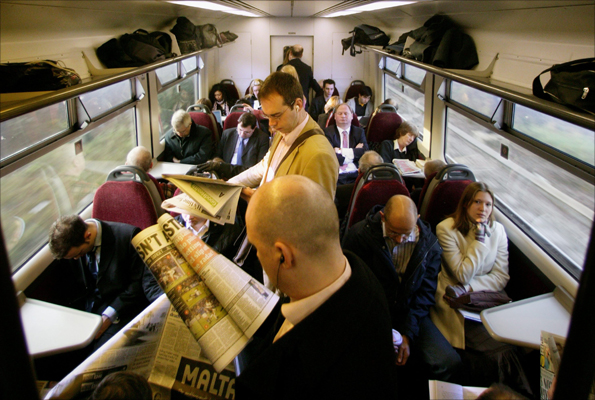
Do you get one of the UK's most overcrowded trains?

Post categories:

Tom EdwardsTom Edwards|11:04 UK time, Monday, 24 January 2011

Comments

A Freedom of Information request has found that all of the top 10 most overcrowded trains (PDF) are those going into and out of the capital.

It probably won't surprise the commuters who use these services but it might be interesting what the train operators are trying to do to alleviate the problem.

Here are the most overcrowded trains and a little explanation underneath from the Department for Transport:

1. 06:12 service from Didcot Parkway to London Paddington (248 passengers in excess of its capacity of 395)
ln May 2010 FGW changed the type of train used on this service (to a 2+7 HST), which increased the number of standard seats to 440, with much more standing room for passengers. More recent figures (spring 2010) showed loadings of 459.

2. O7:42 service from Reading to London Paddington (326 passengers in excess of its capacity of 533)
This is a very popular commuter service into Paddington. FGWwould like to strengthen this service, although is unable to do so with current levels of rolling stock without adversely affecting other services. The company is speaking to the Department about ways to address the issue.

3. 18:30 service from London Paddington to Weston-super-Mare (205 passengers in excess of its capacity of 395)
This is the first off-peak evening service to the West Country. FGW reports that this was its busiest train last autumn and it is very aware of the problems on this service last year. This train became an off-peak service in September 2009, and demand increased. In May 2010 FGW reclassified this as a peak service, to help distribute passenger flows more evenly, which has helped resolve the problem.

4. 18:22 service from London Liverpool Street to Clacton-on-Sea (262 passengers in excess of its capacity of 524)
From the May 2010 timetable NXEA now operates this service utilising 3x321's with a capacity of 876 seats. At 12 carriages, this service is at the maximum length for the route, with current loading of this train averaging 58 per cent.

5. 18:49 service from London Euston to Northampton (244 passengers in excess of its capacity of 492)
The service was extended to a 12-car train (maximum length for the route) trom 12 April 2010.

6. 07:43 service from Henley-on-Thames to London Paddington (110 passengers in excess of its capacity of 225)
FGW recognises the capacity issues on this service, particularly for customers travelling from Twyford. The company is speaking to the Department about ways to address the issue. Latest figures (spring 2010) show a significant reduction in loadings to 267.

7. 07:32 service from Woking to London Waterloo (357 passengers in
excess of its capacity of 738)

This 12-carriage train (Class 450) is the maximum length for any train on the SWT network. The spring 2010 count reveals that the load factor on this particular train has fallen slightly by 5 percentage points to 143 per cent.

There are alternative services from all stations served both 20 minutes earlier and about 10 minutes later (the later train arriving at Waterloo 7 minutes later) both of which have a current load factor of less than 100 per cent (from Woking there are trains every few minutes at this time of day).

There are no track capacity or rolling stock resources to mitigate this with any additional services.

8. 06:00 service from Bristol Temple Meads to London Paddington (180 passengers in excess of its capacity of 395)
FGW recognises the capacity issues on this service from Reading, which is one of its most popular trains. The company is speaking to the Department about ways to address the issue.

9. 07:10 service from Oxford to London Paddington (171 passengers in excess of its capacity of 395)
FGW recognises this is one of its busiest services. The company is speaking to the Department about ways to address the issue.

10.18:45 service from London Paddington to Reading (116 passengers in excess of its capacity of 27O)
The number of carriages on this service has been temporarily reduced to allow FGW to carry out an £8m refresh of its 16x fleet. This will return to a S-carriage train once that work is completed.

Here is the Government's response:

"As part of the Government's commitment to tackle overcrowding on the railways we have pledged to invest in more than 2,100 new rail carriages as well as completing the vital Crossrail and Thameslink projects in London.

"In addition, binding obligations on service quality and tackling overcrowding are likely to form part of the Government's new approach on commuter franchises."

"In total the Government will deliver more than 2,100 new rail carriages onto the network by May 2019. Of these, 1,800 will be for new Crossrail and Thameslink services. This will in turn free up hundreds of existing electric carriages to be deployed onto the newly electrified lines by franchised train operators. In total, there will be at least 1,850 net additional carriages on the network by 2019."

So the bottom line is even though the government is buying 2100 carriages - the actual increase will be 1850 extra carriages on the network as some are replacing old carriages that are at the end of their life and so are not "extra".

And they won't be in use until 2014. So I'm afraid it won't get any better in the short-term.

Thoughts?

Has the Mayor called the union's bluff?

Post categories:

Tom EdwardsTom Edwards|12:48 UK time, Friday, 21 January 2011

Comments


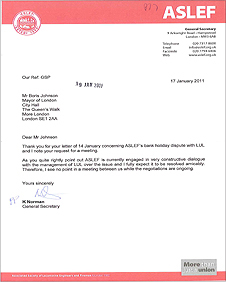
Here's the reply (pdf) from the Tube driver's union ASLEF to the Mayor Boris Johnson.

He'd previously invited them to City Hall to talk about strategy IF they dropped the threat of a strike on the day of the Royal Wedding.

What the letter does is turn down a meeting - for now.

As it stands the threat of a strike on the Royal wedding remains remote according to ASLEF HQ.

The letter says: "I fully expect it be resolved amicably."

At the time I said on BBC 5live that I wouldn't put money on a strike going ahead. And called it union sabre-rattling.

Note that a strike on the Royal wedding day has not yet been ruled out entirely. Some thought (even within BBC London) that we shouldn't have done the story at all.

However, the waters were muddied considerably because the union was not putting forward a uniform message.

Unions are, most of the time, a collection of diverse opinions and there is a certain amount of briefing and counter briefing to the media to nudge some policies along.

And while Branch Organisers and members may have no fear striking on the day of the Royal Wedding - the ASLEF Executive clearly do not have much appetite for one on that day and slapped down the idea.

Presumably as they know there would be very little sympathy from the public and PR-wise it could be a disaster.

Behind the scenes at ASLEF I'm told there is heated disagreement over the next move.

Back to the letter and City Hall will undoubtedly use this to show they have invited transport unions in for talks. And so you can expect this to be recited any time Labour or the unions say the Mayor isn't engaging.


So did Boris Johnson call the union's bluff?

The Mayor may indeed have wanted talks about long-term transport strategy but it does look like he successfully called their bluff.

But can City Hall use that as blanket proof that the Mayor is trying to engage with the all the unions?

No. ASLEF is only one of three of the major unions on the tube - the others being the RMT and TSSA.

And I can't see a meeting between Bob Crow and the Mayor anytime soon...

Follow me on Twitter: @TomSEdwards
Has scrapping the WEZ made any difference?

Post categories:

Tom EdwardsTom Edwards|11:26 UK time, Monday, 17 January 2011

Comments

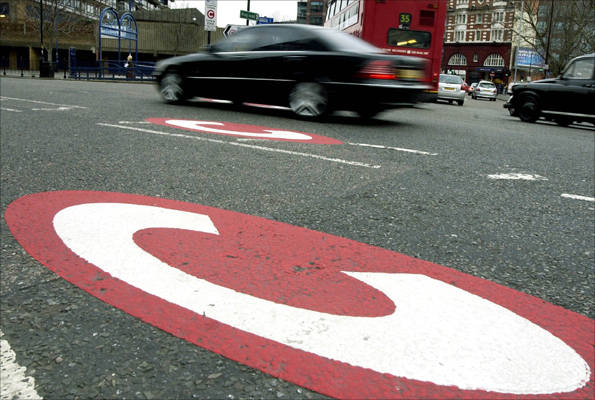
It has been just under a month since motorists stopped paying to drive into the Western Extension of the Congestion Charging Zone (WEZ). It was abolished on January 4th.

So far Transport for London don't have the data on what it's done to congestion and traffic but they say they will have it within the next few weeks.

However, there are a number of quirks of the system that have been turned up.

Firstly, if you mistakenly pay for congestion charge even though the WEZ has been abolished - you can't get a refund. One driver emailed me extremely annoyed by this.

TfL say:

"Unfortunately we are not able to refund daily Congestion Charge payments as, once a payment has been made for a vehicle, we do not keep any images relating to it that are generated by the Congestion Charge cameras.

It is therefore not possible to verify whether a vehicle has been driven in the zone. We understand customers frustration and it is one of the reasons why we have now introduced an automated payment system for the Congestion Charge.

"This allows motorists to register a debit or credit card with TfL that will be automatically billed, at a reduced rate, each time their vehicle is observed in the zone. It will ensure registered customers only pay the charge when they actually drive in the zone and go someway to eliminating this type of problem."

What I think this means is they can't check their records for photos of registration plates that don't exist.

When I asked, if the plates aren't there, doesn't that mean by deduction the car didn't enter the zone?

They pointed out that images are wiped of those that do pay and so they can't keep thousands of images just on the off chance someone makes a mistake. The bottom line is they don't allow it.

However the Autopay system has been a big success.

Initially there were a few teething problems. One driver told us his payments weren't taken and he was issued with a penalty notice.

Supposedly those problems have been sorted out and approximately 47,000 people have now signed up for CC Auto Pay accounts, with 60,000 vehicles registered. The big advantage being you don't get fined and it costs £9 a day and not £10.

Follow me on Twitter: @TomSEdwards
How serious is Boris about the driverless Tube?

Post categories:

Tom EdwardsTom Edwards|16:38 UK time, Friday, 14 January 2011

Comments

In order to see this content you need to have both Javascript enabled and Flash installed. Visit BBC Webwise for full instructions


Last night Mayor Boris Johnson threatened to have more Automatic Train Operation (ATO) systems on the Underground network and implied he could sack Tube drivers if they didn't stop striking and employ non-union staff in their place.

ATO isn't new - however to describe it as "driverless" is a bit misleading as there are drivers most of the time who check the doors but they switch to manual when there's a problem.

It's used on the Victoria and the Central Lines and it's coming on the Jubilee and the Northern Lines.

Driverless is probably more applicable to the DLR but even there they have train captains to look after commuters and the doors.

The hitch with the veiled "plan" is what if you employ someone who's non-union (which you wouldn't know anyway) - how long before they sign up to the RMT or ASLEF?

And with the RMT announcing strike dates on the DLR next week - it proves even really driverless trains don't stop strikes.

Interestingly, the Conservatives on the London Assembly proposed totally driverless train across the network six months ago claiming it would save £140m a year. It was swiftly dismissed by the Mayor's adviser Kulveer Ranger.

The Mayor's opponents say he's grandstanding and baiting the unions.

Others say he's trying to put clear blue water between himself and Ken Livingstone in next year's Mayoral election.

What about another theory.... Is the Mayor trying to isolate the RMT Union?

If he's baiting a union it's certainly only one union - the RMT.

I've been given this letter (PDF) that the Mayor has sent to ASLEF, the Tube drivers union.

The Mayor is asking Keith Norman of ASLEF to a meeting to discuss long-term transport strategy and not enter negoitations on specific issues. That'd include the transport settlement and the Olympics.

A spokesman said it didn't change policy and said they wouldn't meet with unions while actions were going on.

On the one hand the Mayor implies he will sack Tube workers if they don't stop striking - and then on the other he invites them round for tea.

Let's see what ASLEF do.

Difficult decision for them? What will happen to union solidarity now?

Follow me on Twitter: @TomSEdwards
Public transport in London: A decade in numbers

Post categories:

Tom EdwardsTom Edwards|12:50 UK time, Wednesday, 12 January 2011

Comments

In amongst the 290 pages of Transport for London's annual 'Travel in London' (PDF) report are some interesting stats that show the increases in commuters using public transport.

The increases between 2000 and 2009 are absolutely huge when it comes to passenger journeys, particularly on the buses.

That probably reflects the improved service on the buses between those dates in terms of frequency, reliability and perhaps ease of paying with Oyster and the relative expense.

The average number of people on a bus has also jumped up 22%. But the Tube hasn't followed by as much.

Is that because the Tube was already at capacity?

The document says:

"Journey stages by public transport modes (defined as bus, tram, Underground, DLR, rail, taxis and private hire vehicles) increased in share from 30 per cent in 1993 to 34 per cent by 2000, and to 41 per cent by 2008 and 2009. This 7 percentage point increase in the share of public transport stages between 2000 and 2009 is equivalent to a 5 percentage point increase in trip based mode share for public transport in London (see Table 2.4).

These shifts in stage-based mode share have taken place against a backdrop of increased aggregate travel volumes, reflecting among other things population and employment growth.

Thus, within the context of increased overall travel, the net shift in mode share towards public transport simultaneously achieved in London has contributed to travel overall becoming more sustainable."

So overall there has been a 5% increase in the use of public transport.

Having said that, although the number of car journeys has dipped slightly it still represents the largest single mode of transport in London.

The documents say of the dip in car journeys:

"While initially the scale of the decline was greater in Inner and central London than in
Outer London, partly reflecting the introduction of Congestion Charging in central London in 2003, the latest change, between 2008 and 2009, was similar in all three
areas. This 3 per cent fall in London for 2009 compares with a 1 per cent fall
nationally in Great Britain, and is at least partly attributable to the wider effects of the economic recession that have similarly affected other areas."

Passenger journeys

In the tables below, the first figure is for 2000, the second figure is for 2009 and the percentage change is shown in brackets.

  • Buses: 1400 million - 2300 million (+67%)
  • Underground: 970 million - 1100 million (+10%)
  • DLR: 38 million 69 million - (+82%)
  • Rail services: 660 million - 840 million (+27%)
  • River: 1.6 million - 2.2 million (+37%)

Person-kilometres travelled

  • Buses: 4.7 billion - 8.0 billion (+65%)
  • Underground: 7.5 billion - 8.5 billion (+13%)
  • DLR: 0.2 billion - 0.4 billion (+87%)
  • Rail services: 19 billion - 24 billion (+24%)


Average number of passengers on a...

In the table below, the first figure is for 2000, the second figure is for 2010 and the percentage change is shown in brackets.

  • Bus: 13 - 17 (+22%)
  • Tube train: 117 - 122 (+4%)
  • DLR train: 63 - 79 (+18%)
  • Tramlink tram: NA - 53 (NA)

Foreign sales out the backdoor for new London bus?

Post categories:

Tom EdwardsTom Edwards|13:35 UK time, Tuesday, 11 January 2011

Comments

In order to see this content you need to have both Javascript enabled and Flash installed. Visit BBC Webwise for full instructions

The new bus for London is one of Mayor Boris Johnson's flagship transport projects costing £7m in research and development.

I've been given a glimpse of what's been going on behind the scenes with the designers, the manufacturers and Transport for London.

Using the Freedom of Information Act I got hold of some documents (PDF) that show the rear platform has been causing "much debate and discussion" for six months.

At one point an email reply says "sorry this isn't the news we were hoping for" and there was some concern the 'jump on, jump off' platform might not pass safety legislation.

However, it is being built and it's very much happening with the prototype engine now being constructed in Ballymena. Proving tests will begin in Bedfordshire in a few months time.

The vehicle's now being built under the National Small Series Type Approval (NSSTA) scheme.

The Vehicle Certification Agency told me:

National Small Series Type Approval (NSSTA) is a national approval scheme aimed at manufacturers building vehicles in low volumes (small series). UK-issued NSS type approvals are valid in the United Kingdom, and manufacturers may register in the UK a maximum of 250 vehicles of the type in one year. The manufacturer may apply to other Member States to accept the UK approval.


However, some of the documents (PDF) I was given say that "the open platform design is not covered in international regulations, and there is a risk of challenge from the EC."

And if the designs are challenged that could restrict where the new bus is sold in the future.

And Transport for London was looking forward to those revenue streams as it owns the rights to the technology and the new designs.

TfL insists the risk is small.

Also, here is a longer interview with Mike Weston from Transport for London who is in charge of the project.

In order to see this content you need to have both Javascript enabled and Flash installed. Visit BBC Webwise for full instructions


The first bus is still scheduled to be on London's streets in 2012.

Are unions serious about derailing the Royal wedding?

Post categories:

Tom EdwardsTom Edwards|15:06 UK time, Monday, 10 January 2011

Comments

It's a headline that will cause consternation in lots of places and not just in the Royal household.

"Tube strike threat on Royal wedding day"

Business leaders are already gnashing their teeth.

The London representative of ASLEF Steve Grant told Dick Murray, the Evening Standard's Transport Correspondent that the union couldn't rule out a strike on Prince William and Kate's big day on April 29th.

When I spoke to ASLEF HQ they played down the strike describing it as "very premature."

It says it hasn't been discussed by the executive and it would need another ballot as it says the mandate will have run out.

ASLEF represent about half of the Tube drivers on the Underground so the disruption would be extremely embarrassing for the profile of the capital as the world watched, and for the Mayor Boris Johnson, who has posted his own response to this threat on YouTube.

Now the truth is the union isn't ruling out striking on ANY bank holiday as it tries to get triple pay and a day in lieu for working bank holidays.

London Underground says an agreement is already in place that covers bank holidays.

The union knows the world's media will report almost anything to do with the royal wedding and it gets the threat on the front pages.

So there is, of course, an element of brinkmanship and sabre-rattling from the Union.

They walked out on Boxing Day but would they walk out on the day of the Royal Wedding? Would they want to and risk losing sympathy from the public?

Also, some insiders have said to me that there is also a union relations element to this story.

Both the RMT Union and ASLEF are competing for members and so both have to be seen to be fighting their corner.

If that's the case, it also raises the stakes.

So far London Underground have refused point blank to move on the issue of bank holiday pay. But with this hanging over them - how long before talks?

And if ASLEF walks out, will RMT members support them and will there be any sympathy at all from the travelling public?

And so again we enter into the realm of industrial negotiations...

Boris bikes: The truth behind the pretty pictures

Post categories:

Tom EdwardsTom Edwards|15:46 UK time, Friday, 7 January 2011

Comments

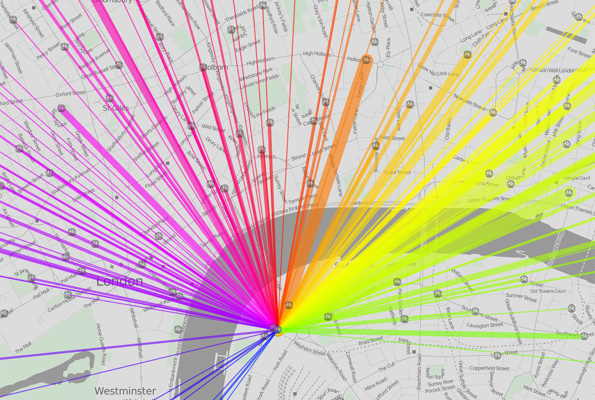
A graphic representation of the first million journeys on the Mayor of London's bike hire scheme

Here's a nice picture to lighten the mood on the Mind the Gap blog. It's nearly the weekend after all. Actually it's a graphic representation of the first million journeys on the bike hire scheme.

The data was released to Adrian Short who writes apps for the scheme.

Away from the pretty pictures like this one.

The data also shows us what many thought might be the case initially - that the scheme is struggling to make money at the moment.

The Daily Telegraph's assessment states:

"The scheme, which will cost TfL £140 million over six years, generated only £323,545 in revenue from journeys in the first 96 days.

"Only 72,700 from the first 1.4 million journeys earned any revenue, with 44 per cent coming from 939 individuals who were charged £150 "late return" fees."


That's also quite a lot of people who haven't returned the bikes on time. Also these figures I assume don't take into account the "fully open" scheme which may generate more from people using credit cards.

I await a response from Transport for London.

Masking up on the Underground

Post categories:

Tom EdwardsTom Edwards|11:52 UK time, Wednesday, 5 January 2011

Comments

In order to see this content you need to have both Javascript enabled and Flash installed. Visit BBC Webwise for full instructions


On the Tube yesterday I spotted this tourist wearing a face mask.

I assume it's to protect against flu or swine flu on the network?

From memory, during the last scare, I seem to recall that the masks were ineffective.

He was certainly getting some odd sideways glances from other travellers.

Anyway, good luck sir I hope it works... Would you wear a mask on the Tube?

Follow me on Twitter: @TomSEdwards
BBC © 2014The BBC is not responsible for the content of external sites. Read more.

This page is best viewed in an up-to-date web browser with style sheets (CSS) enabled. While you will be able to view the content of this page in your current browser, you will not be able to get the full visual experience. Please consider upgrading your browser software or enabling style sheets (CSS) if you are able to do so.