Throughout these Tube strikes, Steve Phillips and I have created a series of exclusive video-blogs.
Here is our latest effort, and below I write about why the latest talks between the two sides have failed to get the strike called off.
In order to see this content you need to have both Javascript enabled and Flash installed. Visit BBC Webwise for full instructions
At the heart of this dispute is the level of staffing required at ticket office windows and what the transport unions TSSA and RMT deem to be acceptable.
I've spoken to some of those involved and this is an attempt to explain it.
The talks have for the last four weeks focussed on what level is acceptable for both sides in terms of the job losses and how they are worked out.
The 800 job losses are the result of a calculation.
The unions have told me they think the calculation is based on stations that sell 30 tickets hour per hour could have its hours reduced or closed altogether.
The RMT and TSSA unions believe that at that level, stations will not have adequate staffing levels to provide a safe service.
Not surprisingly that's disputed by Transport for London who say all stations will be staffed while open.
The unions want that calculation to be based on a far lower number - officially they won't say at what level. But unofficially they want it around 15-20 sales an hour.
However, London Underground (LU) are disputing the 'tickets sold per hour' calculation used by the unions.
LU say it is too simplistic, and the actual number of tickets sold per hour varies depending on the location, time of day and other factors, such as how long each customer spends at the ticket window.
Both unions offered to suspend the strikes IF they got a 12 week review of the above issues and they say they also offered binding arbitration.
LU offered a six week safety review. They say they've already had four weeks of intensive discussions.
The date that looms large is the full implementation of the losses which is February 13 2011.
Unions say six weeks is not long enough to work through the figures. London Underground say it is and will talk night and day until the end of the year.
Either way, neither side could compromise, nor meet in the middle, and talks broke down.
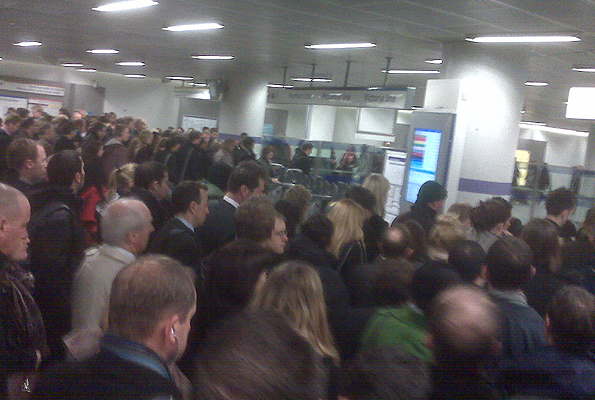
And so I'm afraid the strike starts Sunday night at 1830 for 24 hours.
Throughout Monday, we'll also have the latest travel information and news.
UPDATE: 4pm Sunday, 28 November
I've just been given this message from the Tube boss Mike Brown that has been posted on London Underground's intranet.
Note the last paragraph.
I've also been told by the TSSA union they're expecting students to join them on their picket line tomorrow.
The copy below is from London Underground:
Facing strike action
The latter part of this week has been dominated, yet again, by the threat of industrial action. I want to give you my view on what has happened this week.
For many months the unions refused to engage in meaningful discussion on the proposals for station staffing. Their starting point was that we must withdraw all proposals. Clearly that was not an option.
The proposals put forward in March were our response to changing circumstances and specifically changes to customer behaviour. As with any organisation it is absolutely right that we review our staffing models and bring them up to date if necessary.
Right from the start we made it absolutely clear that there would be no compulsory redundancies as part of these changes. One of our main objectives is to reduce the impact on our people.
We have also made it clear that our fundamental staffing model - people rostered at stations at all times - is not to be touched. But the fact is the changes we are making have the protection of our customer service at their heart. This is why we are also keeping ticket offices open at the stations which currently have them - demand at some is extremely low (and declining) but we know that some of our customers still prefer to buy their tickets this way and they will continue to be able to do so.
Recently, we felt that we had had something of a breakthrough with the unions. Some weeks ago now the team working on the ticket office changes started detailed discussions with representatives from both the TSSA and RMT. These discussions culminated this week in the unions calling for us to put the proposals on hold for 12 weeks while we reviewed the safety case and other concerns. We felt strongly that this would have a significant impact on the roll-out of the plans and instead proposed a six week pause in the implementation plan to review any safety or other concerns.
We believed this proposal had genuine support from the unions. At ACAS their representatives had worked very hard in developing much of it and it went a long way towards addressing the points that they said were of most importance to them and their members. But today we learned through the media (at the time of writing we still have not had official notice) that the offer has not been accepted and that strike action will go ahead.
This looks extremely cynical to me - the unions say they are concerned about safety; well, let's take six weeks and sit down and look at each of these concerns. Instead, the union leaderships would rather have their members out on strike - a strike that they know is pointless.
We have already seen 150 members of staff leave the organisation on voluntary severance. We have more than 300 vacancies that are not being filled and a further 50 members of station staff (those in areas where we are making reductions) have now said that they would be interested in voluntary severance. For the remaining post reductions, people will be placed on the reserve until the natural leave rate means that they can join the roster on their original group. The management and administration changes have already been made. We are well advanced in preparing for the changes in February. These changes will happen. It is grossly unfair to expect people to lose pay for nothing and at the same time to cause such a high level of disruption for London.
The trades unions have always had an important contribution to make to our organisation. I have always believed that. But the behaviour this week and during this current dispute brings in to question the motivation of some of those who claim their role is to protect their members.
I hope you will think again about losing another days pay and will consider coming to work on Sunday and Monday to help run a service. We will do everything we can to keep London moving.
Mike Brown