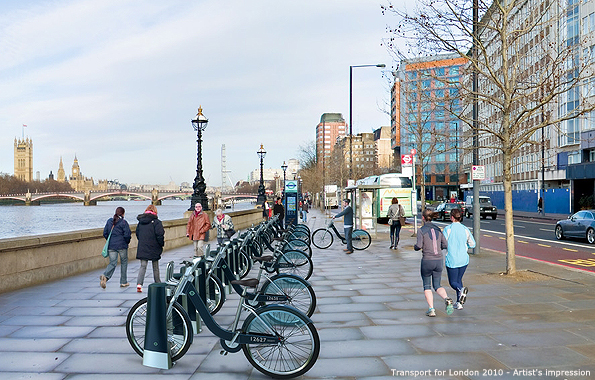
So, if all goes to plan, we'll be getting the new London Bike Hire scheme on the 30th July. More on them and the pricing here.
One thing worth noting from the prices announced in December is it won't actually be completely free for the first half hour.
You will have to pay a daily access charge of £1.
Access fee
- 24-hour access - £1
- Seven-day access - £5
- Annual access - £45 (members only)
Usage charges
Up to 30 minutes free then:
- Up to 1 hour: £1
- Up to 1 hour and 30 minutes: £4
- Up to 2 hours: £6
- Up to 2 hours and 30 minutes: £10
- Up to 3 hours: £15
- Up to 6 hours: £35
- Up to 24 hours (maximum usage fee): £50
So the hire charges ramp up the longer you have the bike.
Re-dock it before the 30 mins and use it for less than half an hour later in the day and there's no extra charge.
So the pricing is designed for small little trips around town and presumably to price it around the cost of a bus fare. But look at these "other charges".
These will hurt, and one of these could change your mind about the bikes...
Other charges:
- Late return charge: £150
- Damage charge up to: £300
- Non-return charge: £300
And what's a late return charge? Aren't the bikes meant to let you return them whenever you want?
Transport for London say that's for when your 24 hour access fee runs out and you've still got the bike in your shed... Ouch.
A number of transport commentators have said this scheme is going to be very significant politically and infrastructure wise.
It will show if Boris Johnson and his team at Transport for London can deliver and maintain new transport schemes.
This is the first major project coming to fruition from that team. They say they're confident it's on track.
The project will also ask all sorts of questions about cycling in London; its joys and perils including relative novices taking to two wheels.
It'll eventually mean 6,000 hire bikes and 400 docking stations in Central London.
The cost in total is £140 million over six years paid to the contractor Serco for setting up and running the scheme by Transport for London.
The set-up costs are £91.6 million (incidentally that's nearly double the amount touted before a contract was awarded). TfL will keep the "farebox".
I had a look at the bikes and they handle pretty well. I also outlined some of the concerns about safety and novice cyclists.
In order to see this content you need to have both Javascript enabled and Flash installed. Visit BBC Webwise for full instructions
However, there's more grumbling afoot from within the bike industry, in particular concerns over maintenance and the number of technicians the contractor Serco will employ.
"Industry sources" quoted by bikebiz.com say Serco won't be able to cope. However, Serco in London will employ 29 technicians for 6,000 bikes and they say they'll be able to run and maintain a good scheme.
Now, maintenance is clearly going to be a big issue for these hire bikes in London probably more so than in Montreal whose scheme we're adopting. Expect to see lots of this.
There's already been some criticism that the bikes aren't being built in the UK.
In Montreal, they have fewer bikes 5,000 and they're only operational for eight months of the year due to the harsh winters and the bikes were brand new. But even there the replacement rate was between 3 and 5 per cent in the early days.
With each bike costing an estimated £350 that will add up for the operator (I'm basing that on the French velib bike - we don't know the exact figure as it's "commercially sensitive").
But London's bikes will be on the streets a third longer every year in London (an extra 4 months) without that break for serious repairs and presumably London's will be used more.
Serco will have 29 maintenance staff in London compared to 15 in Montreal.
I've asked TfL for its estimated replacement rate. So far they haven't got back to me but if the replacement rate is the same as Montreal (and it won't be .. you'd think it'd be much higher as they're outdoors the whole year) it will cost Serco between £63,000 and £105,000 a year.
However, it could cost the operator even more. Compare it to the French Velib scheme and the cost to Serco could be far far higher.
With that scheme in 18 months all of the 20,000 bikes have been replaced due to them being vandalised or nicked.
If that scenario played out here in London then that would cost Serco 6,000 x 350 = £2,100,100 for every total replacement of the bikes... If that happened surely it wouldn't be long before Serco wanted the contracts redone?
All of this doesn't mean it won't be a success - bike hire has been extremely popular wherever it's been introduced.
So long-term will it work? What d'you think about the charges?
If your bike gets nicked while it's in your possession will you be happy paying £300? Will it be ready by 30th July?
And do you think £140 million is money well spent?


 |06:52 UK time, Saturday, 29 May 2010