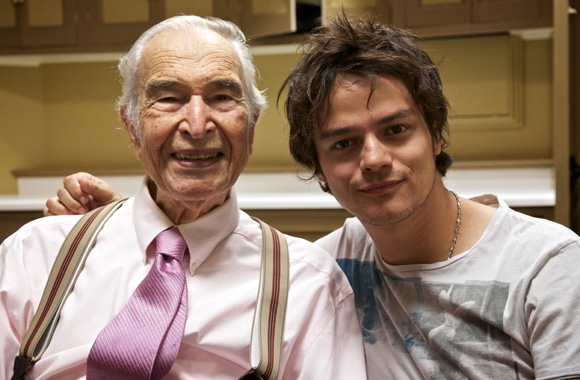
It was such an honour to spend time with Dave Brubeck let alone interview him at the Newport Jazz Festival. There are a few figures in the world of jazz who are still around who pretty much created the music and Dave Brubeck is one of them. Such an important figure and a great, great guy.
We went over to his hotel one morning while we were at the Newport Jazz Festival and we sat down with him at his hotel and the whole thing felt more like a conversation. It was so interesting to hear his stories of how he got started and his time in the war. He's just an extraordinary musician and he just comes over as a phenomenal man, a family man, a great sense of who he is but also who he is in his family as well.
He's been married to his wife Iola for 67 years and what really transpired in the interview is a lot of that stuff people know him for, Take 5 and It's A Raggy Waltz and that whole Time Out album, he's been developing and creating his music for his entire career right up until the current day. He's writing ballets, he's writing entire masses for church. An incredibly interesting musician who's never stood still a day in his life.
One of the things I love about Dave Brubeck's music that I've always tried to apply to my own music is to not sacrifice certain musical complexities in the music but also make it really listen-able for people who aren't necessarily that drawn to jazz. Dave Brubeck was really the first jazz musician to have a huge hit in the charts and that was with Take 5 and indeed the whole album Time Out was a huge, huge hit with people that had probably never really listened to jazz before and I just find that amazing because this is music that is technically very difficult to play but he makes it sound easy with its playfulness and sheer listen-ability.
The two-part special we recorded with Dave Brubeck runs on the 30th November and the 7th December to coincide with his 90th birthday.
Find out more about the programme
I was in a newsagent in Chippenham and 16 years old. Too young for a car, waiting for the bus home. My green walkman had Herbie Hancock's "Headhunters" blasting into my A-Level tired ears. It was early on in my world of jazz appreciation. There was the acid jazz movement that was my way in, a few kids at school were into it too, but I still was nervous to talk about Monk or Miles, Coltrane or Sun Ra. Not quite confident enough in my awkward teen self to proclaim my love of jazz.
A magazine, unlike others shone out at me, printed on gorgeous paper, the front cover proclaimed to have an article about Sun Ra inside. I picked it up and devoured the article about the outerspace jazz planeteer.
I also discovered the acid jazz of United Future Organisation and the Eastern experiments of Talvin Singh. It was a similar entry point to Jazz that both DJ Gilles Peterson and the world of Acid Jazz were. It spoke to me as a young man who liked to dance and party and have friends, but also as someone with a burgeoning interest in a somewhat niche art form - especially in Chippenham. Straight No Chaser was a magazine I could have under my arm and toss it down next to the sixth form common room's copy of the NME and Melody Maker with no fear of recrimination.
It was a beautiful magazine that has regretfully been discontinued. No other magazine ever brought together the world of jazz, dance, world and electronic music/DJ Culture like SNC did. It was also regularly beautifully graphic designed. Collectors items that I still covet to this day. How many magazines do that to you?
Pete Williams was a regular photographer at Straight No Chaser, channelling the genius of past greats like Herman Leonard, William Claxton and Francis Wolff, giving the new vibrant world of jazz a fresh image with a strong link to the past. In keeping with the magazine's philosophy of presenting jazz like the club scene it always belonged to.
There's an exhibition of Pete's work at the Maverik Showroom in London. Check it out and dig out an old copy of Straight no Chaser. It still feels like the future.