The magazine has a lot of readers in Cameroon. They're loyal, and informed (judging by the letters we get from there). The latest issue has a feature on the country under the long-serving Paul Biya. It's a good time because elections are scheduled in October. But last week a demonstration was planned in the economic capital Douala. Civil society and oppositon groups wanted to agitate for political reform. This unverified actuality of the demonstration and the security forces' response to it has since found its way onto Youtube. See it here - or here
In order to see this content you need to have both Javascript enabled and Flash Installed. Visit BBC Webwise for full instructions. If you're reading via RSS, you'll need to visit the blog to access this content.
The government has blamed the large Cameroonian diaspora for planning a 'revolution by proxy'. It's also said that those wanting change in Cameroon should go to the ballot box. Not sure what it has said on Libya, Egypt and Tunisia, though - if anything. Will have a look.
So Yoweri Museveni has another term in Uganda. We predicted it in the January to March issue of the magazine and it has come to pass. Not much of a surprise though considering the amount of money spent by Museveni on the campaign. It's interesting that it comes on the weekend that Libya, Morocco and Tunisia are rocked by more pro-democracy protests. And it's quite telling that the Ugandan leader has had to state his positon on the chance of North Africa-style protests happening on his own turf. He's not worried apparently because Ugandans are 'revolutionaries' while people up north are 'office workers'. But much like Alassane Ouattarra on the other side of the continent in Ivory Coast, Uganda's embatteled oppoistion leader - Kizza Besigye - is calling for people to hit the streets to voice displeasure at the outcome. We know how Laurent Gbagbo responded to those who heeded Ouattarra's call. Will Kampala also load - and fire - its guns on its own people?
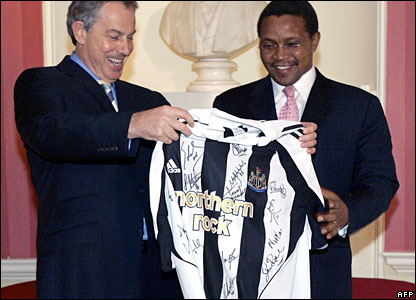
So out of the blue the Focus on Africa magazine took a call from Tony Blair's office last week. The former British Prime Minister was interested in talking to us about his new African initiative. For various reasons it didn't work out, but we thought the call was a sure sign that Blair himself - or one of his media staff - had probably seen the latest issue of the magazine. There he is - believe it or not - on our sports pages with the Tanzanian President Jakaya Kikwete. Between them - a Newcastle United jersey, the club supported by the Tanzanian president. Taken at Downing Street during a state visit, it was used to illustrate an article by Peter Musembi and Pamela Whitby on so-called 'minnow' football sides and their (very few) supporters in Africa. It would be great to get your views on this. Are you in Africa and do you support a side that's not Manchester United, Liverpool or Chelsea? And, of course, the biggest question - why?
Never underestimate the importance of a crystal ball in putting together a quarterly Africa magazine. It's indispensable actually. How else would we be able to produce over 70 pages of fresh copy that would sit on newsagent shelves easily for three months and not go stale? It's a challenge, but not impossible. Seriously, we couldn't have forseen that Tunisia and Egypt would have exploded in the way they did (much like Kenya in early 2008). It's just unfortunate that our press day was the end of November. But that doesn't mean that the January to March issue doesn't have anything to say to the situation in Tunis and Cairo. The key I suppose is getting hold of top writers, which - mostly - I think we do. Critically, their words repeatedly inform or 'speak to' current events. For instance, we have a brilliant piece by the Zimbabwean author and writer Blessing Miles-Tendi on prospects for the unity government in his country. He writes that despite all the stresses, strains and figurative firing above heads, Mugabe and Tsvangirai are not about to give up on each other. Crudely put, despite massive personal differences and a relationship that has completely broken down, in an election year they need each other.
So what do the rumblings of revolution in North Africa have to do with Zimbabwe? Well, there's been a lot of speculation recently about the chances of this spreading south. Some say it can't happen in Zimbabwe. Others point to Zimbabwe's neighbour Mozambique as an example of what mass protests can achieve.
Perhaps what the uprisings in Tunisia and Egypt have shown definitively is that for change to happen, the political opposition is not as critical as it may think it is. An important lesson for a year ahead that will see so many elections on the continent.
What do you think? And, just a final note - our April to June issue will be packed to the brim with North Africa.

 |14:40 UK time, Monday, 28 February 2011