BBC BLOGS - Domesday Reloaded

Archives for June 2011

Geograph and Domesday Reloaded

Alex Mansfield|16:18 UK time, Thursday, 30 June 2011

David Hawgood suited up for Geograph

David Hawgood suited up for Geograph

Many of the 2011 pictures appearing in Domesday Reloaded so far have come from members of the "Geograph" community.

The Geograph project has much in common with the original idea of the BBC Community Disc. David Hawgood, who has contributed some 6000 photographs to that project, here writes of how Geograph members have been helping with Domesday Reloaded today... 

Geograph Britain and Ireland project aims to collect geographically representative photographs and information for every square kilometre of Great Britain and Ireland. Thus it has close parallels with BBC Domesday Reloaded.

Since early 2005, over 10,000 members have contributed almost a quarter of a million images covering over 260,000 grid squares, almost 80% of the total. For each image there is some description or keywords, grid references of subject and photographer, and date taken. There is also a section of map from Ordnance Survey, who sponsor the project.

"As well as being available at https://www.geograph.org.uk/ and the schools%20site, images are archived by the British Library, so they should remain available in future by quoting the image number. Images are published under aCreative Commons licence so that users can copy them freely.

"Since the BBC launched the Domesday Reloaded web site some Geograph members have gone out to take photos recreating the Domesday photos. These have been published on the Geograph website and submitted to Domesday Reloaded, and more will appear in future.

"Facilities have been added to Geograph to provide conversion between D-Block number and grid reference.

"A Domesday D-Block is 12 of the National Grid 1km squares, 4km East-West by 3km North-South. The menu bar at the bottom of every Geograph photo page includes "More links for this image". One of those links is "Domesday Reloaded" to the appropriate D-Block page of the BBC site. The Geograph page for a grid square e.g. SK0000 has a similar "More links" item.

"Geograph search facilities now include a D-Block Finder. Entering the D-Block number in the GridRef box displays a Geograph page with photos from the grid squares of the D-Block. For example, entering GB-400000-300000 gives twelve thumbnails from grid squares with SK0000 bottom left.

"Search facilities in Geograph may also help users of Domesday Reloaded locate the positions of the 1986 photos. You can search by text words and place name. Entering a place name shows all places from a gazetteer including that name, with county, district, borough or equivalent. Entering words from the Domesday Reloaded description may find a photo near the 1986 one. The "More links" from photo pages and grid squares includes links to various maps and aerial views.

"Finally, a note on the relationship between D-Block numbers and the National Grid:

"The D-Block number shows the number of metres East and North from the National Grid false origin. National Grid references give each 100km square a two letter reference for England, Scotland, Wales and the Isle of Man. For Ireland the 100km squares have single letter references.

"GB-84000-6000 is in the "bottom left" 100 km square SV of the GB set and stretches North and East from SV8406 in the Isles of Scilly. D-Block GB-400000-300000 is in the Midlands near Walsall with grid square SK0000 at the bottom left of the 4x3 block. D-Block NI-332000-372000 is around Belfast in Northern Ireland with grid square J3272. CI-530000-5476000 is St Peter Port in the Channel Islands - Geograph Channel Islands is separate from Geograph Britain and Ireland and does not have the Domesday links so far."
Read the rest of this entry

Outreach team back on the road helping communities update Domesday

Neil Copeman|17:36 UK time, Friday, 17 June 2011

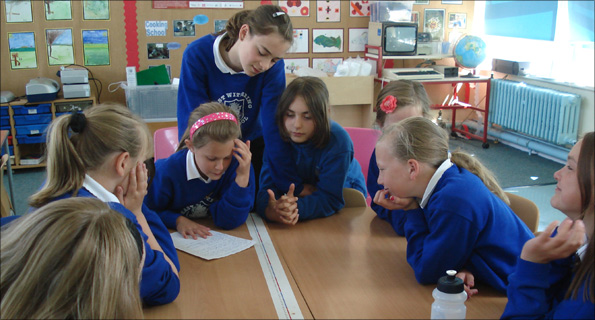
Pupils at East Wittering Primary School

Pupils at East Wittering Primary School

The Outreach team have been back on the road, taking Domesday Reloaded into communities and schools across the country - and it's been a busy couple of weeks.

In partnership with Girl Guiding UK we have helped groups in Oxfordshire and Dorset update the Domesday Project archive that was collected about their area in 1986. We've also been working with primary schools across the country, including East Wittering Primary School and Salhouse Primary School to produce slideshows about how life has changed over the past 25 years.

In Lincolnshire, the Gainsborough Heritage Association have been getting on board, and in Cheltenham we joined forces with Community Service Volunteers and hosted a special Domesday Reloaded session at the Oakley Community Resource Centre Fun Day.

A big thanks to all who took part for your support of the project, we hope you've had as much fun as we have. A "special thank you" to Heather Bartlett from Witchampton WI for all her assistance in gathering updates and tracking down original contributors in Dorset.

You can read more about Domesday outreach here

Lessons ready to learn from Domesday Reloaded

Alex Mansfield|11:56 UK time, Friday, 3 June 2011

Article written by Anna Challand
Anna Challand

Anna Challand


Teaching consultant for Domesday Reloaded

When I was first asked to look at the material on the Domesday Reloaded site it was a historian's dream come true to discover an archive that had been left untouched for 25 years.

At first I looked up the details of my home town and where I live now which was fascinating. But as I did this the wealth of material that could be used in the classroom became abundantly clear.

To be able to teach the history of a period by examining material produced by children of their age is a unique opportunity for pupils and what made it all the more fascinating is that for many of the pupils in primary school today it was their parents who had completed the original Domesday research.

The material on the site however goes beyond just learning about the history of the 1980s, it enables pupils to develop a real understanding of both the change and continuity of the physical and social geography as well as cultural attitudes within the communities in which they live.

This site is truly addictive because it contains so much local history. There are articles about local customs that relate to events from making Halloween night lanterns from turnips to making Mayday garlands which create an atmosphere of familiarity while discussing specifically local traditions.

The descriptions of people's daily lives will give you a glimpse of a world less rushed where egg on toast is the most common breakfast for dads and Weetabix is a child’s favourite breakfast. Interviews with elderly residents provide glimpses of daily life and local history that go back to the 1880s. As well as searching for places of interest you can search for articles on specific topics that can range from Oatcakes to Olympics.

Moreover, as both a teacher and a parent it will now be possible for me to prove that I did not go to school in the Victorian era and was never evacuated due to the Blitz. My favourite story is the description of my junior school teacher's daily routine. I was amazed to discover that despite her professional approach to her lessons she still found time to play golf most days after school. This short extract highlighted the immense changes that have occurred in education since the 1980s more than any formal history of education and made both me and my daughter laugh at what would happen if I attempted to do any type of sport between collecting her from school and planning my lessons.

There are articles that relate to most areas of employment which highlight the differences and similarities between occupations in the 1980s and the 21st Century. One article that could have been written today was an interview with a local reporter who talked about the value of newspapers that could be read on the bus or the train unlike other media. The paper still survives although the debate over whether newsprint or digital media is best still continues.

If you look at the lesson plans you will see that we have put together a set of cross curricular lessons aimed at Key Stage 2 (but could also be adapted for use with KS1 and 3) which we hope will enthuse teachers and pupils about the wonders of this project. It would be amazing if schools and local history groups could be use these as a starting point for creating a new history of their Domesday square so that the children of those in Key Stage 2 today could investigate the wonders of their lives in the future.

(Domesday Reloaded lesson plans and teachers' resources are now available at BBC Learning's Primary History site.)

BBC © 2014The BBC is not responsible for the content of external sites. Read more.

This page is best viewed in an up-to-date web browser with style sheets (CSS) enabled. While you will be able to view the content of this page in your current browser, you will not be able to get the full visual experience. Please consider upgrading your browser software or enabling style sheets (CSS) if you are able to do so.