
Blight, beetroot and being a bee
Post categories: squash
 |11:21 UK time, Tuesday, 11 August 2009
I've been religiously cutting off any suspect bits of my plants, and it seems to have held the blight sort of at bay for the moment. I've got one orange tomato, so it looks like I'll get at least a taster from my plants, little though that is.  Blightwatch latest!
I've been recommended to spray my plants with semi-skimmed milk against the blight. Never heard of this before, anyone out there tried it? Any advice or comments would be great.
 On a lighter note, may I present the embodiment of evil in a root vegetable - the Bloody Baron Beetroot. He vants to suck your sap. This is my contribution to Dig In's veggie doll gallery - please send us more, because they're really making me laugh. The triple potato wedding picture sent in by Pauline is a work of sheer genius.
Then onto bees. Illy, who also works on Dig In, asked me a question which set me thinking about a delicate subject - plant sex. So far, she's had plenty of flowers, but no fruit on her squash plants, suggesting they're not, ahem, getting enough.
I think it's because her squash flowers aren't getting pollinated, perhaps because the bees don't visit her urban balcony as much as they do my smalltown allotment. It could be that some of you reading this are having a similar problem.
Unlike tomatoes, which have flowers with both male and female parts, squash flowers are strictly one or the other.If pollen from the male flowers doesn't get to the "ovules" (a fancy term for eggs, really) of the female ones, they won't be fertilised and no fruit will grow.Normally bees do the job of carrying the pollen from one to the other, but their numbers have been dropping for the past few years, causing problems with pollination.
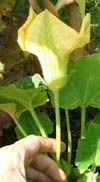
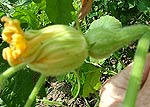 So, if the bees won't do it, you have to do the job yourself by hand pollinating your plants. First thing is to identify which flower is which.It's not too tricky - males (left) have a straight, thin stem, while females (right) have a bulge, which turns into the fruit if they are pollinated. This one may have already been pollinated and started growing, but is still only a bit larger than when the flower first appears.
 Next get a small paintbrush and swirl it round in the depths of the male flower until you can see specks of yellow pollen on it - pull the petals off if it makes it easier.Then use the brush to dust the pollen onto the middle of the female flower (shown in the pic to the right - this bit is called the stigma).Or you can just pull the male flower off, remove the petals, and rub it across the stigma. Lots of male flowers to one female will give the best result, they're saucy types, these squash.
If you're planning on saving seeds, you've really got to do it this way.Bees can carry pollen a fair distance, and butternut squash can cross with all other types of squash, as well as pumpkins.It won't affect the taste of the fruit that grows this year, but any saved seeds may well grow into strange hybrid of butternut squash and whatever your neighbours were growing.Hand pollinating lets you know exactly what you'll be getting, though to be really sure you have to stop inseacts doing any sneaky pollinating when you're not looking, by clipping flowers shut or putting a bag over them.
It all goes to show how important bees are to keep our veg growing.I don't mind pollinating the odd plant here and there, but I'd never manage all of them. I'm definitely going to add bee homes to my garden and allotment, and I can't think of a better reason to bung in a few more pots of plants they like, such as lavender, thyme and catnip in.


Comments