BBC BLOGS - Gregory's First Law

Archives for December 2010

Fighting BSE

David Gregory|09:51 UK time, Wednesday, 29 December 2010

Comments

"Hopefully by the end of the century we will be down to a very low level indeed, maybe we'll have no cases at all"

That's Keith Meldrum, Chief Veterinary Officer speaking on Countryfile in February 1990. In the same interview he insists it would be "a very brave man" who makes such predictions.

In fact he was right. In the Midlands at least BSE reached it's highpoint in 1992 with 2902 cases. This year there will be none at all. Across the country cases peaked at 36,682 falling to just nine this year.

In fact the methods used to detect BSE have changed over the years, it's likely we'd find a lot more cases in 1992 if we used today's standards.

So clearly the measures put in place to control the disease and to protect cattle, sheep and of course people have worked. Much of the work done on the disease and the controls needed was done here in the Midlands at a Ministry farm near Drayton in Warwickshire.

It was here researchers established that transmission from mother to calf was low risk as was milk and contact with cattle. But that if the conditions were right then you'd need little more than a fingernail sized piece of infectious agent to give1000 cattle with BSE. The work became even more important after 1996 when the link between BSE and another disease in humans, CJD, was confirmed.

Today the measures created because of the Drayton research are still in place and indeed it costs millions worldwide to make sure meat is safe. It may be that one day they will be relaxed. In the meantime the work at Drayton came to an end this year, but there are 1.4 million samples from the farm stored in giant freezers at the Veterinary Laboratories Agency in Surrey.

As BSE disappears, these samples will be hugely important to train future generations of vets and researchers in what to look for and to help understand more about this terrible disease.

More than 20 years later Keith Meldrum's prediction was pretty much right, the expensive measures taken seem to have worked. Too often when reporting science we don't look back to give credit where it's due. Tackling BSE wasn't easy and the measures introduced still have an impact and a cost today. But thanks to the research done at Drayton we were spared something that could have been so much worse.
Warm winter bees revealed

David Gregory|16:13 UK time, Wednesday, 15 December 2010

Comments

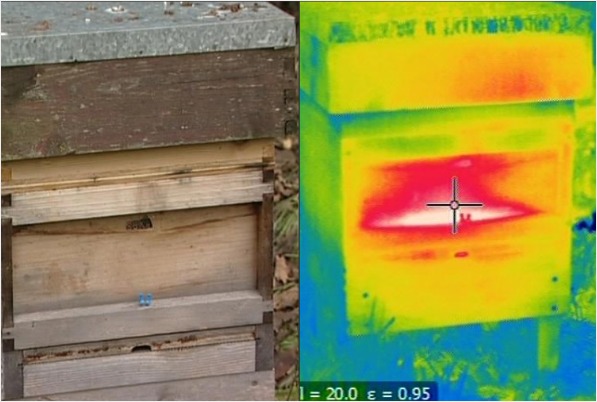
On the right the thermal image of this hive shows the warm bees deep inside it

It's the end of the BBC's "Bee Part Of It" campaign. Our local radio stations have been looking after their hives since the start of the year and many have now harvested the honey produced. But what happens to the bees now as we head into what looks like a very cold winter?

Well as you can see from our thermal camera picture above the bees in the hive are definitely giving out some heat. You can see the red and white patch right at the centre of the hive. Here a core of honeybees will huddle together, staying warm, to make it through the winter.

Unlike wasps and bumblebees our honeybees don't hibernate, in fact they rely on the honey they produce for food. It takes about 20-30 lb of honey to survive an average winter. Obviously the beekeepers encourage the bees to produce more for our toast.

You can read more about the honeybee at the British Beekeepers Association website here. And I must say thank you to Genevieve Tudor from BBC Radio Shropshire for helping us out with a hive to use our thermal camera on. You can read more about her bees on her blog.

Across the Midlands our "Bee Part of It" hives produced markedly different amounts of honey with BBC Hereford and Worcester topping our league with 11.5kg of honey. BBC Radio Shropshire's hive didn't make it this year so they came bottom. Radio Stoke didn't harvest because their bees didn't arrive till July and they'll need the honey to make it through the winter. But at least now we know they should stay nice and warm.

If you keep bees let us know how your year has been in the comments below.

Have you seen a blue tit wearing leggings?

Post categories:

David Gregory|18:09 UK time, Friday, 10 December 2010

Comments

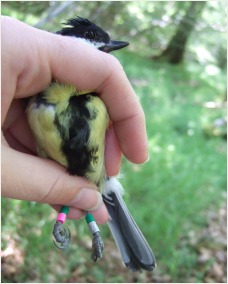
Tit with colour ringed legs

The wild birds of Chaddesley Woods near Bromsgrove are some of the most studied birds in the Midlands.

I've blogged before about the work being done by the University of Birmingham to learn more about the Blue Tits and Great Tits that live in the woods. And the same team of researchers also appealed for your help with a garden bird survey and we'll have the results of that in the New Year.

Now the team needs your help once again. Every year some two thousand birds in Chaddesley Woods are ringed by the team. These are standard British Trust for Ornithology (BTO) rings that contain lots of information but you have to catch a bird before you can read the ring.

However this year the team have also ringed about three hundred adult Blue and Great Tits with not just the BTO ring but also the brightly coloured rings you can see in the picture. So there are four rings in all which allow the team to identify individual birds from a distance.

So they need your help to spot the birds and see how far they have travelled from the woods.

If you think you see a Blue or Great Tit with coloured rings on a feeder in your garden they'd like to know. Chances are any particular bird will come back to the feeder several times and that will allow you to read the ring combination correctly and send it to the team. In return they'll let you know the history of your particular bird, including if it has mated and how many chicks it has reared.

So here's Simone Webber from the University with advice on how to read the rings;

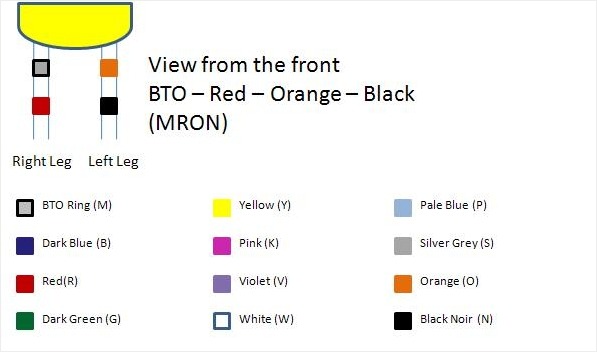
"The combination should be read from top to bottom right on the bird's right leg, and then from top to bottom on the bird's left leg. The rings should be read as if the bird is standing up, so the top right ring is the uppermost one, nearest the bird's belly, on the right leg. The diagram below demonstrates a schematic view from the front of a Great or Blue Tit, and the colour combination is BTO ring (M), red (R), orange (O), black (N)."
Diagram of coloured rings

That means the bird in the photo at the top of this blog is Green, Pink, Green, Metal (GKGM). You'd then record the time, date and location you saw this bird and the species and then send the information in to the researchers via email , telephone (0121 414 4090) or post addressed to;

Simone Webber, School of Biosciences, University of Birmingham, Edgbaston, Birmingham B17 0DE

Obviously those living closest to the woods have the most chance of spotting one of these birds, but if the cold snap returns it will be interesting to see just how far they do move. So if you feed the birds in your garden do keep an eye out for Blue Tits or Great Tits sporting what might at first look appear to be some rather snazzy leg warmers!

Magic results from MERLIN

Post categories:

David Gregory|17:49 UK time, Tuesday, 7 December 2010

Comments

This is an image that shows how the light from a quasar billions of light years away being bent around a foreground galaxy by the curvature of space. This light has been travelling for 9 billion years before it reached the Earth.

There are two things the small village of Knockin in Shropshire is supposed to be famous for. The local store supposedly labelled the "Knockin Shop"* and the radio telescope on the outskirts of the village.

I can't vouch for the name of the shop (although Wikipedia insists it's true, hmmmm) but I have stood in the dish of the radio telescope. It's part of a network of 6 dishes controlled from Joderell Bank. These form the MERLIN radio telescope which stands for Multi-Element Radio Linked Interferometer Network.

You join up all these different smaller telescopes and effectively create one much larger one with all the benefits that brings for astronomers.

MERLIN has had some noticeable successes. With the Hubble Space Telescope it was responsible for spotting the first "Einstein Ring" in 1998. Phenomena where the gravity of a really massive object such as a galaxy bends the light coming from behind it so that from earth it forms a ring.

But MERLIN did have its downside. Not least the problem of a network of dishes spread over hundreds of miles. The amount of data that could be gathered and sent back was limited and sometimes engineers would have to be sent out to each dish before certain measurements could be taken.

So the whole network has been upgraded and renamed from MERLIN to e-MERLIN. Faster data links mean the researchers can collect much more data than ever before and that will improve their results. And the picture at the top of this post is the first image from the new e-MERLIN telescope.

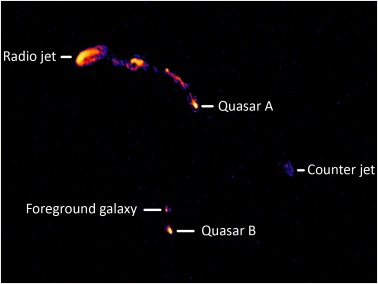
Diagram showing double image of quasar and jet of matter.

Although this is called a "double quasar" in fact there's only one. But as with the "Einstein Ring" the light is bent by a galaxy. In this case in such a way that you don't get a ring, but instead we see two images of the quasar itself. In the second picture the researchers have labelled everything in the picture so you can see what's going on.

You can also see a jet of matter leaving the quasar which is moving at the speed of light. Here the bending caused by the galaxy has given the jet a distorted curved look. And the quasar itself is actually a galaxy powered by a super-massive black hole. Which may be the coolest thing I've ever written on this blog.

Now the team will be testing e-MERLIN and using it to examine everything from planets orbiting nearby stars to black holes and galaxies. More here.

There's a long list of people who have got e-MERLIN to this stage; The Science and Technology Facilities Council (STFC), the Northwest Development Agency, The University of Manchester, The University of Cambridge and Liverpool John Moores University. The telescope is being operated by STFC and the University of Manchester.

*My producer says; "As a Shropshire lad, I can vouch for the name of the shop."

Combating the office milk snatcher - an experiment

Post categories:

David Gregory|12:29 UK time, Tuesday, 7 December 2010

Comments

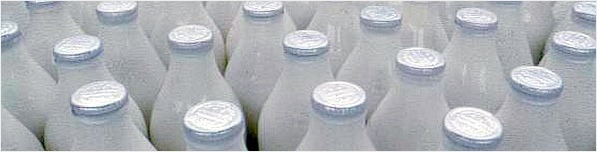
Bottle of milk

This past few months I have been conducting an experiment on my colleagues and I hope you'll find the results useful.

It is the bugbear of any modern workplace, stopping people "borrowing" your milk from the office fridge leaving you nothing for your tea or coffee. And in the name of science I decided to do something about it. After all, science is the answer.

Fortunately the BBC has an Editorial Policy department to help me navigate any potential difficulties in conducting experiments that could directly impact the health of my co-workers. It was agreed as long as I didn't add anything harmful to my milk I could go ahead.

This meant of course that this would be a psychological experiment and I would have to rely on altering the physical appearance of bottles and the milk itself to deter light-fingered caffeine addicts. Other measures that were suggested such as using silver nitrate to chemically brand a thief were not allowed.

So with a bit of help from posters at the Bad Science forums and Bang Goes the Theory's Dr. Yan Wong I drew up a list of potential milk-modifications and testing got underway.

I kept things simple, leaving an unmarked control bottle of milk alongside the altered one. At the end of a week I compared one with the other to give a league table of the most effective ideas. So without further ado here are the results from five weeks of concentrated testing over the last year from worst to best deterrent;

In last place and so therefore the least effective modification was a bottle of milk with my boss's name on it which actually vanished completely from the fridge. Fourth a milk bottle with my name on it. Third place went to a bottle which I added some staring eyes to the label designed to trigger feelings of being watched in potential milk snatchers. In second place a bottle where I used food colouring and coloured the milk green. And the bottle that lost the least amount of milk to theft? One labelled "breast milk".

Now these are of course absolute measurements of the amount of milk liberated by my colleagues each week. It's possible that in any particular week the more morally ambiguous or caffeine-addicted members of staff might have been on holiday or not in the office that much. So that's where the control comes in.

We can compare how the control faired each week and use that to create a "fudge factor" in a fine scientific tradition. When we apply the fudge factor we get the same order for our experiment except the most effective carton-modifications are reversed with green milk coming out on top and breast milk slipping to second.

So what does this tell us? That a few drops of green food dye and writing "breast milk" in biro on the label of your carton will encourage most people to leave your milk alone.

But the most effective solution I found after more than a month of experimentation? Learn to like your coffee black.

For those that want them the numbers are here[20.0 KB].

BBC © 2014The BBC is not responsible for the content of external sites. Read more.

This page is best viewed in an up-to-date web browser with style sheets (CSS) enabled. While you will be able to view the content of this page in your current browser, you will not be able to get the full visual experience. Please consider upgrading your browser software or enabling style sheets (CSS) if you are able to do so.