BBC BLOGS - Backstage.bbc.co.uk blog

Archives for June 2009

BBC Live on Boxee

Post categories:

Ian ForresterIan Forrester|13:18 UK time, Friday, 26 June 2009

Comments

BBC Boxee winner[/caption]

Its always good to see innovative uses of BBC data and content, but to be awarded a prize too is even better. Ian Tweedie from the UK entered the Boxee challenge of creating a application/plugin for boxee. He won the peoples vote for video. Taken from the readwriteweb,

Boxee-user Ian Tweedie was disappointed with the selection of Boxee applications available to those outside of the US. While UK-users could already access BBC's iPlayer, Tweedie created BBC Live in just 10 hours to take the title as the first developer to bring live TV to European Boxee audiences. Says Tweedie, "I'm just a normal guy living in the UK trying my best to find a job whilst using my free time to learn and tryout fun new things... The dev challenge seemed the perfect excuse to dive in, because if TV isn't electronic heaven, I don't know what is."

Boxee is certainly gaining momentum with its open infrastructure and being across almost all platforms. Its a very good story of how commercial companies can learn and build upon open source and free software. Boxee is build on its bigger geeky brother XBMC, which has already captured many peoples imagination. Backstage gave a talk at the art of design workshop recently where we encouraged content producers to put there content on the web openly and use RSS to make it machine readable. Just like the Open University plugin which didn't win but was noticed by The Guardian , it was easy to build the gui around the solid base of rss feeds and videos of the Open University's content.

Drupal Camp UK hosted by BBC Backstage

Post categories:

Ian ForresterIan Forrester|09:24 UK time, Monday, 15 June 2009

Comments

Recently there's been talk about what events BBC Backstage have done in the North. Instead we've been waiting and watching, I would say becoming a good citizen and looking where it makes sense to get involved. The BBC Manchester building on Oxford Road isn't ideal for large events unless we use a studio.However since the Ubuntu 9.04 launch party which crammed about 80 people into our BBC Bar, we've been thinking about the ability to maybe support some kinds of camp events.

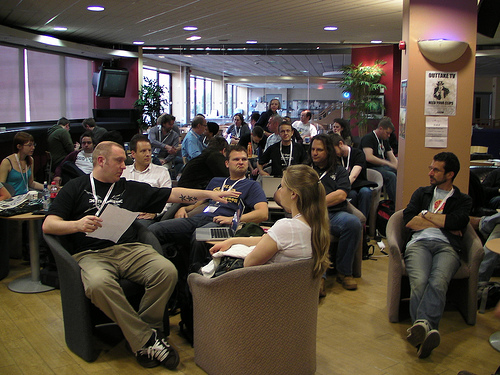
DrupalCampManchester was discussed ages ago and Dan did a great job putting the whole thing together. Being the host, I just stepped in when needed. Everything went well and a special thanks to Herm and Derek for there help. The only complaint we had was the heat which is currently broken. But generally there were about 80 smiling faces at the peak but even on Sunday the numbers didn't drop far below 50. Its certain the drupal uk community is certainly a lot tighter since this event.

From a BBC point of view, the event was relatively simple and cheap to host. The biggest cost is actually peoples time to help out. Having someone else also run the event took most of the management out of it. So whats next? TED-X Manchester seems to be next but the dates are TBA. Currently we're masterminding the idea of a Friday afternoon with a suitable event to follow it into the night.

BBC Backstage SPARQL Endpoint

Post categories:

Ian ForresterIan Forrester|15:13 UK time, Wednesday, 10 June 2009

Comments

The Linked Open Data approach to nurturing a next-generation Web is getting lots of attentionrecently. At the BBC, we've been involved in this approach for the past year and a half or so. It looks to be very promising indeed.

To explain Linked Open Data, Sir Tim Berners-Lee wrote:

"It is about making links [between datasets], so that a person or machine can explore the web of data. With linked data, when you have some of it, you can find other, related, data."

Over the last few months we've been continuing our expansion of the amount of Linked Data that we're publishing on the BBC /programmes and /music sites, to provide additional detail about episodes of radio and TV programmes, and more links between the data exposed from each site. So, for example, we're now exposing segment data for Radio 2 & 6 Music programmes that link the artists in each section to the relevant data on the /music website.

This provides some really nice ways to navigate and mash-up the two websites. But we've also been wondering: what else could we do? What if there was a way to not only retrieve the data that underlies each page on the website, but also a way to run queries across the whole datasets? This would provide a way to do even more with the data, allowing it to be sliced, diced, queried and analysed in all kinds of new ways.

With this in mind, we've asked two companies who specialise in Linked Data technology (OpenLink Software & Talis) to start regularly crawling the BBC /programmes and /music websites to harvest all of the data and load it into their semantic web platforms. Both platforms allow you to search and query the BBC data in a number of different ways, including SPARQL -- the standard query language for semantic web data. If you're not familiar with SPARQL, the Talis folk have published a tutorial that uses some NASA data.

Talis & OpenLink are regularly crawling and updating the data, and we're working with them on ways to make sure it stays as up to date as possible, but for now expect it to lag a little behind the live data on our sites. But these triplestores already contain metadata for over 300,000 radio and TV episodes, over 6000 series, more than 4000 album reviews, and additional data about thousands of music artists and albums. All of the BBC subject categories and programme genres are also included, so there are plenty of ways to query and slice up the data whether you're interested in a particular type of programme, channel, artist, or person. Where our data links to DBpedia, we can include some additional context -- so for example, all of the music artist information can be queried from one source. And, as we add more data to the /programmes and /music sites, this will all get added.

The Talis Platform

The combined /programmes and /music data is in a store called "bbc-backstage" whose API is

available from: https://api.talis.com/stores/bbc-backstage. The Talis developers have already put together a few example queries and demos which query the dataset, these show how to query the data using AJAX, e.g., fetching lists of music reviewers and their reviews, or analysing relationships between categories of TV programmes.

The OpenLink Virtuoso Platform

The Virtuoso hosted data can be found and queried via https://bbc.openlinksw.com/sparql. In addition, the OpenLink provided Linked Data space offers a faceted browser interface, engine, and REST API, alongside a collection of sample queries.

A richer BBC data API, based on Linked Data

This is a trial project that we're running for six months to explore what the Backstage community can do with BBC data when it's exposed through a richer API than we've been able to provide thus far. We're excited to see what you can create, and in the feedback you can provide us -- so we can learn what works and what doesn't, and make changes. So please do keep us up to date through the BBC Backstage email list.

Enjoy!

R&DTV: Episode 2

Post categories:

Ian ForresterIan Forrester|15:55 UK time, Wednesday, 3 June 2009

Comments

Today we're launching the second pilot for R&DTV, we're really excited as we have learnt so much from working on the first episode and from the feedback we received from you all. We feel that we've improved on a lot of areas and await your feedback again.

This episode includes motion graphics, music, subtitles and we've improved the sound. It features our intrepid trip to the UK's first Maker Faire in Newcastle, David Kirby on the BBC R&D Ingex project and interviews from Matt Biddulph CTO of Dopplr and Jason Calacanis CEO of Mahalo.com.

If you missed the first episode, R&DTV is a pilot show, designed to be shareable, remix-able and redistribution. It was built for the internet era and we release all the assets which make up the show under a Creative Commons Attribution Non-Commercial license. The show its self, features interesting tech stories inside and outside the BBC. We're also looking at how we distribute content in various encoding methods and formats.

We've deliberately taken a 'different' approach to creating the content, one which doesn't include working in a studio or with elaborate production methods to show that you can do create interviews inexpensively and with off the shelf kit. There's a emphases on this being something you can do.

R&DTV is a collaboration between BBC Backstage and RAD teams, who are: Producers Rain Ashford and Hemmy Cho, as well as Exec Producers: Ian Forrester, George Wright and Adrian Woolard.

So this is how you can enjoy R&DTV:

1. A brief 5 minute video, containing all the very best bits

2. A longer 30 minute video, containing deeper conversations

3. The Asset Bundle, containing everything we used and didn't use to make the video edits

Where you can find Episode 2 of R&DTV:

We would like to thank everyone who contributed to this episode: Gids Goldberg for the subtitles, Tom Barton for the music, Alia Sheikh, Ant Miller, Cy Thompson & Andy Gibb for Maker Faire, Frank Considine for filming at FOWA, David Allen for Eastenders VT, Theo Jones & Pete Warren for titles, Ciaran Anscomb for tech support and not least Malcolm Warren who was Editor.

Don't forget we'd love to see anything you've created with the assets and please do give us your feedback, both here on the blog or email rdtv [at] bbc.co.uk.

More from this blog...

Categories

These are some of the popular topics this blog covers.

BBC © 2014The BBC is not responsible for the content of external sites. Read more.

This page is best viewed in an up-to-date web browser with style sheets (CSS) enabled. While you will be able to view the content of this page in your current browser, you will not be able to get the full visual experience. Please consider upgrading your browser software or enabling style sheets (CSS) if you are able to do so.