

The Santa Ana winds and your bicycle pump
Post categories: Winds, weather watch
 |18:00 UK time, Monday, 14 November 2011
Distance travelled ~ 817'507'200
Air is funny stuff. The oxygen that we take from it is our most fundamental necessity, but air is invisible, odourless, colourless and easily ignored. Day to day, we have better things to think about. But air is doing some interesting things while we're busy ignoring it, and one of those things has the potential to cause huge damage in Southern California this month.
Let's have a think about what air is. What you're taking into your lungs at this very moment is a bustling crowd of billions of molecules, zooming about at speeds of about 1150mph, bouncing off each other and anything else they hit. It's busy down there in the microscopic world that we can't see.
To get to Californian weather, we need to know something about gases. Air temperature is just a way of measuring how fast the gas molecules are all zooming about. If they're travelling on average at 1100 mph, it's about zero degrees Celsius. If they're moving at 1300 mph, it's 100 degrees Celsius, and so on. So temperature represents the amount of energy that's carried by those air molecules.
Now here's the really interesting bit. It happens every time you open a pressurized fizzy drink. As you unscrew the bottle, high pressure air rushes out and when it meets the lower pressure outside, it expands. But for the gas to expand, those molecules have to move further apart from each other and that takes energy. So they use some of their movement energy. As they move apart, the molecules slow down, and that means that the temperature goes down. Put your hand over the bottle opening, immediately after you open it, and you'll feel the cold. So when air expands, it cools, and when it's compressed, it heats up - that's why your bicycle pump gets hot as you pump air into a tyre. Physicists call this adiabatic heating.
Why should all this matter for California? It's because an atmospheric version of the bicycle pump happens there on a huge scale at this time of year. To the east of California there are vast deserts at an altitude of 2 km. Weather systems over those deserts push air westwards, so it flows down the slope towards the ocean. Air pressure gets higher as you go downwards, because there's a greater weight of air above you. So the air flowing down the slope is compressed as it goes and it heats up. Then there isn't just a wind, there's a really hot wind, about 20 degrees Celsius higher than temperature in the desert. These winds are called the Santa Ana winds, and as the air flows down towards the ocean they get funnelled down canyons, increasing the wind speed even more.
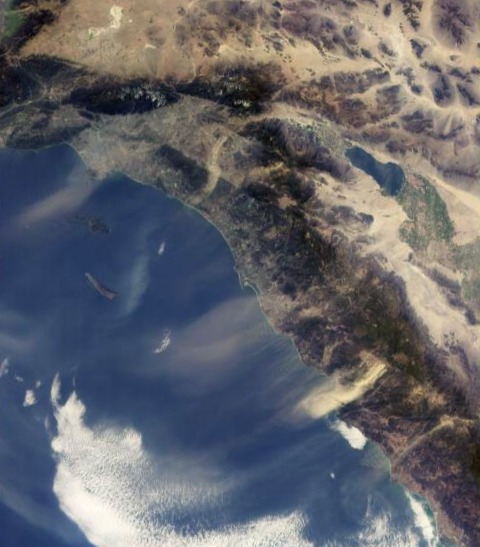
Image credit: NASA/GSFC/LaRC/JPL, MISR Team
The result is that after the hot dry summer, San Diego, LA and everything in between get dried out even more by a massive atmospheric hair dryer blowing down from the high deserts. And if a spark starts a fire, there isn't much to stop it. This is why wildfires are such a hazard at this time of year, and why California's fire service is now on high alert. There have been huge destructive fires in the past few years, and Californians just have to prepare for them and do everything they can to prevent a blaze starting. It all happens because of a fundamental rule of physics - that air gets hot when you squash it. At this time of year, it's a rule that many Californians probably think they could do without.
 Kate Humble:
 Helen Czerski:
 Stephen Marsh:
 Aira Idris:


Comment number 1.
At 22:15 14th Nov 2011, Appleista_com wrote:Very concerned about this owing to the bushfire potential. California is right on to be on very high alert.
Complain about this comment (Comment number 1)
Comment number 2.
At 12:35 22nd Nov 2011, Helen Czerski wrote:Hello Appleista_com. Yes, the bushfires have the potential to be very serious. I was living in San Diego during the wildfires of 2007, and the damage then was pretty substantial. Even several miles away, the amount of ash settling on everything was incredible.
Complain about this comment (Comment number 2)