

Turbulent weekend across USA leaves a trail of destruction
Post categories: Videos, guest bloggers, monsoon, news, northern hemisphere
 |11:30 UK time, Tuesday, 16 August 2011
Distance travelled ~ 585'258'400 km
A turbulent weekend across the USA left a trail of destruction from the Midwest to the east coast.
Forecasters began warning of severe thunderstorms during Saturday, as a developing area of low pressure began to interact with warm, humid air across the Great Plains. Towards evening, weather radars in Indiana showed storms lining up and advancing towards Indianapolis. Tragedy followed, when a freak gust of 60-70mph toppled a stadium at the Indiana State Fair as the storm front approached.
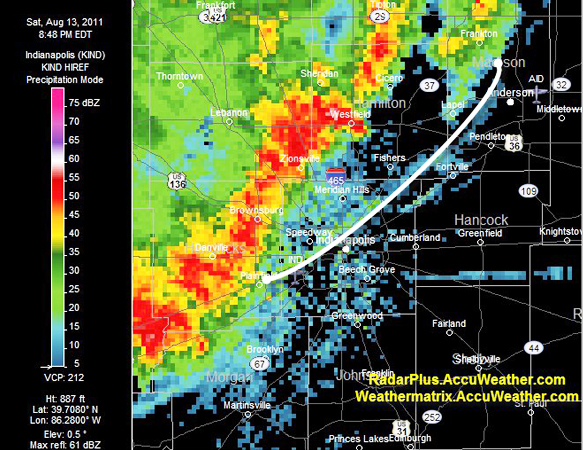
Image from Accuweather.com
Severe thunderstorms produce vicious downdraughts as heavy rain and hail falling through the cloud cools the surrounding air, making it heavier and denser. As this hits the ground, it spreads outwards as a gust front which can arrive several minutes ahead of the main storm. These "downbursts" are a major hazard for aircraft as they can change the airspeed over the wings in a matter of seconds, causing it to stall. They are also very difficult to forecast precisely, as the strongest gusts can be very localised with all the energy focused into a narrow zone. This seems to be what may have happened at the Indiana State Fair.
The developing area of low pressure created different problems as it pushed further east. Slowing as it reached the east coast on Sunday, the swirling system began to replenish its store of warm, moist air from the Atlantic waters. This was converted into torrential rain which fell for hour after hour across New Jersey and New York City. JFK airport smashed their all-time daily rainfall record with a massive total of 198mm, nearly twice the amount they would normally see in the whole of the month.
Some of that rain would have been very welcome further south. In Waco, Texas, they've had 62 days this year with a temperature of 100F (38.4C) or above. One more and they'll equal the record set in 1980.
 Kate Humble:
 Helen Czerski:
 Stephen Marsh:
 Aira Idris:


Comment number 1.
At 01:58 17th Aug 2011, ProfMHSettelen wrote:This comment has been referred for further consideration. Explain.
Complain about this comment (Comment number 1)